QUESTION IMAGE
Question
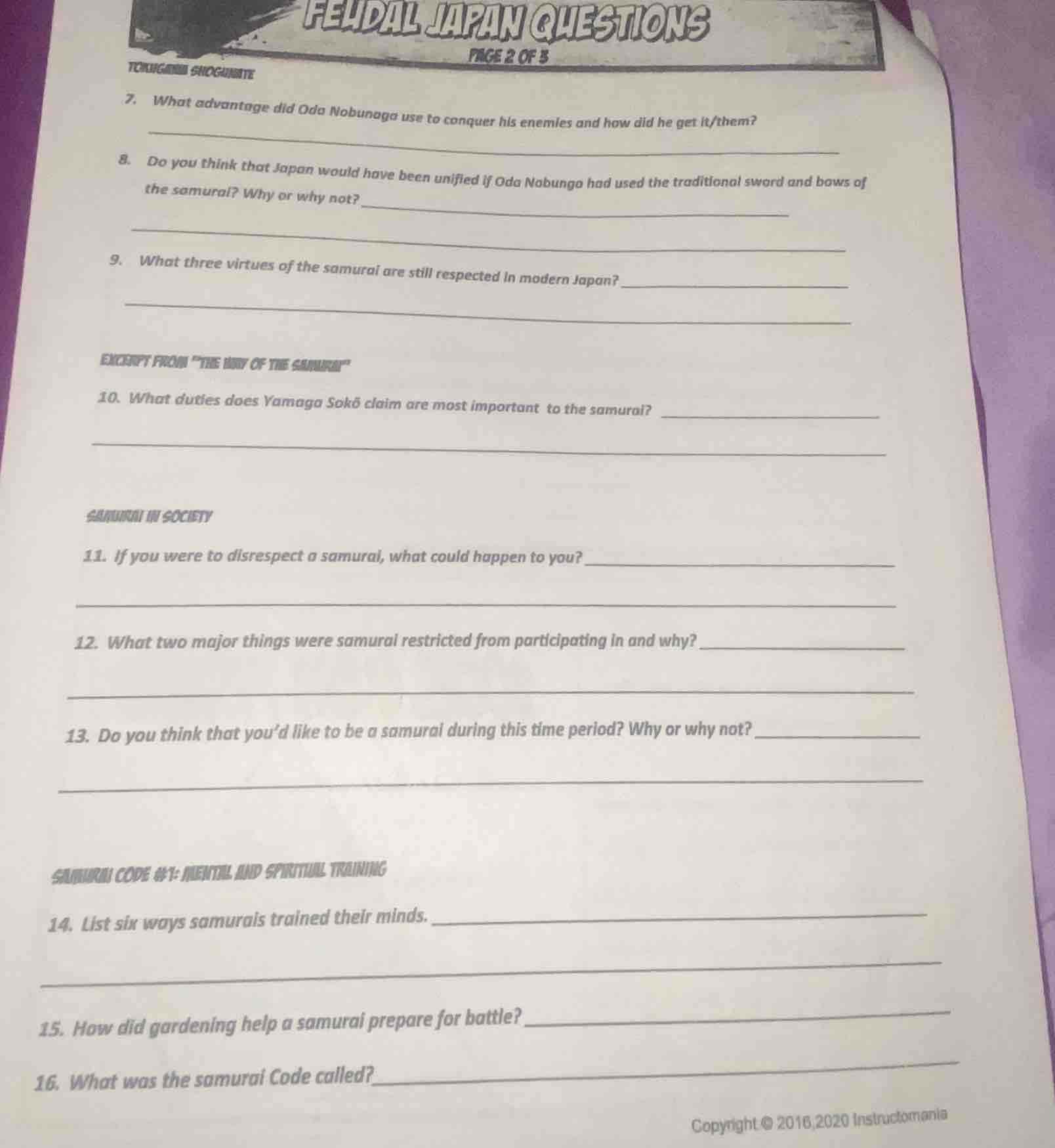
feudal japan questions
page 2 of 3
tokugawa shogunate
- what advantage did oda nobunaga use to conquer his enemies and how did he get it/them?
- do you think that japan would have been unified if oda nobunga had used the traditional sword and bows of the samurai? why or why not?
- what three virtues of the samurai are still respected in modern japan?
excerpt from \the way of the samurai\
- what duties does yamaga sokō claim are most important to the samurai?
samurai in society
- if you were to disrespect a samurai, what could happen to you?
- what two major things were samurai restricted from participating in and why?
- do you think that you’d like to be a samurai during this time period? why or why not?
samurai code #1: mental and spiritual training
- list six ways samurais trained their minds.
- how did gardening help a samurai prepare for battle?
- what was the samurai code called?
Question 7
Oda Nobunaga's key advantage was firearms (matchlock rifles, called tanegashima). He obtained them through trade with Portuguese merchants who arrived in Japan in the 1540s, and he mass-produced and deployed them innovatively in battles.
Question 8
Japan likely would not have unified as quickly, or possibly at all, with only traditional weapons. Nobunaga's massed firearms neutralized the samurai's traditional melee and bow-based battlefield dominance, allowing him to defeat larger, more established clans. Traditional weapons would have kept the balance of power more evenly split between rival domains.
Question 9
Three widely respected samurai virtues in modern Japan are:
- Seishin (integrity/honor)
- Giri (duty/loyalty)
- Yūki (courage)
Question 10
Yamaga Sokō, a prominent Confucian scholar for samurai, claimed the most important duties were:
- Mastering martial skills for warfare
- Studying Confucian ethics to cultivate virtue
- Serving their lord with absolute loyalty
Question 11
In feudal Japan, disrespecting a samurai could result in immediate punishment, including being killed on the spot via kirisute gomen (the samurai's legal right to kill commoners who showed disrespect). Lesser punishments might include severe beating or a demand for recompense.
Question 12
Samurai were restricted from:
- Trade and manual labor: This was to preserve their status as a warrior class, separate from commoners, and focus their energy on military service and loyalty to their lord.
- Marrying outside their class: Maintaining strict class boundaries ensured the purity of the warrior class and preserved the social hierarchy of feudal Japan.
Question 13
(Subjective example answer): I would not want to be a samurai. The strict code of bushidō demanded extreme loyalty that could lead to death in battle or ritual suicide (seppuku) for minor failures, and the life was defined by constant military duty with little personal freedom.
Question 14
Six ways samurai trained their minds:
- Studying Confucian and Buddhist texts
- Practicing zazen (meditation)
- Engaging in calligraphy and poetry
- Participating in tea ceremonies to cultivate focus
- Enduring physical hardships (like fasting) to build mental resilience
- Studying strategy and philosophy of warfare
Question 15
Gardening, particularly the practice of creating rock gardens, required intense focus, patience, and attention to detail. These skills translated to battle by teaching samurai to stay calm, plan strategically, and maintain discipline in high-pressure situations.
Question 16
The formal samurai code was called Bushidō (literally "the way of the warrior").

Snap & solve any problem in the app
Get step-by-step solutions on Sovi AI
Photo-based solutions with guided steps
Explore more problems and detailed explanations
- Oda Nobunaga used mass-produced matchlock rifles (tanegashima), obtained via trade with Portuguese merchants in the 1540s, then deployed them in organized, volley-fire formations to overwhelm enemies.
- No, Japan likely would not have unified quickly. Traditional weapons would have preserved the balance of power between rival clans, as Nobunaga's firearms neutralized the samurai's traditional battlefield advantage.
- 1. Integrity/honor (seishin), 2. Duty/loyalty (giri), 3. Courage (yūki)
- Yamaga Sokō claimed the most important samurai duties were mastering martial skills, studying Confucian ethics, and absolute loyalty to their lord.
- You could be killed immediately via kirisute gomen (the samurai's legal right to execute disrespectful commoners), or face severe beatings/recompense demands.
- 1. Trade/manual labor: To preserve their warrior status and focus on military service. 2. Marrying outside their class: To maintain strict feudal class boundaries and warrior class purity.
- (Subjective example): No, I would not. The strict Bushidō code demanded extreme loyalty that could lead to death or ritual suicide, with little personal freedom.
- 1. Studying Confucian/Buddhist texts, 2. Zen meditation (zazen), 3. Calligraphy/poetry, 4. Tea ceremonies, 5. Enduring physical hardships, 6. Studying warfare strategy
- Gardening (especially rock gardens) built focus, patience, and strategic thinking, which translated to calm discipline and careful planning in battle.
- Bushidō ("the way of the warrior")