QUESTION IMAGE
Question
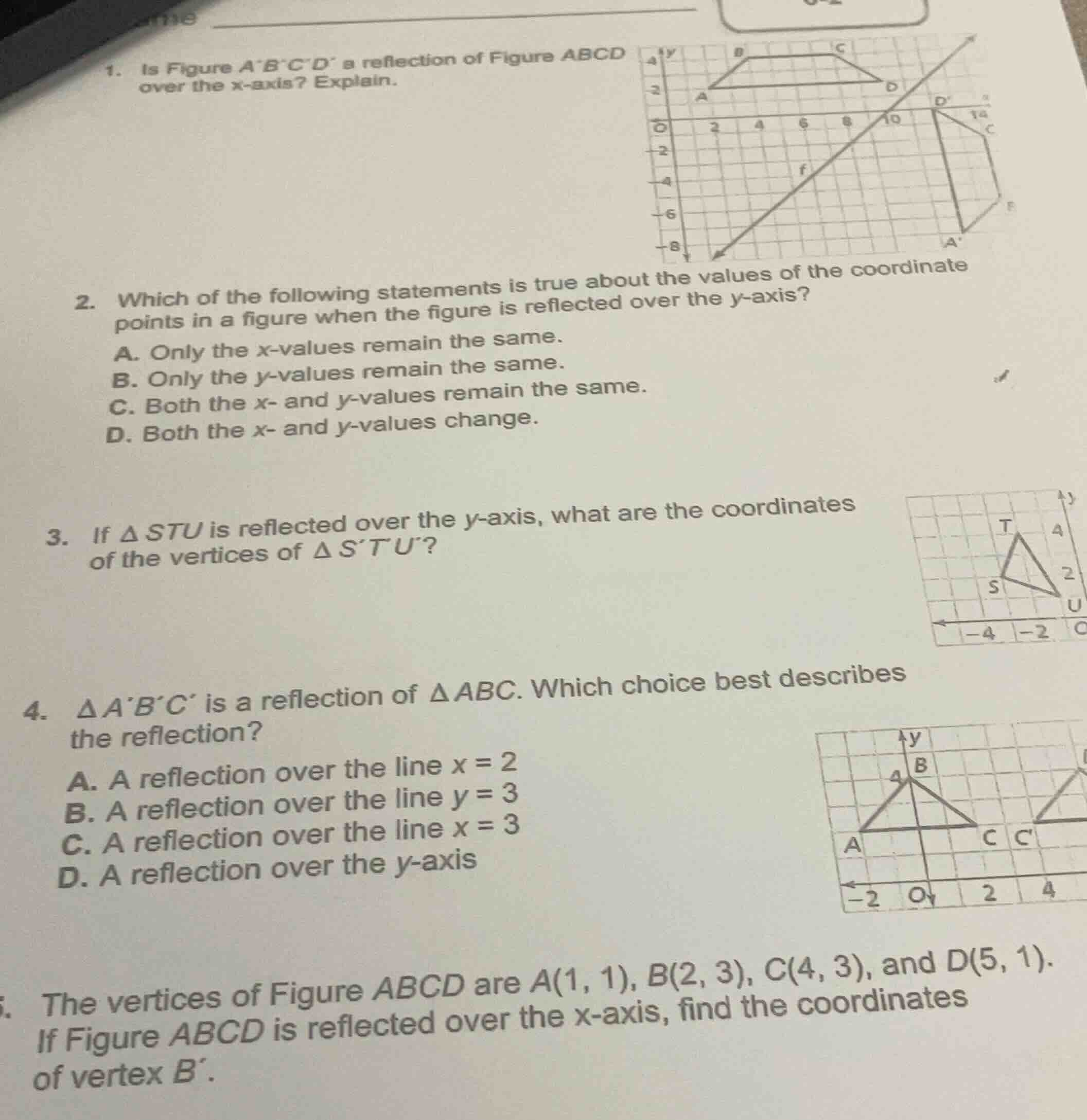
- is figure abcd a reflection of figure abcd over the x - axis? explain.
- which of the following statements is true about the values of the coordinate points in a figure when the figure is reflected over the y - axis?
a. only the x - values remain the same.
b. only the y - values remain the same.
c. both the x - and y - values remain the same.
d. both the x - and y - values change.
- if δstu is reflected over the y - axis, what are the coordinates of the vertices of δstu?
- δabc is a reflection of δabc. which choice best describes the reflection?
a. a reflection over the line x = 2
b. a reflection over the line y = 3
c. a reflection over the line x = 3
d. a reflection over the y - axis
- the vertices of figure abcd are a(1, 1), b(2, 3), c(4, 3), and d(5, 1). if figure abcd is reflected over the x - axis, find the coordinates of vertex b.
Step1: Analyze Question 1 rule
A reflection over the x-axis transforms a point $(x,y)$ to $(x,-y)$, meaning each point and its image must be equidistant from the x-axis with opposite y-values.
Step2: Compare Figure ABCD and A'B'C'D'
Looking at the graph, Figure A'B'C'D' is mapped across the line $f$ (not the x-axis), and its points do not follow the $(x,y)\to(x,-y)$ rule. For example, point $A(1,3)$ would map to $(1,-3)$ for an x-axis reflection, but $A'$ is at $(11,-8)$, which does not match.
Step3: Solve Question 2 rule
Reflection over y-axis: $(x,y)\to(-x,y)$. The y-value stays the same, x-value flips sign.
Step4: Identify original coordinates for Question3
From the graph: $S(-2,2)$, $T(-1,4)$, $U(0,1)$.
Step5: Apply y-axis reflection to Question3
Use $(x,y)\to(-x,y)$:
- $S(-2,2)\to S'(2,2)$
- $T(-1,4)\to T'(1,4)$
- $U(0,1)\to U'(0,1)$
Step6: Analyze reflection line for Question4
Check the distance from each point of $\triangle ABC$ to the line $x=3$:
- $A(-2,1)$: distance to $x=3$ is $3-(-2)=5$; $A'(8,1)$: $8-3=5$
- $B(0,4)$: distance to $x=3$ is $3-0=3$; $B'(6,4)$: $6-3=3$
- $C(2,1)$: distance to $x=3$ is $3-2=1$; $C'(4,1)$: $4-3=1$
Each point and its image are equidistant from $x=3$, so it is the reflection line.
Step7: Apply x-axis reflection to Question5
Reflection over x-axis: $(x,y)\to(x,-y)$. For $B(2,3)$, the image is $(2,-3)$.

Snap & solve any problem in the app
Get step-by-step solutions on Sovi AI
Photo-based solutions with guided steps
Explore more problems and detailed explanations
- No. A reflection over the x-axis maps $(x,y)$ to $(x,-y)$, but Figure A'B'C'D' does not follow this rule (it is reflected over a different line, not the x-axis).
- B. Only the y-values remain the same.
- $S'(2,2)$, $T'(1,4)$, $U'(0,1)$
- C. A reflection over the line $x = 3$
- $(2,-3)$