QUESTION IMAGE
Question
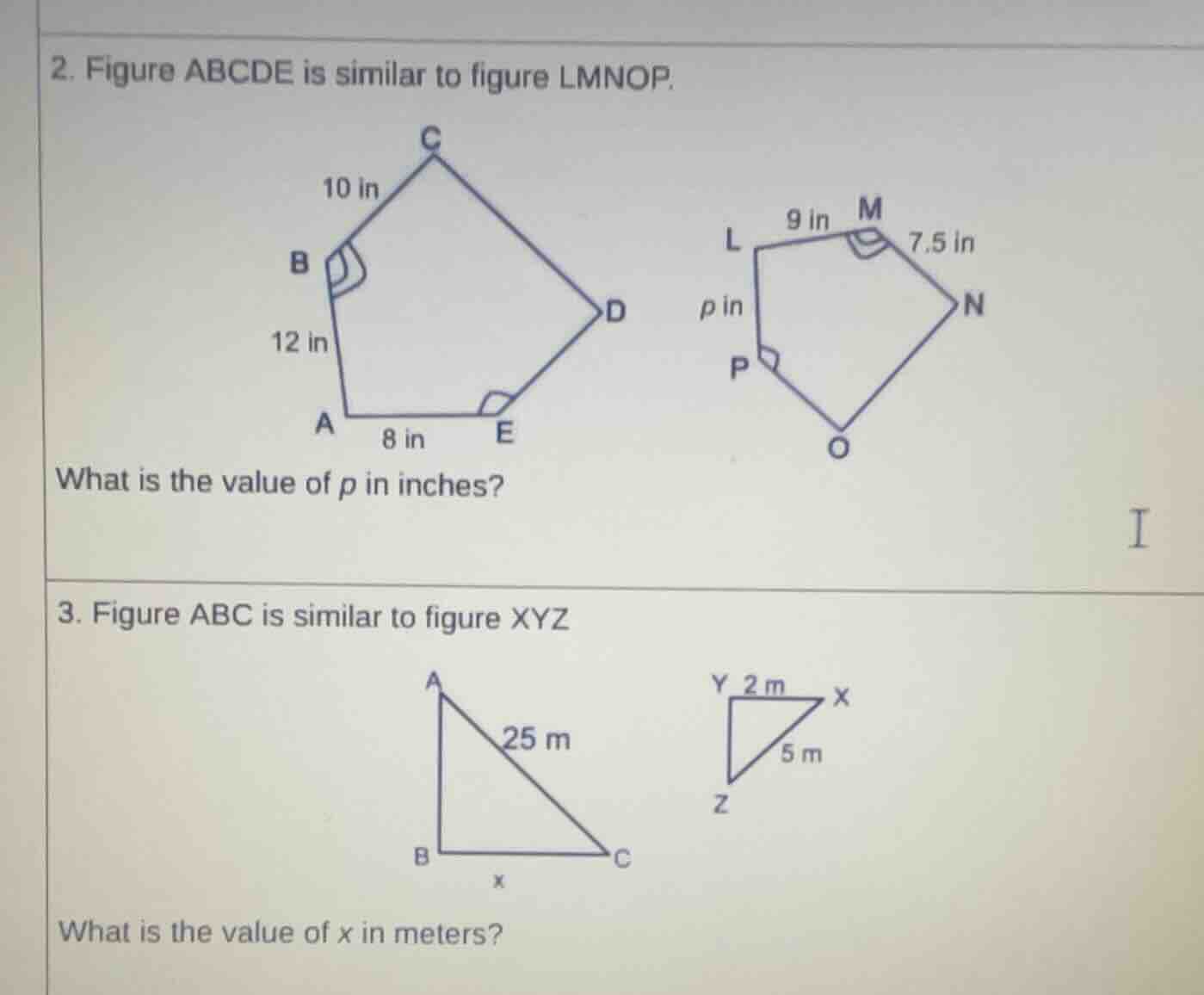
- figure abcde is similar to figure lmnop.
what is the value of p in inches?
- figure abc is similar to figure xyz
what is the value of x in meters?
Problem 2
Step1: Identify corresponding sides
In similar figures, corresponding sides are proportional. Let's find the ratio of corresponding sides. The side of length 10 in in ABCDE corresponds to 7.5 in in LMNOP? Wait, no, let's check the angles. The angle at B (with the mark) in ABCDE corresponds to the angle at M in LMNOP. So side AB (12 in) in ABCDE corresponds to side MN (7.5 in)? Wait, no, maybe BC (10 in) and LM (9 in)? Wait, no, let's look at the other sides. Wait, ABCDE is a pentagon? Wait, no, ABCDE: B to C is 10 in, B to A is 12 in, A to E is 8 in. LMNOP: L to M is 9 in, M to N is 7.5 in, P to L is p in. Wait, maybe AB (12 in) corresponds to MN (7.5 in)? No, wait, the angle at B (right angle? Wait, the marks: angle at B in ABCDE and angle at M in LMNOP are similar, angle at E in ABCDE and angle at P in LMNOP are similar. So AB (12 in) in ABCDE corresponds to MN (7.5 in) in LMNOP? No, maybe BC (10 in) and LM (9 in)? Wait, no, let's set up the proportion. Let's see, the side AE is 8 in in ABCDE. Let's find the ratio. Wait, maybe AB (12 in) and LM (9 in)? No, wait, the figure ABCDE: sides are AB=12, BC=10, AE=8. Figure LMNOP: sides are LM=9, MN=7.5, PL=p. Wait, let's check the ratio of AB (12) to MN (7.5): 12/7.5 = 1.6. BC (10) to LM (9): 10/9 ≈1.11, no. Wait, maybe AE (8) and PL (p)? Wait, no, angle at E and angle at P are similar. So AE (8) corresponds to PL (p), AB (12) corresponds to MN (7.5), BC (10) corresponds to LM (9)? Wait, no, 12/7.5 = 1.6, 10/9 ≈1.11, 8/p should be equal to 12/7.5? Wait, 12/7.5 = 1.6, 8/p = 1.6 → p=8/1.6=5? No, that can't be. Wait, maybe AB (12) corresponds to LM (9)? 12/9=4/3. Then BC (10) corresponds to MN (7.5): 10/7.5=4/3. Yes! 10/7.5=4/3, 12/9=4/3. So the scale factor is 4/3 from LMNOP to ABCDE, or 3/4 from ABCDE to LMNOP. Wait, ABCDE to LMNOP: AB=12, LM=9 (12(3/4)=9), BC=10, MN=7.5 (10(3/4)=7.5). Then AE=8, so PL (p) should be 8(3/4)=6? Wait, no, AE is 8 in, so the corresponding side in LMNOP is PL (p). So AE (8) (3/4) = p? Wait, no, if ABCDE is the original and LMNOP is the similar figure with scale factor 3/4 (since 123/4=9, 103/4=7.5), then AE (8) 3/4 = p? 8(3/4)=6. Wait, but let's check: 12 (AB) corresponds to 9 (LM): 12/9=4/3. 10 (BC) corresponds to 7.5 (MN): 10/7.5=4/3. So the ratio of ABCDE to LMNOP is 4/3. So AE (8) corresponds to PL (p), so 8/p = 4/3 → p= (8*3)/4=6. Wait, that makes sense. So 8/p = 12/9 (since AB=12, LM=9). So 12/9 = 8/p → cross multiply: 12p=72 → p=6. Yes, that works.
Step1: Set up the proportion
Since the figures are similar, the ratio of corresponding sides is equal. Let's identify corresponding sides: AB (12 in) in ABCDE corresponds to LM (9 in) in LMNOP? Wait, no, AB is 12, LM is 9? Wait, no, earlier we saw that BC (10) corresponds to MN (7.5) with ratio 10/7.5=4/3, and AB (12) corresponds to LM (9) with ratio 12/9=4/3. So the ratio of ABCDE to LMNOP is 4/3. Then AE (8 in) in ABCDE corresponds to PL (p in) in LMNOP. So 8/p = 4/3.
Step2: Solve for p
Cross - multiply: 4p = 8×3.
4p = 24.
Divide both sides by 4: p = 24/4 = 6.
Step1: Identify corresponding sides
Figure ABC is similar to figure XYZ. So corresponding sides are proportional. In triangle ABC, hypotenuse AC is 25 m, in triangle XYZ, hypotenuse XZ is 5 m, and side XY is 2 m. So side XY (2 m) in XYZ corresponds to side AB (let's assume AB is the vertical side) in ABC, and hypotenuse XZ (5 m) corresponds to hypotenuse AC (25 m). So the ratio of similarity is AC/XZ = 25/5 = 5. So the sides of ABC are 5 times the sides of XYZ.
Step2: Find the length of x
Side XY (2 m) in XYZ corresponds to side AB (let's say), and side BC (x) in ABC corresponds to side YZ (let's say, but in XYZ, the horizontal side? Wait, XYZ: XY=2, XZ=5, so YZ can be found by Pythagoras: \( YZ=\sqrt{5^{2}-2^{2}}=\sqrt{25 - 4}=\sqrt{21} \)? No, wait, no, ABC is a right triangle (since it's similar to XYZ, which is a right triangle, as XZ is hypotenuse). So in XYZ, right triangle with legs XY=2, YZ=?, hypotenuse XZ=5. Wait, no, 2 - 5 -? Wait, 2² + YZ² = 5² → YZ²=25 - 4=21 → YZ=√21. But in ABC, hypotenuse AC=25, so the ratio is 25/5=5. So side BC (x) corresponds to side YZ, so x = YZ×5. But wait, maybe XY (2) corresponds to AB, and YZ corresponds to BC, and XZ (5) corresponds to AC (25). So the ratio is 25/5=5. So if XY=2, then AB=2×5=10. Then BC (x) can be found by Pythagoras in ABC: \( AB^{2}+BC^{2}=AC^{2} \) → \( 10^{2}+x^{2}=25^{2} \) → \( 100 + x^{2}=625 \) → \( x^{2}=525 \) → \( x=\sqrt{525}=5\sqrt{21} \)? No, that can't be. Wait, maybe I got the correspondence wrong. Wait, ABC: right triangle with right angle at B, so AB and BC are legs, AC hypotenuse (25 m). XYZ: right triangle with right angle at Y, so XY and YZ are legs, XZ hypotenuse (5 m), XY=2 m. So corresponding sides: XY (2 m) corresponds to AB, YZ corresponds to BC, XZ (5 m) corresponds to AC (25 m). So the ratio of similarity is AC/XZ = 25/5 = 5. So AB = XY×5 = 2×5 = 10 m. Then, in triangle ABC, \( AB^{2}+BC^{2}=AC^{2} \) → \( 10^{2}+x^{2}=25^{2} \) → \( 100 + x^{2}=625 \) → \( x^{2}=525 \) → \( x=\sqrt{525}=5\sqrt{21} \approx 22.91 \)? No, that seems complicated. Wait, maybe the correspondence is different. Wait, maybe XY (2) corresponds to BC (x), and XZ (5) corresponds to AC (25). Then the ratio is 25/5=5, so x = 2×5=10? No, that can't be. Wait, no, let's check the problem again. Figure ABC: A at top, B at bottom left, C at bottom right, right angle at B. So AB is vertical, BC is horizontal (x), AC hypotenuse 25. Figure XYZ: Y at top, Z at bottom left, X at bottom right, right angle at Y. So XY is horizontal (2 m), YZ is vertical, XZ hypotenuse 5 m. So corresponding sides: XY (horizontal, 2 m) in XYZ corresponds to BC (horizontal, x) in ABC, YZ (vertical) in XYZ corresponds to AB (vertical) in ABC, XZ (hypotenuse, 5 m) corresponds to AC (hypotenuse, 25 m). So the ratio of similarity is AC/XZ = 25/5 = 5. Therefore, BC (x) corresponds to XY (2 m), so x = XY×5 = 2×5 = 10? Wait, no, 2×5=10, but then AB would be YZ×5. Let's check with Pythagoras. If BC=10, AB=?, AC=25. Then AB=√(25² - 10²)=√(625 - 100)=√525≈22.91. In XYZ, XY=2, YZ=√(5² - 2²)=√21≈4.58, then AB=√21×5≈22.91, which matches. But the problem is asking for x, which is BC. Wait, but maybe the correspondence is XY (2) to AB, and XZ (5) to AC, so AB=2×5=10, then BC=x=√(25² - 10²)=√525≈22.91? No, that's not a nice number. Wait, maybe I made a mistake. Wait, the problem says "Figure ABC is similar to figure XYZ". Let's assume that side XY (2 m) corresponds to side BC (x), and side XZ (5 m) corresponds to side AC (25 m). So the ratio is 25/5=5, so x=2×5=10? No, that can't be, because 2×5=10, and 10² + AB²=25²…

Snap & solve any problem in the app
Get step-by-step solutions on Sovi AI
Photo-based solutions with guided steps
Explore more problems and detailed explanations
\( p = 6 \) inches.