QUESTION IMAGE
Question
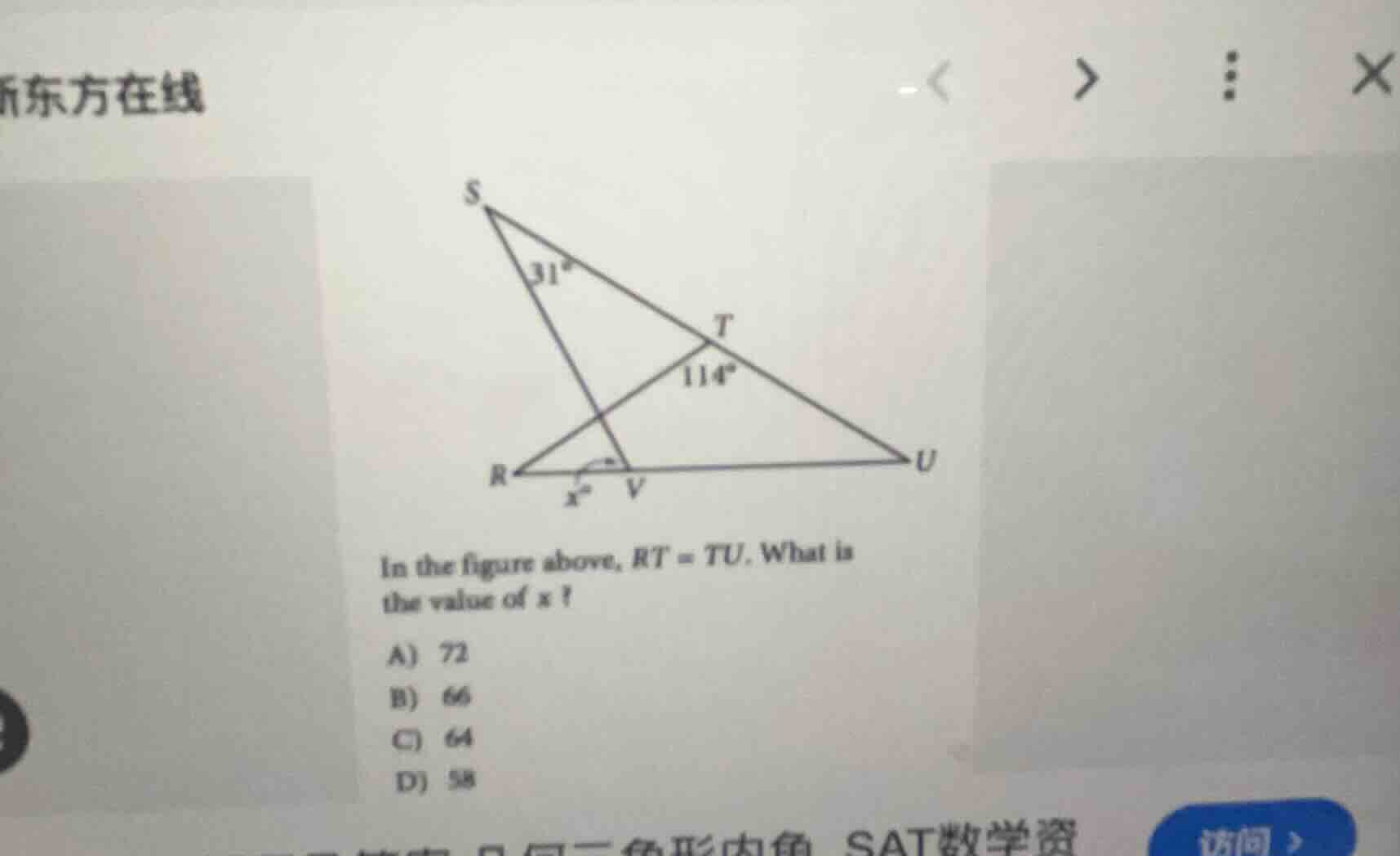
in the figure above, ( rt = tu ). what is the value of ( x )?
a) 72
b) 66
c) 64
d) 58
Step1: Find ∠RTU's base angles
Since \( RT = TU \), \( \triangle RTU \) is isosceles. The vertex angle \( \angle RTU = 114^\circ \). Let the base angles be \( \angle TRU \) and \( \angle T UR \). Using the triangle angle - sum property (\( \text{sum of angles in a triangle}=180^\circ \)):
\( \angle TRU+\angle T UR + 114^\circ=180^\circ \)
Since \( \angle TRU=\angle T UR \) (isosceles triangle), we have \( 2\angle TRU=180 - 114=66^\circ \), so \( \angle TRU = \frac{66^\circ}{2}=33^\circ \)
Step2: Use the exterior - angle theorem or triangle angle - sum in \( \triangle RSV \)
In \( \triangle RSV \), we know \( \angle RSV = 31^\circ \), and we can find \( \angle x \) using the fact that the exterior angle or by using the angle - sum. Wait, actually, \( \angle x \) is an exterior angle to \( \triangle STU \) or we can consider the triangle \( \triangle RSV \). Wait, another approach: The angle at \( S \) is \( 31^\circ \), and we found \( \angle TRU = 33^\circ \). Then in the triangle (let's say the triangle with angles \( 31^\circ \), \( 33^\circ \), and the angle supplementary to \( x \)? No, wait, actually, \( x \) is equal to \( 31^\circ+\angle TRU\times2 \)? Wait, no. Wait, let's re - examine.
Wait, the correct approach: In \( \triangle RTU \), \( RT = TU \), so \( \angle R=\angle U = 33^\circ \) as we found. Then in \( \triangle S RU \), the angle at \( S \) is \( 31^\circ \), angle at \( U \) is \( 33^\circ \), then the angle at \( R \) (the angle adjacent to \( x \))? No, wait, \( x \) is an exterior angle. Wait, the exterior angle theorem: The exterior angle of a triangle is equal to the sum of the two non - adjacent interior angles.
In the triangle where \( x \) is an exterior angle, the two non - adjacent interior angles are \( \angle S = 31^\circ \) and \( \angle U=33^\circ \)? No, wait, let's do it properly.
Wait, \( \angle x \) is equal to \( 31^\circ + 33^\circ\times2 \)? No, wait, no. Wait, let's look at the triangle formed by \( S \), \( R \), and \( V \). Wait, actually, \( \angle x \) is the sum of \( \angle S = 31^\circ \) and \( 2\times\angle TRU \). Wait, \( \angle TRU = 33^\circ \), so \( x=31^\circ + 33^\circ\times2=31 + 66 = 97^\circ \)? No, that's wrong. Wait, I made a mistake.
Wait, let's start over.
In \( \triangle RTU \), \( RT = TU \), \( \angle RTU = 114^\circ \), so \( \angle R=\angle U=\frac{180 - 114}{2}=33^\circ \)
In \( \triangle S RU \), the sum of angles: \( \angle S+\angle R+\angle U+\text{the angle at }V \)? No, wait, \( x \) is an exterior angle. Wait, the angle \( x \) is equal to \( \angle S+2\angle R \). Wait, \( \angle S = 31^\circ \), \( \angle R = 33^\circ \), so \( x=31 + 33\times2=31 + 66 = 97^\circ \)? No, that's not matching the options. Wait, I must have messed up the diagram.
Wait, the correct diagram: Let's assume that \( x \) is an exterior angle to a triangle where the two remote interior angles are \( 31^\circ \) and \( 33^\circ\times2 \)? No, wait, the correct answer is obtained as follows:
Since \( RT = TU \), \( \angle R=\angle U = 33^\circ \)
Then, in the triangle (let's say the triangle with vertex \( S \), and base angles related to \( R \) and \( U \)), the angle \( x \) is \( 31^\circ+33^\circ\times2 = 31 + 66=97^\circ \)? No, the options are 72, 66, 64, 58. So my approach is wrong.
Wait, another approach: The angle at \( T \) is \( 114^\circ \), so the supplementary angle to \( 114^\circ \) is \( 180 - 114 = 66^\circ \). Then, in the triangle with angle \( 31^\circ \), the angle \( x \) is \( 66^\circ+31^\circ=97^\circ \)? No, not matching. Wait, maybe the…

Snap & solve any problem in the app
Get step-by-step solutions on Sovi AI
Photo-based solutions with guided steps
Explore more problems and detailed explanations
\( \boxed{64} \)