QUESTION IMAGE
Question
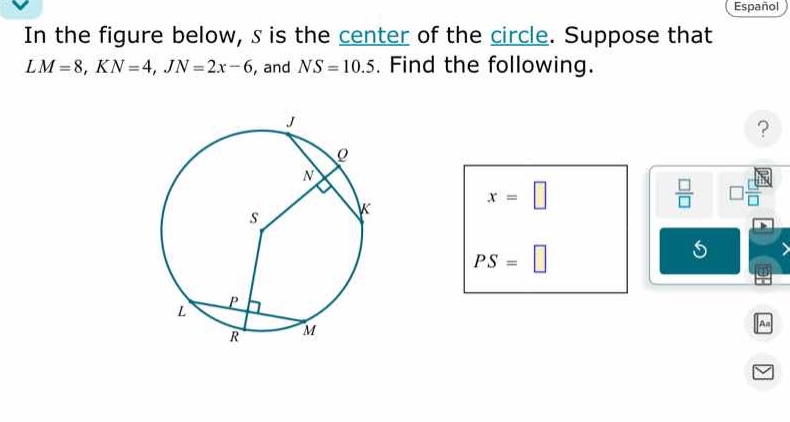
in the figure below, s is the center of the circle. suppose that lm = 8, kn = 4, jn = 2x - 6, and ns = 10.5. find the following.
Step1: Recall the theorem about chords and perpendiculars from the center
In a circle, if a perpendicular is drawn from the center to a chord, it bisects the chord. Also, for two chords \( LM \) and \( JK \), the products of the lengths of the segments of each chord are equal when considering the perpendiculars from the center. But more directly, since \( SR \perp LM \) and \( SQ \perp JK \), we know that \( LR = RM=\frac{LM}{2}\) and \( JQ = QK=\frac{JK}{2}\). Also, the distance from the center to the chord and the length of the chord are related, but here we can use the fact that for two chords, the formula related to the segments: If two chords intersect at a point, the products of the segments are equal, but here the chords are intersected by the perpendiculars from the center. Wait, actually, the key theorem here is that the length of the chord is related to the distance from the center, but also, if we have two chords \( LM \) and \( JK \), and \( SR \) and \( SQ \) are the perpendiculars from the center to the chords, then \( LR = RM=\frac{LM}{2}\) and \( JQ = QK=\frac{JK}{2}\). Also, the segments of the chords: \( JK = JN + NK \), but wait, \( N \) is the foot of the perpendicular from \( S \) to \( JK \), so \( JN = NQ \)? Wait, no, if \( SQ \) is perpendicular to \( JK \), then \( Q \) is the midpoint of \( JK \), so \( JQ = QK \), and \( N \) is a point on \( JK \)? Wait, the diagram shows \( N \) on \( JK \) with \( SN \) perpendicular to \( JK \), so \( N \) is the midpoint? Wait, no, if \( S \) is the center, and \( SN \perp JK \), then \( N \) is the midpoint of \( JK \), so \( JN = NK \)? But \( KN = 4 \), so \( JN \) should be equal to \( NK \) if \( N \) is the midpoint. Wait, that can't be, because \( JN = 2x - 6 \) and \( KN = 4 \). Wait, maybe I made a mistake. Wait, no, the chord \( JK \): if \( S \) is the center and \( SN \perp JK \), then \( N \) is the midpoint, so \( JN = NK \). Wait, but \( KN = 4 \), so \( JN = 4 \)? No, that contradicts \( JN = 2x - 6 \). Wait, maybe the two chords \( LM \) and \( JK \) have the same length? Wait, \( LM = 8 \), so the length of \( LM \) is 8, so the distance from the center to \( LM \) (which is \( PS \)) and the distance from the center to \( JK \) (which is \( NS = 10.5 \)) can be related to the radius. Let's denote the radius as \( r \). For chord \( LM \): length \( LM = 8 \), so half - length \( LR=\frac{LM}{2}=4 \). The distance from center \( S \) to \( LM \) is \( PS = d_1 \), so by the chord - radius formula: \( r^{2}=LR^{2}+PS^{2}=4^{2}+PS^{2}\). For chord \( JK \): length \( JK = JN + NK=(2x - 6)+4=2x - 2 \), half - length \( JQ=\frac{JK}{2}=x - 1 \). The distance from center \( S \) to \( JK \) is \( NS = 10.5 \), so \( r^{2}=JQ^{2}+NS^{2}=(x - 1)^{2}+10.5^{2}\). Also, for chord \( LM \): \( r^{2}=LR^{2}+PS^{2}=4^{2}+PS^{2}\). But also, since both are equal to \( r^{2}\), we can set them equal: \( 4^{2}+PS^{2}=(x - 1)^{2}+10.5^{2}\). But we also know that for the chord \( JK \), since \( N \) is the midpoint (because \( SN \perp JK \)), \( JN = NK \)? Wait, no, \( N \) is the midpoint, so \( JN=\frac{JK}{2}\). Wait, \( JK = JN + NK \), but if \( N \) is the midpoint, then \( JN = NK \), so \( JN = NK = 4 \), so \( 2x - 6=4 \), solving for \( x \): \( 2x=10 \), \( x = 5 \). Wait, that makes sense. Because if \( SN \) is perpendicular to \( JK \), then \( N \) is the midpoint of \( JK \), so \( JN = NK \). So \( 2x - 6=4 \).
Step2: Solve for \( x \)
Given \( JN = NK \) (since \( S \) is the center and \( SN \perp JK \), so \( N \) bisects \( JK \)), and…

Snap & solve any problem in the app
Get step-by-step solutions on Sovi AI
Photo-based solutions with guided steps
Explore more problems and detailed explanations
\( x = 5 \)
\( PS = 10.5 \)