QUESTION IMAGE
Question
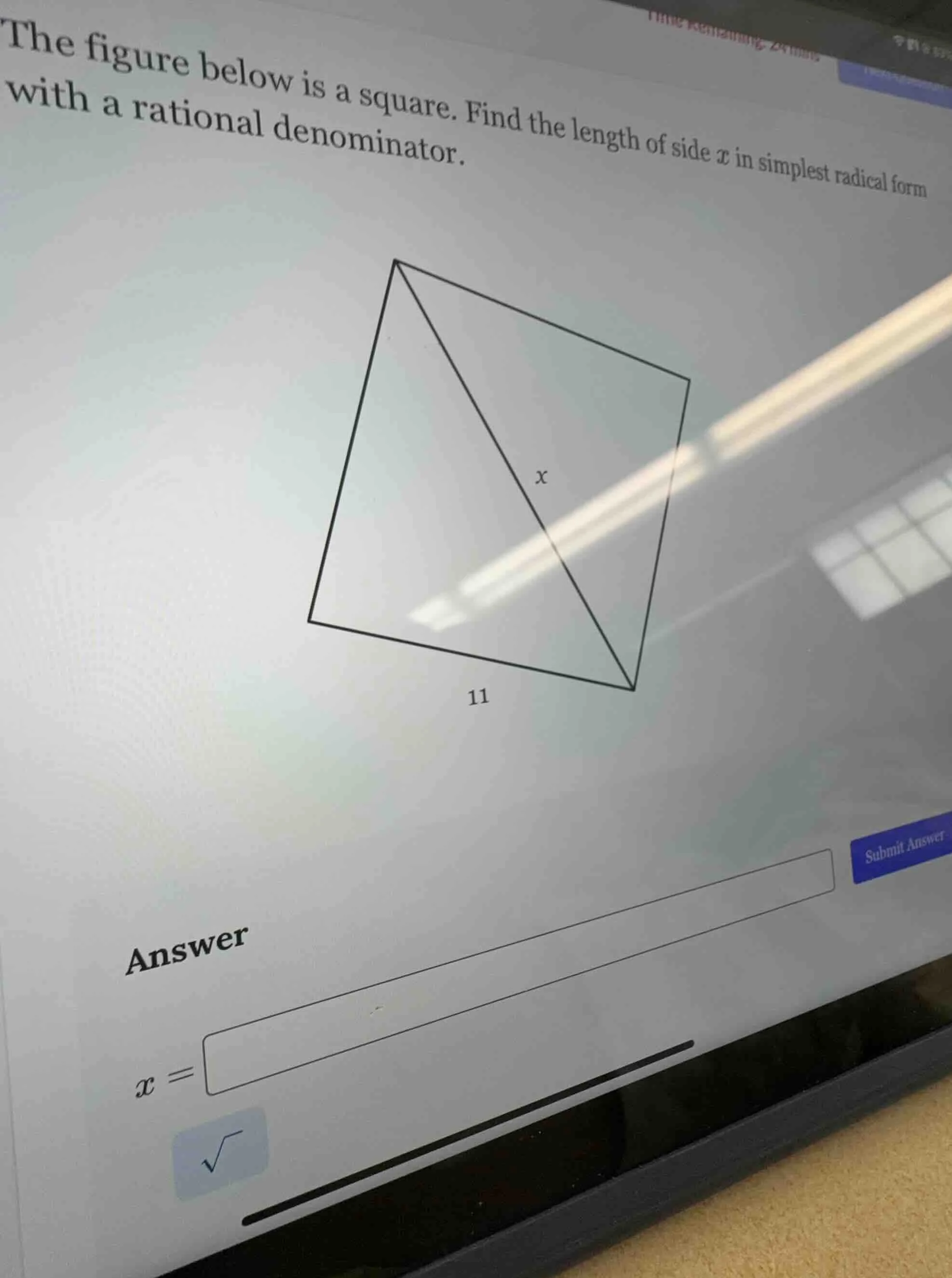
the figure below is a square. find the length of side ( x ) in simplest radical form with a rational denominator.
answer
( x = ) (sqrt{})
Step1: Identify the triangle type
The figure is a square, so the triangle formed by the diagonal and two sides is a right - isosceles triangle (since all angles in a square are \(90^{\circ}\) and the two sides of the square are equal). Let the side length of the square be \(a = 11\). We can use the Pythagorean theorem \(c^{2}=a^{2}+b^{2}\), where in a square \(a = b=11\) and \(c=x\) (the diagonal).
Step2: Apply the Pythagorean theorem
Substitute \(a = 11\) and \(b = 11\) into the Pythagorean theorem:
\[
\]
Step3: Simplify the radical
We know that \(242=121\times2\), so \(\sqrt{242}=\sqrt{121\times2}\). Using the property of square roots \(\sqrt{ab}=\sqrt{a}\times\sqrt{b}\) (\(a\geq0,b\geq0\)), we have \(\sqrt{121\times2}=\sqrt{121}\times\sqrt{2}=11\sqrt{2}\). Since \(x\) represents a length, \(x>0\), so \(x = 11\sqrt{2}\).

Snap & solve any problem in the app
Get step-by-step solutions on Sovi AI
Photo-based solutions with guided steps
Explore more problems and detailed explanations
\(11\sqrt{2}\)