QUESTION IMAGE
Question
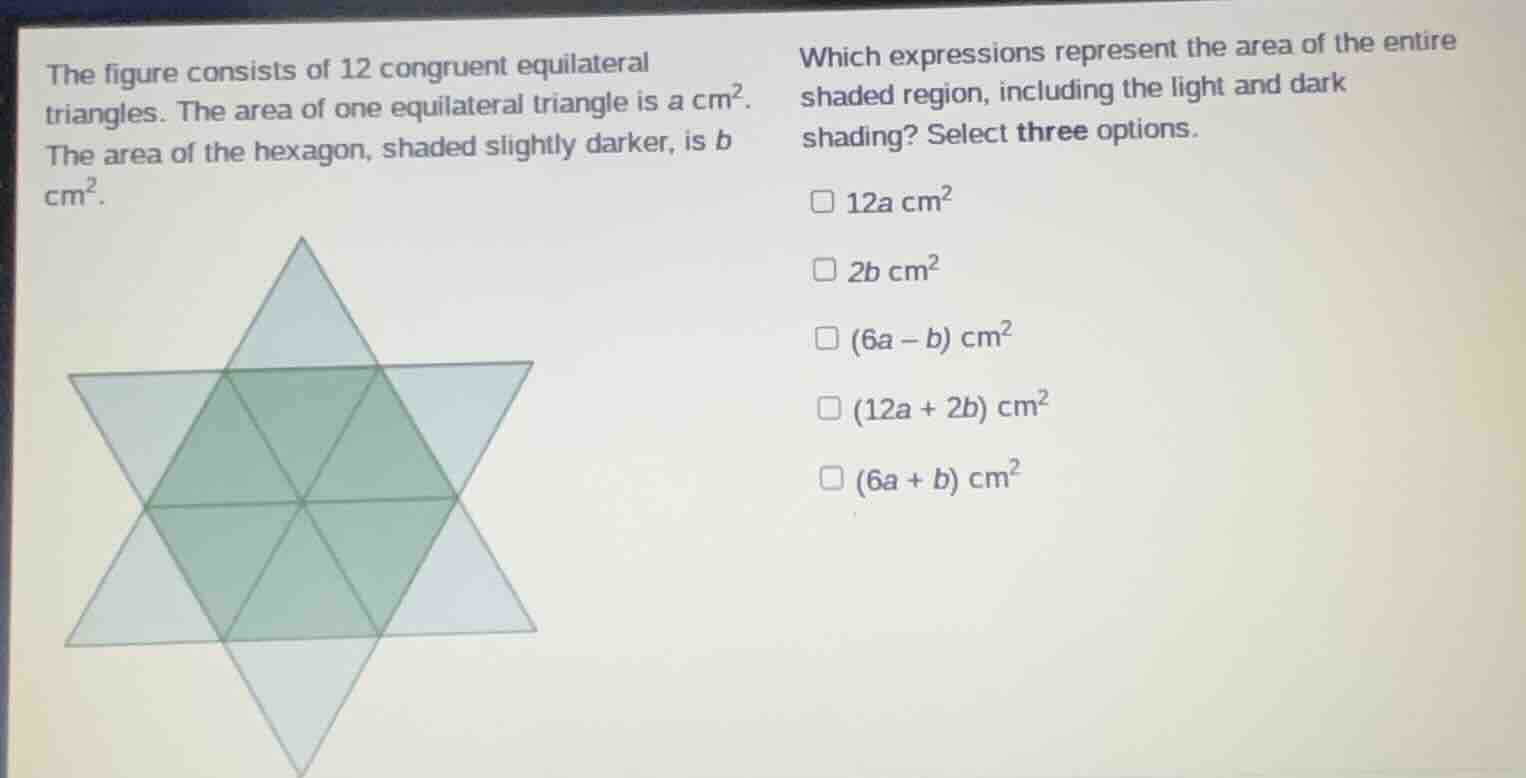
the figure consists of 12 congruent equilateral triangles. the area of one equilateral triangle is a cm². the area of the hexagon, shaded slightly darker, is b cm². which expressions represent the area of the entire shaded region, including the light and dark shading? select three options. ☐ 12a cm² ☐ 2b cm² ☐ (6a − b) cm² ☐ (12a + 2b) cm² ☐ (6a + b) cm²
Step1: Analyze total triangles
There are 12 congruent equilateral triangles, each with area \( a \, \text{cm}^2 \). So total area from triangles: \( 12a \, \text{cm}^2 \).
Step2: Analyze hexagon and total shaded
The hexagon (darker) has area \( b \, \text{cm}^2 \). Looking at the figure, the hexagon is made of 6 triangles? Wait, no—wait, the star (shaded region) can be seen as two hexagons? Wait, the total shaded region: let's think again. The 12 triangles: the darker hexagon is \( b \), and the light and dark together. Wait, the figure is a star of David, which is two overlapping triangles, making a hexagon in the middle. Wait, the 12 congruent triangles: the darker hexagon is \( b \), and the total shaded (light + dark) – let's see the options.
First, \( 12a \): since there are 12 triangles, each \( a \), so total area is \( 12a \). So \( 12a \) is correct.
Second, \( 2b \): if the hexagon (darker) is \( b \), and the total shaded is two hexagons? Wait, maybe the hexagon is made of 6 triangles? Wait, 12 triangles: the star has a central hexagon (darker) and 6 light triangles? Wait, no, the figure shows a star with 6 light triangles (the points) and a central hexagon (darker) and 6 dark triangles? Wait, maybe the hexagon \( b \) is 6 triangles, so two hexagons would be \( 2b \), and since 12 triangles is \( 12a \), and if \( b = 6a \) (since hexagon is 6 triangles), then \( 2b = 12a \), so \( 2b \) is also correct.
Third, \( 6a + b \): Wait, no, let's re-examine. Wait, the total shaded region: the darker hexagon is \( b \), and the light triangles: how many? The 12 triangles: the hexagon is 6 triangles? So \( b = 6a \), then the light triangles would be \( 12a - b = 6a \). Then total shaded is \( b + 6a = 6a + b \). Wait, yes! So \( (6a + b) \) is correct. Wait, but earlier I thought \( 12a \) is correct, but wait, no—wait, the shaded region is the entire figure, which is the light and dark. Wait, maybe I messed up. Wait, the problem says "the entire shaded region, including the light and dark shading". So:
- \( 12a \): 12 triangles, so total area \( 12a \) – correct.
- \( 2b \): if the hexagon (darker) is \( b \), and the total shaded is two hexagons (since the star is two overlapping triangles, each contributing a hexagon? Wait, no, maybe the hexagon is \( b = 6a \), so \( 2b = 12a \), so \( 2b \) is equal to \( 12a \), so that's correct.
- \( 6a + b \): if the hexagon is \( b = 6a \), then the light triangles are \( 6a \) (since 12a - 6a = 6a), so total shaded is \( b + 6a = 6a + b \). Wait, but let's check the options.
Wait, the options are:
- \( 12a \) – correct (12 triangles, each \( a \)).
- \( 2b \) – if \( b = 6a \), then \( 2b = 12a \), so correct.
- \( (6a + b) \) – if \( b = 6a \), then \( 6a + b = 12a \), but wait, no—wait, maybe the hexagon is \( b \), and the light triangles are \( 6a \), so total shaded is \( b + 6a \). Wait, but let's check the other options. \( (12a + 2b) \) is wrong, \( (6a - b) \) is wrong.
So the correct three options are \( 12a \), \( 2b \), and \( (6a + b) \)? Wait, no, wait:
Wait, let's re-express:
- Total area of shaded region: 12 triangles, so \( 12a \) – correct.
- The hexagon \( b \): if the hexagon is 6 triangles, then \( b = 6a \), so two hexagons ( \( 2b \)) would be 12 triangles, so \( 2b = 12a \) – correct.
- \( 6a + b \): if \( b = 6a \), then \( 6a + b = 12a \), but wait, maybe the shaded region is the hexagon (\( b \)) plus 6 light triangles (each \( a \), so 6a), so total \( 6a + b \) – correct.
Wait, but let's check the wrong options:
- \( (6a - b) \):…

Snap & solve any problem in the app
Get step-by-step solutions on Sovi AI
Photo-based solutions with guided steps
Explore more problems and detailed explanations
A. \( 12a \, \text{cm}^2 \)
B. \( 2b \, \text{cm}^2 \)
E. \( (6a + b) \, \text{cm}^2 \)