QUESTION IMAGE
Question
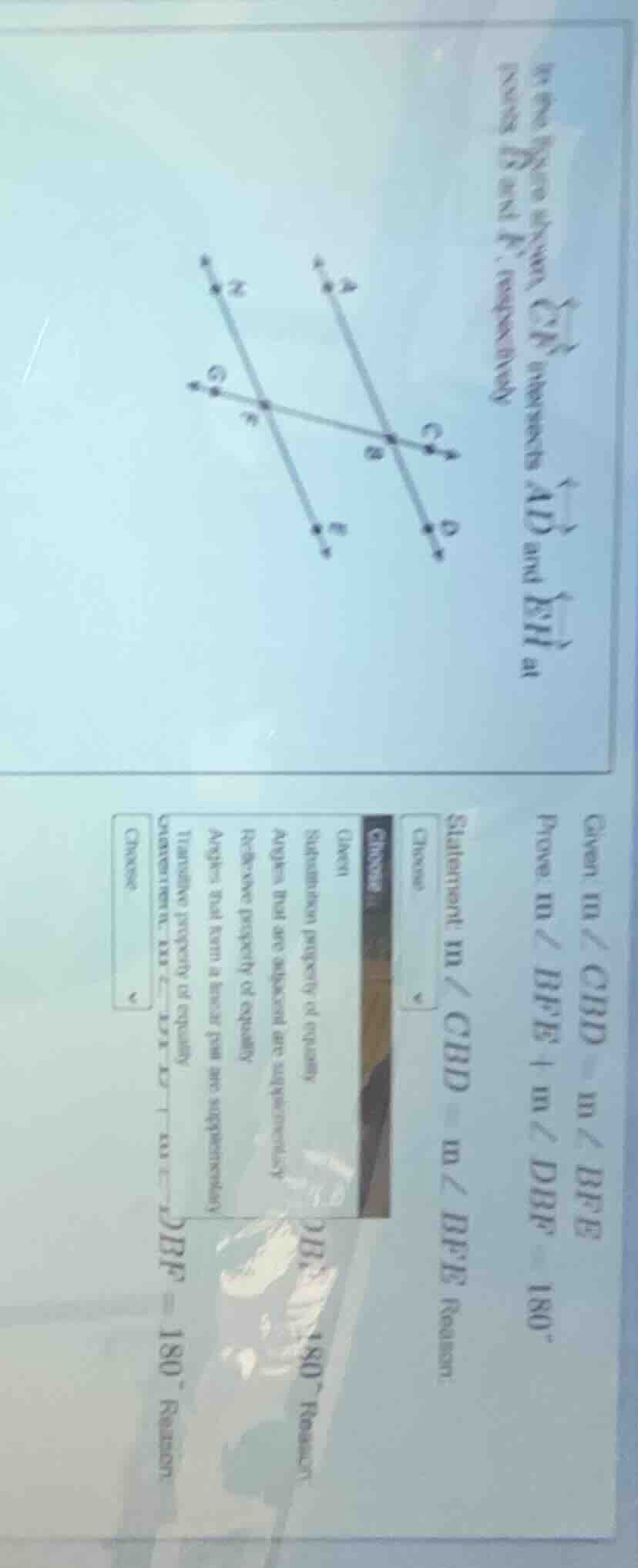
in the figure, \\( \overleftrightarrow{ck} \\) intersects \\( \overleftrightarrow{ad} \\) and \\( \overleftrightarrow{eh} \\) at points b and k, respectively.
given \\( m\angle cbd = m\angle bfe \\), prove \\( m\angle bfe + m\angle dbf = 180^\circ \\).
statement: \\( m\angle cbd = m\angle bfe \\) (reason: given)
multiple choice options for next step: substitution property of equality, angles that are adjacent are supplementary, reflexive property of equality, angles that form a linear pair are supplementary, transitive property of equality, etc. then another statement: \\( m\angle cbd + m\angle dbf = 180^\circ \\) (reason: choice from properties)
Step1: Identify Given Information
We are given that \( m\angle CBD = m\angle BFE \). This is our starting point.
Step2: Analyze the Angle Relationship
We need to prove \( m\angle BFE + m\angle DBF = 180^\circ \). Let's substitute \( m\angle CBD \) with \( m\angle BFE \) (from the given equality) in the angle sum. So we consider the angles \( \angle CBD \) and \( \angle DBF \).
Step3: Determine the Angle Property
Angles \( \angle CBD \) and \( \angle DBF \) are adjacent and form a linear pair (they are supplementary, meaning their measures add up to \( 180^\circ \)). So \( m\angle CBD + m\angle DBF = 180^\circ \).
Step4: Substitute Using Given Equality
Since \( m\angle CBD = m\angle BFE \) (given), we substitute \( \angle CBD \) with \( \angle BFE \) in the equation \( m\angle CBD + m\angle DBF = 180^\circ \). This gives us \( m\angle BFE + m\angle DBF = 180^\circ \), which is what we needed to prove.
For the first "Choose" (statement): The statement is \( m\angle CBD = m\angle BFE \) (given), so we select that.
For the second "Choose" (reason for \( m\angle CBD + m\angle DBF = 180^\circ \)): The reason is that angles that form a linear pair are supplementary (or "Angles that form a linear pair are supplementary" from the options, which corresponds to the linear pair property leading to supplementary angles).

Snap & solve any problem in the app
Get step-by-step solutions on Sovi AI
Photo-based solutions with guided steps
Explore more problems and detailed explanations
- First "Choose" (Statement): \( m\angle CBD = m\angle BFE \) (the given statement)
- Second "Choose" (Reason): Angles that form a linear pair are supplementary (or the corresponding option about linear pair and supplementary angles)
(If we need to match the options more precisely, assuming the options have "Angles that form a linear pair are supplementary" as a choice, that's the reason, and the statement is the given \( m\angle CBD = m\angle BFE \))