QUESTION IMAGE
Question
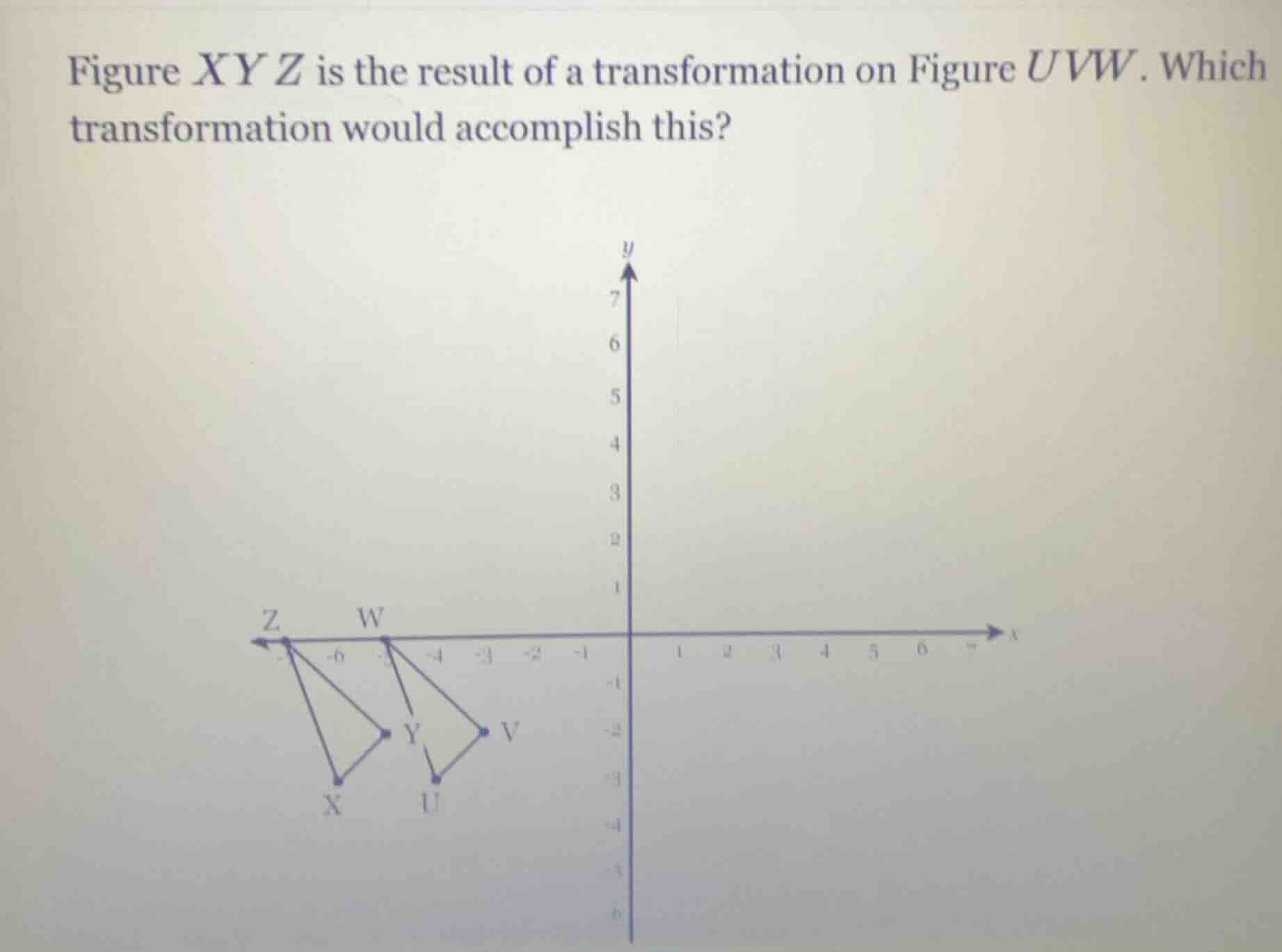
figure xyz is the result of a transformation on figure uvw. which transformation would accomplish this?
Step1: Analyze the transformation type
To determine the transformation from Figure \( UVW \) to Figure \( XYZ \), we check the horizontal shift. Let's consider the coordinates of corresponding points (e.g., \( W \) to \( Z \), \( U \) to \( X \), \( V \) to \( Y \)).
- For point \( W \) (let's assume \( W \) is at \( (-5, 0) \)) and \( Z \) (at \( (-7, 0) \)): The change in \( x \)-coordinate is \( -7 - (-5) = -2 \), meaning a shift left by 2 units.
- For point \( U \) (e.g., \( (-5, -3) \)) and \( X \) (e.g., \( (-7, -3) \)): Also a shift left by 2 units.
- For point \( V \) (e.g., \( (-3, -2) \)) and \( Y \) (e.g., \( (-5, -2) \)): Shift left by 2 units.
This is a translation (horizontal shift) of 2 units to the left. Alternatively, we can check if it's a reflection (no, since orientation is same), rotation (no, since shape and orientation preserved), so translation. Specifically, a translation 2 units left (or in vector terms, \( (x, y) \to (x - 2, y) \)).

Snap & solve any problem in the app
Get step-by-step solutions on Sovi AI
Photo-based solutions with guided steps
Explore more problems and detailed explanations
A translation 2 units to the left (or equivalent description of horizontal shift left by 2)