QUESTION IMAGE
Question
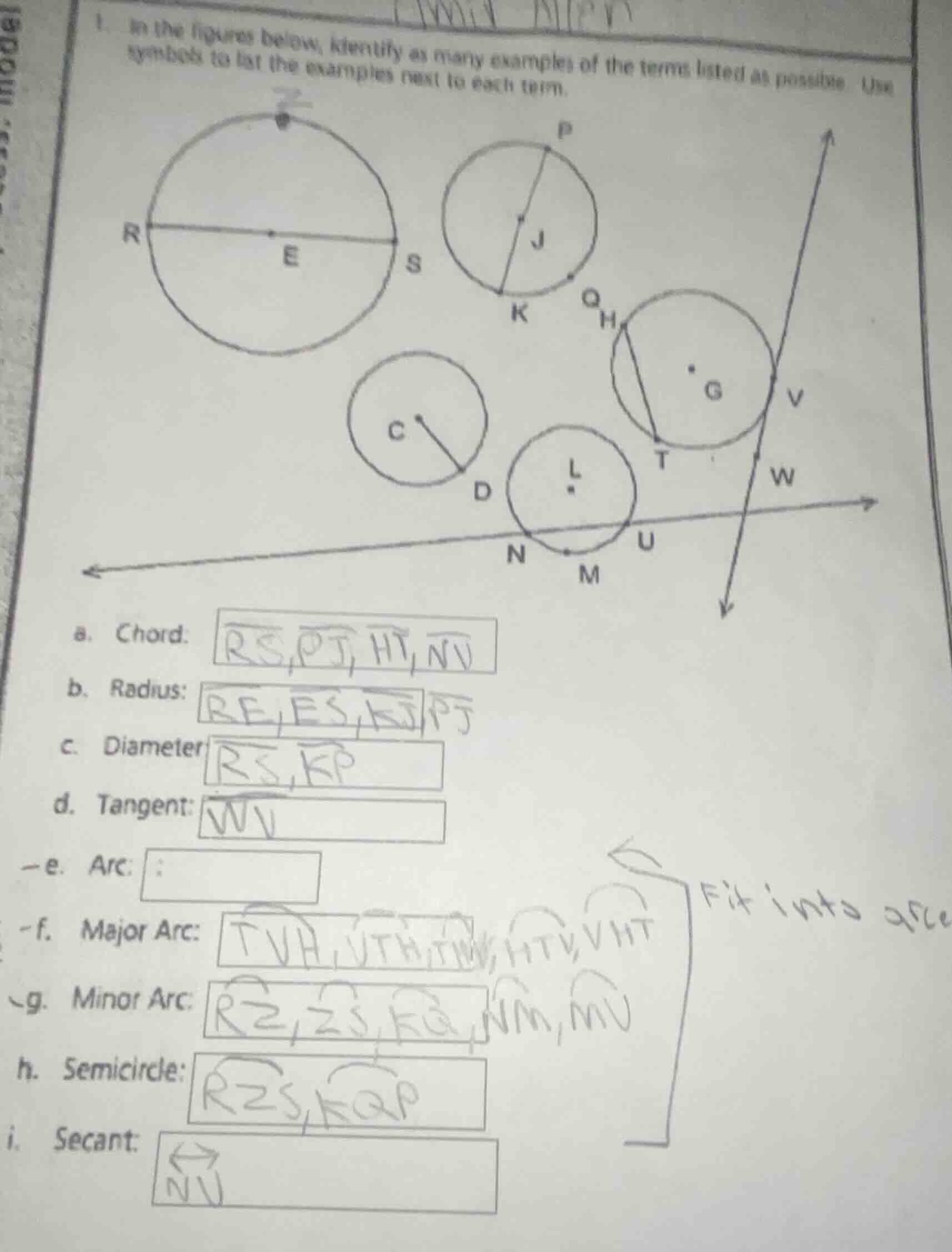
- in the figures below, identify as many examples of the terms listed as possible. use symbols to list the examples next to each term.
a. chord:
b. radius:
c. diameter
d. tangent:
e. arc:
f. major arc:
g. minor arc:
h. semicircle:
i. secant:
To solve this, we analyze each term using circle definitions:
a. Chord
A chord is a line segment with both endpoints on the circle.
- $\overline{RS}$: Endpoints $R, S$ on circle $E$.
- $\overline{PK}$: Endpoints $P, K$ on circle $J$.
- $\overline{HT}$: Endpoints $H, T$ on circle $G$.
- $\overline{NU}$: Endpoints $N, U$ on circle $L$.
b. Radius
A radius is a line segment from the center to the circle.
- $\overline{RE}$: Center $E$ to $R$ on circle $E$.
- $\overline{ES}$: Center $E$ to $S$ on circle $E$.
- $\overline{JP}$: Center $J$ to $P$ on circle $J$.
- $\overline{JK}$: Center $J$ to $K$ on circle $J$.
- $\overline{CD}$: Center $C$ to $D$ on circle $C$.
c. Diameter
A diameter is a chord passing through the center (longest chord).
- $\overline{RS}$: Passes through $E$ (center of circle $E$).
- $\overline{PK}$: Passes through $J$ (center of circle $J$).
d. Tangent
A tangent is a line touching the circle at exactly one point.
- Line $WV$: Touches circle $G$ at $V$ (only one point).
e. Arc
An arc is a portion of the circle’s circumference.
- $\overset{\frown}{RZ}$, $\overset{\frown}{ZS}$, $\overset{\frown}{RZS}$ (semicircle), $\overset{\frown}{PK}$, $\overset{\frown}{KQ}$, $\overset{\frown}{QH}$, $\overset{\frown}{HT}$, $\overset{\frown}{TN}$, $\overset{\frown}{NM}$, $\overset{\frown}{MU}$, etc.
f. Major Arc
A major arc is longer than a semicircle (measures $> 180^\circ$).
- $\overset{\frown}{RZS}$ (wait, no—correction: For circle $G$, $\overset{\frown}{HTV}$ (longer than semicircle). For circle $E$, $\overset{\frown}{RZS}$ is a semicircle, so major arcs like $\overset{\frown}{RZS}$ (no, semicircle is $180^\circ$). Correct major arcs: $\overset{\frown}{TVH}$ (circle $G$), $\overset{\frown}{VHT}$ (circle $G$), $\overset{\frown}{RZS}$ is semicircle, so major arcs must be $> 180^\circ$.
g. Minor Arc
A minor arc is shorter than a semicircle (measures $< 180^\circ$).
- $\overset{\frown}{RZ}$, $\overset{\frown}{ZS}$, $\overset{\frown}{PK}$, $\overset{\frown}{KQ}$, $\overset{\frown}{HT}$, $\overset{\frown}{TN}$, $\overset{\frown}{NM}$, $\overset{\frown}{MU}$.
h. Semicircle
A semicircle is an arc measuring $180^\circ$ (half the circle).
- $\overset{\frown}{RZS}$ (circle $E$, since $RS$ is diameter).
- $\overset{\frown}{PKQ}$? No, $\overset{\frown}{PK}$ is diameter, so $\overset{\frown}{PKQ}$? Wait, $\overset{\frown}{RZS}$ (circle $E$) and $\overset{\frown}{PK}$ (diameter, so semicircle $\overset{\frown}{PKQ}$? No, diameter divides circle into two semicircles. So $\overset{\frown}{RZS}$ (circle $E$) and $\overset{\frown}{PK}$ (circle $J$) as semicircles.
i. Secant
A secant is a line intersecting the circle at two points.
- Line $NU$: Intersects circle $L$ at $N$ and $U$.
Final Answers (Key Examples):
a. $\boldsymbol{\overline{RS}, \overline{PK}, \overline{HT}, \overline{NU}}$
b. $\boldsymbol{\overline{RE}, \overline{ES}, \overline{JP}, \overline{JK}, \overline{CD}}$
c. $\boldsymbol{\overline{RS}, \overline{PK}}$
d. $\boldsymbol{WV}$ (line)
e. $\boldsymbol{\overset{\frown}{RZ}, \overset{\frown}{ZS}, \overset{\frown}{PK}, \overset{\frown}{KQ}}$ (examples)
f. $\boldsymbol{\overset{\frown}{TVH}, \overset{\frown}{VHT}}$ (examples)
g. $\boldsymbol{\overset{\frown}{RZ}, \overset{\frown}{ZS}, \overset{\frown}{PK}, \overset{\frown}{KQ}}$ (examples)
h. $\boldsymbol{\overset{\frown}{RZS}, \overset{\frown}{PK}}$ (semicircles)
i. $\boldsymbol{NU}$ (line)

Snap & solve any problem in the app
Get step-by-step solutions on Sovi AI
Photo-based solutions with guided steps
Explore more problems and detailed explanations
To solve this, we analyze each term using circle definitions:
a. Chord
A chord is a line segment with both endpoints on the circle.
- $\overline{RS}$: Endpoints $R, S$ on circle $E$.
- $\overline{PK}$: Endpoints $P, K$ on circle $J$.
- $\overline{HT}$: Endpoints $H, T$ on circle $G$.
- $\overline{NU}$: Endpoints $N, U$ on circle $L$.
b. Radius
A radius is a line segment from the center to the circle.
- $\overline{RE}$: Center $E$ to $R$ on circle $E$.
- $\overline{ES}$: Center $E$ to $S$ on circle $E$.
- $\overline{JP}$: Center $J$ to $P$ on circle $J$.
- $\overline{JK}$: Center $J$ to $K$ on circle $J$.
- $\overline{CD}$: Center $C$ to $D$ on circle $C$.
c. Diameter
A diameter is a chord passing through the center (longest chord).
- $\overline{RS}$: Passes through $E$ (center of circle $E$).
- $\overline{PK}$: Passes through $J$ (center of circle $J$).
d. Tangent
A tangent is a line touching the circle at exactly one point.
- Line $WV$: Touches circle $G$ at $V$ (only one point).
e. Arc
An arc is a portion of the circle’s circumference.
- $\overset{\frown}{RZ}$, $\overset{\frown}{ZS}$, $\overset{\frown}{RZS}$ (semicircle), $\overset{\frown}{PK}$, $\overset{\frown}{KQ}$, $\overset{\frown}{QH}$, $\overset{\frown}{HT}$, $\overset{\frown}{TN}$, $\overset{\frown}{NM}$, $\overset{\frown}{MU}$, etc.
f. Major Arc
A major arc is longer than a semicircle (measures $> 180^\circ$).
- $\overset{\frown}{RZS}$ (wait, no—correction: For circle $G$, $\overset{\frown}{HTV}$ (longer than semicircle). For circle $E$, $\overset{\frown}{RZS}$ is a semicircle, so major arcs like $\overset{\frown}{RZS}$ (no, semicircle is $180^\circ$). Correct major arcs: $\overset{\frown}{TVH}$ (circle $G$), $\overset{\frown}{VHT}$ (circle $G$), $\overset{\frown}{RZS}$ is semicircle, so major arcs must be $> 180^\circ$.
g. Minor Arc
A minor arc is shorter than a semicircle (measures $< 180^\circ$).
- $\overset{\frown}{RZ}$, $\overset{\frown}{ZS}$, $\overset{\frown}{PK}$, $\overset{\frown}{KQ}$, $\overset{\frown}{HT}$, $\overset{\frown}{TN}$, $\overset{\frown}{NM}$, $\overset{\frown}{MU}$.
h. Semicircle
A semicircle is an arc measuring $180^\circ$ (half the circle).
- $\overset{\frown}{RZS}$ (circle $E$, since $RS$ is diameter).
- $\overset{\frown}{PKQ}$? No, $\overset{\frown}{PK}$ is diameter, so $\overset{\frown}{PKQ}$? Wait, $\overset{\frown}{RZS}$ (circle $E$) and $\overset{\frown}{PK}$ (diameter, so semicircle $\overset{\frown}{PKQ}$? No, diameter divides circle into two semicircles. So $\overset{\frown}{RZS}$ (circle $E$) and $\overset{\frown}{PK}$ (circle $J$) as semicircles.
i. Secant
A secant is a line intersecting the circle at two points.
- Line $NU$: Intersects circle $L$ at $N$ and $U$.
Final Answers (Key Examples):
a. $\boldsymbol{\overline{RS}, \overline{PK}, \overline{HT}, \overline{NU}}$
b. $\boldsymbol{\overline{RE}, \overline{ES}, \overline{JP}, \overline{JK}, \overline{CD}}$
c. $\boldsymbol{\overline{RS}, \overline{PK}}$
d. $\boldsymbol{WV}$ (line)
e. $\boldsymbol{\overset{\frown}{RZ}, \overset{\frown}{ZS}, \overset{\frown}{PK}, \overset{\frown}{KQ}}$ (examples)
f. $\boldsymbol{\overset{\frown}{TVH}, \overset{\frown}{VHT}}$ (examples)
g. $\boldsymbol{\overset{\frown}{RZ}, \overset{\frown}{ZS}, \overset{\frown}{PK}, \overset{\frown}{KQ}}$ (examples)
h. $\boldsymbol{\overset{\frown}{RZS}, \overset{\frown}{PK}}$ (semicircles)
i. $\boldsymbol{NU}$ (line)