QUESTION IMAGE
Question
fill in the blank 1 point
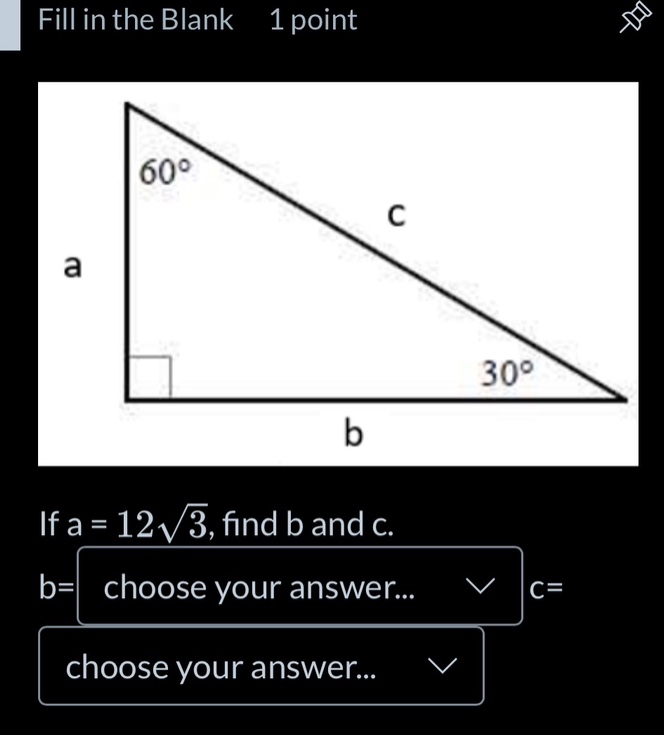
if a = 12\sqrt{3}, find b and c.
b= choose your answer... c= choose your answer...
Step1: Identify triangle type
This is a 30-60-90 right triangle. In such a triangle, the sides are in the ratio \(1 : \sqrt{3} : 2\), where the side opposite \(30^\circ\) is the shortest (let's call it \(x\)), opposite \(60^\circ\) is \(x\sqrt{3}\), and hypotenuse is \(2x\).
Here, side \(a\) is opposite \(30^\circ\)? Wait, no. Wait, the right angle is between \(a\) and \(b\). So angle \(30^\circ\) is at the bottom right, so side opposite \(30^\circ\) is \(a\)? Wait no, let's check angles. The right angle is between \(a\) (vertical leg) and \(b\) (horizontal leg). The angle at the bottom is \(30^\circ\), so the side opposite \(30^\circ\) is \(a\) (vertical leg), side opposite \(60^\circ\) is \(b\) (horizontal leg), and hypotenuse is \(c\). Wait, no: in a right triangle, the side opposite \(30^\circ\) is the shorter leg. Let's confirm: angle at bottom is \(30^\circ\), so the side opposite to it is \(a\) (vertical leg). Then side opposite \(60^\circ\) (top angle) is \(b\) (horizontal leg), and hypotenuse is \(c\).
In 30-60-90 triangle, the ratios are:
- Shorter leg (opposite \(30^\circ\)): \(x\)
- Longer leg (opposite \(60^\circ\)): \(x\sqrt{3}\)
- Hypotenuse: \(2x\)
Wait, but here \(a = 12\sqrt{3}\) is the side opposite \(30^\circ\)? Wait no, if angle at bottom is \(30^\circ\), then the side opposite to it is \(a\) (vertical leg). Then the longer leg (opposite \(60^\circ\)) is \(b\), and hypotenuse \(c\). Wait, but if \(a\) is opposite \(30^\circ\), then \(a = x\), longer leg \(b = x\sqrt{3}\), hypotenuse \(c = 2x\). But \(a = 12\sqrt{3}\), so \(x = 12\sqrt{3}\)? Wait that can't be, because then longer leg would be \(x\sqrt{3} = 12\sqrt{3} \times \sqrt{3} = 12 \times 3 = 36\), and hypotenuse \(2x = 24\sqrt{3}\). Wait, but that seems reversed. Wait maybe I mixed up the angles. Let's re-examine the triangle.
The right angle is between \(a\) (vertical) and \(b\) (horizontal). The top angle is \(60^\circ\), bottom angle is \(30^\circ\). So the side opposite \(30^\circ\) is \(a\) (vertical leg), side opposite \(60^\circ\) is \(b\) (horizontal leg), hypotenuse \(c\). Wait, but in a 30-60-90 triangle, the side opposite \(30^\circ\) is the shorter leg. So if \(a\) is opposite \(30^\circ\), then \(a\) is the shorter leg. But \(a = 12\sqrt{3}\), which is longer than, say, if \(b\) were the shorter leg. Wait maybe I got the opposite sides wrong. Let's use trigonometry.
Using trigonometric ratios:
For angle \(30^\circ\) (bottom angle):
\(\tan(30^\circ) = \frac{\text{opposite}}{\text{adjacent}} = \frac{a}{b}\)
\(\tan(30^\circ) = \frac{1}{\sqrt{3}}\), so \(\frac{1}{\sqrt{3}} = \frac{a}{b}\) => \(b = a\sqrt{3}\)
Also, \(\sin(30^\circ) = \frac{\text{opposite}}{\text{hypotenuse}} = \frac{a}{c}\)
\(\sin(30^\circ) = \frac{1}{2}\), so \(\frac{1}{2} = \frac{a}{c}\) => \(c = 2a\)
Wait, but if \(a = 12\sqrt{3}\), then:
\(b = a\sqrt{3} = 12\sqrt{3} \times \sqrt{3} = 12 \times 3 = 36\)
\(c = 2a = 2 \times 12\sqrt{3} = 24\sqrt{3}\)? Wait no, that can't be, because then the hypotenuse would be longer than the leg, but \(24\sqrt{3}\) is longer than \(36\)? Wait \(24\sqrt{3} \approx 24 \times 1.732 \approx 41.57\), and \(36\) is less than that, so hypotenuse is longer, which is correct. Wait, but let's check with the other angle, \(60^\circ\) (top angle):
\(\tan(60^\circ) = \frac{b}{a}\) (since for angle \(60^\circ\), opposite is \(b\), adjacent is \(a\))
\(\tan(60^\circ) = \sqrt{3}\), so \(\sqrt{3} = \frac{b}{a}\) => \(b = a\sqrt{3}\), which matches the earlier result.
\(\sin(60^\circ) = \frac{b}{c}\) => \(\frac{\sqrt{3}}{2} = \frac{b}{c}\) =>…

Snap & solve any problem in the app
Get step-by-step solutions on Sovi AI
Photo-based solutions with guided steps
Explore more problems and detailed explanations
\(b = 36\), \(c = 24\sqrt{3}\)