QUESTION IMAGE
Question
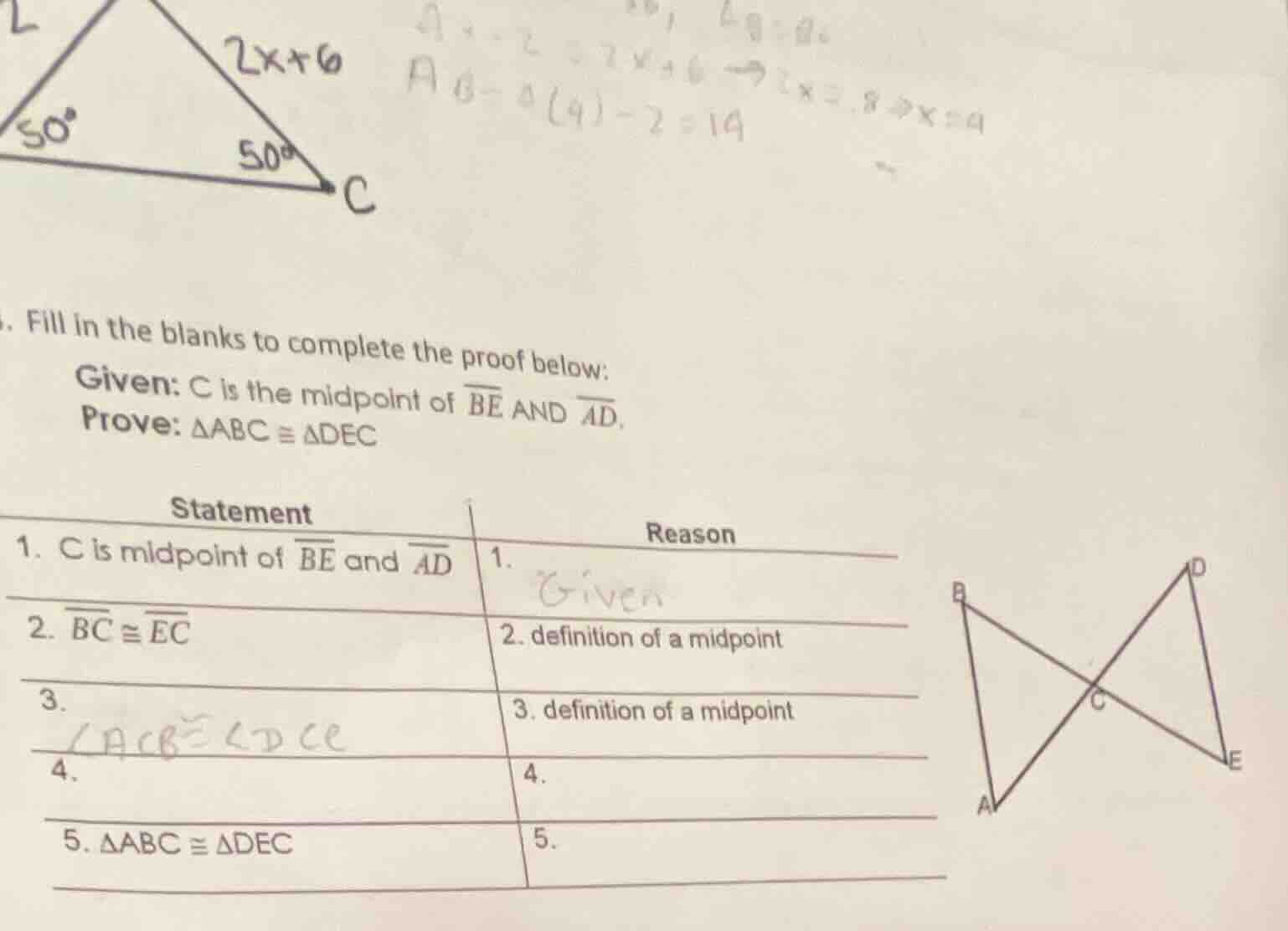
. fill in the blanks to complete the proof below:
given: c is the midpoint of $overline{be}$ and $overline{ad}$.
prove: $\triangle abc cong \triangle dec$
| statement | reason |
|---|
| 1. c is midpoint of $overline{be}$ and $overline{ad}$ | 1.
| 2. $overline{bc} cong overline{ec}$ | 2. definition of a midpoint
| 3. | 3. definition of a midpoint
| 4. | 4.
| 5. $\triangle abc cong \triangle dec$ | 5.
Step1: Analyze Statement 3
Since \( C \) is the midpoint of \( \overline{AD} \), by the definition of a midpoint, \( \overline{AC} \cong \overline{DC} \). So the statement for step 3 is \( \overline{AC} \cong \overline{DC} \).
Step2: Analyze Statement 4
\( \angle ACB \) and \( \angle DCE \) are vertical angles. Vertical angles are congruent, so the statement is \( \angle ACB \cong \angle DCE \) and the reason is "vertical angles are congruent".
Step3: Analyze Statement 5
We have \( \overline{BC} \cong \overline{EC} \) (step 2), \( \angle ACB \cong \angle DCE \) (step 4), and \( \overline{AC} \cong \overline{DC} \) (step 3). By the Side - Angle - Side (SAS) congruence postulate, \( \triangle ABC \cong \triangle DEC \). So the reason for step 5 is "SAS congruence postulate".

Snap & solve any problem in the app
Get step-by-step solutions on Sovi AI
Photo-based solutions with guided steps
Explore more problems and detailed explanations
- \( \boldsymbol{\overline{AC} \cong \overline{DC}} \)
- \( \boldsymbol{\angle ACB \cong \angle DCE} \); Reason: vertical angles are congruent
- Reason: SAS congruence postulate