QUESTION IMAGE
Question
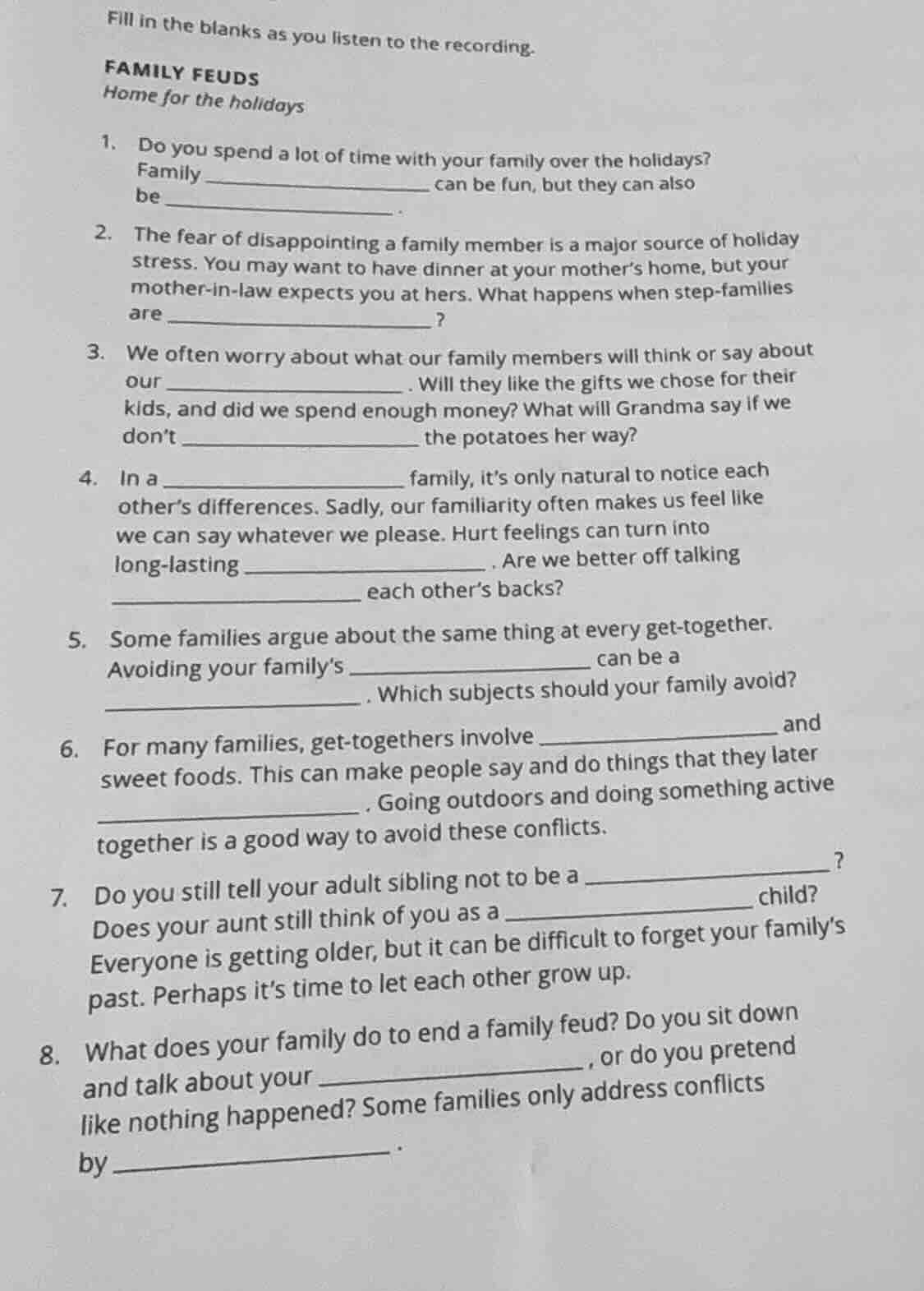
fill in the blanks as you listen to the recording.
family feuds
home for the holidays
- do you spend a lot of time with your family over the holidays?
family ____________ can be fun, but they can also
be ____________.
- the fear of disappointing a family member is a major source of holiday
stress. you may want to have dinner at your mother’s home, but your
mother - in - law expects you at hers. what happens when step - families
are ____________?
- we often worry about what our family members will think or say about
our ____________. will they like the gifts we chose for their
kids, and did we spend enough money? what will grandma say if we
don’t ____________ the potatoes her way?
- in a ____________ family, it’s only natural to notice each
other’s differences. sadly, our familiarity often makes us feel like
we can say whatever we please. hurt feelings can turn into
long - lasting ____________. are we better off talking
____________ each other’s backs?
- some families argue about the same thing at every get - together.
avoiding your family’s ____________ can be a
____________. which subjects should your family avoid?
- for many families, get - togethers involve ____________ and
sweet foods. this can make people say and do things that they later
____________. going outdoors and doing something active
together is a good way to avoid these conflicts.
- do you still tell your adult sibling not to be a ____________?
does your aunt still think of you as a ____________ child?
everyone is getting older, but it can be difficult to forget your family’s
past. perhaps it’s time to let each other grow up.
- what does your family do to end a family feud? do you sit down
and talk about your ____________, or do you pretend
like nothing happened? some families only address conflicts
by ____________.
This is a listening - fill - in - the - blanks exercise. Since it is a listening task, the answers depend on the content of the recording. Without the audio, we can only analyze the context to predict possible answers:
Question 1
- The first blank: According to the context "spend a lot of time with your family", it is likely to be "gatherings" (family gatherings mean family get - togethers).
- The second blank: The sentence says family gatherings can be fun but also have a negative side. A possible word is "stressful" (because the following content also mentions holiday stress).
Question 2
- The blank: When step - families are "involved" (when step - families are involved in the situation of choosing where to have dinner), it will cause more complex problems.
Question 3
- The first blank: From the following "Will they like the gifts...", we can infer that we worry about family members' opinions on our "choices" (the choices of gifts and other things).
- The second blank: "cook" the potatoes her way (it means to make the potatoes in the way grandma likes).
Question 4
- The first blank: In a "close - knit" family (a family with close relationships), it is natural to notice each other's differences.
- The second blank: Hurt feelings can turn into long - lasting "resentments" (long - term negative emotions).
- The third blank: "behind" each other's backs (talk behind each other's backs means to talk about others when they are not around).
Question 5
- The first blank: Avoiding family's "arguments" (the things that families argue about at every get - together).
- The second blank: Avoiding these arguments can be a "challenge" (it is not easy to avoid family arguments).
Question 6
- The first blank: Family get - togethers often involve "rich" (rich foods, which are usually high - calorie) and sweet foods.
- The second blank: Eating these foods can make people do things they later "regret" (they will feel sorry for what they said or did).
Question 7
- The first blank: Do you still tell your adult sibling not to be a "nuisance" (a person who is annoying).
- The second blank: Does your aunt still think of you as a "spoiled" (a child who is over - indulged) child.
Question 8
- The first blank: Sit down and talk about your "feelings" (talk about your inner feelings to end a family feud).
- The second blank: Some families only address conflicts by "ignoring" them (pretend like nothing happened, that is, ignore the conflicts).
Since this is a listening exercise, the above are just predictions based on context. To get the accurate answers, you need to listen to the recording.

Snap & solve any problem in the app
Get step-by-step solutions on Sovi AI
Photo-based solutions with guided steps
Explore more problems and detailed explanations
This is a listening - fill - in - the - blanks exercise. Since it is a listening task, the answers depend on the content of the recording. Without the audio, we can only analyze the context to predict possible answers:
Question 1
- The first blank: According to the context "spend a lot of time with your family", it is likely to be "gatherings" (family gatherings mean family get - togethers).
- The second blank: The sentence says family gatherings can be fun but also have a negative side. A possible word is "stressful" (because the following content also mentions holiday stress).
Question 2
- The blank: When step - families are "involved" (when step - families are involved in the situation of choosing where to have dinner), it will cause more complex problems.
Question 3
- The first blank: From the following "Will they like the gifts...", we can infer that we worry about family members' opinions on our "choices" (the choices of gifts and other things).
- The second blank: "cook" the potatoes her way (it means to make the potatoes in the way grandma likes).
Question 4
- The first blank: In a "close - knit" family (a family with close relationships), it is natural to notice each other's differences.
- The second blank: Hurt feelings can turn into long - lasting "resentments" (long - term negative emotions).
- The third blank: "behind" each other's backs (talk behind each other's backs means to talk about others when they are not around).
Question 5
- The first blank: Avoiding family's "arguments" (the things that families argue about at every get - together).
- The second blank: Avoiding these arguments can be a "challenge" (it is not easy to avoid family arguments).
Question 6
- The first blank: Family get - togethers often involve "rich" (rich foods, which are usually high - calorie) and sweet foods.
- The second blank: Eating these foods can make people do things they later "regret" (they will feel sorry for what they said or did).
Question 7
- The first blank: Do you still tell your adult sibling not to be a "nuisance" (a person who is annoying).
- The second blank: Does your aunt still think of you as a "spoiled" (a child who is over - indulged) child.
Question 8
- The first blank: Sit down and talk about your "feelings" (talk about your inner feelings to end a family feud).
- The second blank: Some families only address conflicts by "ignoring" them (pretend like nothing happened, that is, ignore the conflicts).
Since this is a listening exercise, the above are just predictions based on context. To get the accurate answers, you need to listen to the recording.