QUESTION IMAGE
Question
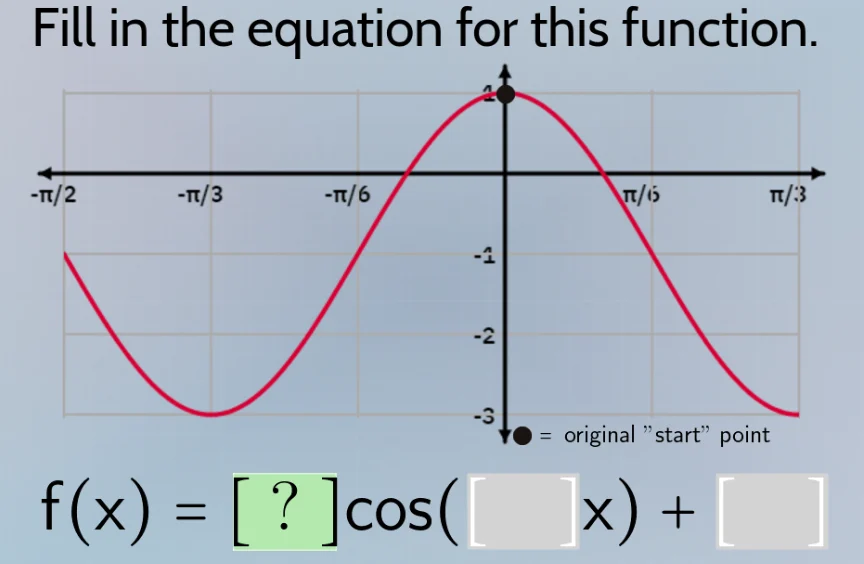
fill in the equation for this function.
● = original start point
$f(x) = ?\cos(\square x) + \square$
Step1: Identify vertical shift (D)
The midline of the cosine function is the average of the maximum and minimum values. The maximum value is 2, the minimum value is -3.
$\text{Midline } D = \frac{2 + (-3)}{2} = -\frac{1}{2}$
Step2: Calculate amplitude (A)
Amplitude is half the distance between max and min.
$A = \frac{2 - (-3)}{2} = \frac{5}{2}$
Step3: Find angular frequency (B)
The period of the function: from the graph, the distance from the peak at $x=0$ to the next peak would be the period. The function goes from peak to trough over $\frac{\pi}{3}$, so full period $T = \frac{2\pi}{3}$. Using $T = \frac{2\pi}{B}$, solve for B:
$B = \frac{2\pi}{T} = \frac{2\pi}{\frac{2\pi}{3}} = 3$
Step4: Assemble the function
The general form is $f(x)=A\cos(Bx)+D$. Substitute the values:
$f(x)=\frac{5}{2}\cos(3x) - \frac{1}{2}$

Snap & solve any problem in the app
Get step-by-step solutions on Sovi AI
Photo-based solutions with guided steps
Explore more problems and detailed explanations
$f(x) = \boldsymbol{\frac{5}{2}}\cos(\boldsymbol{3}x) + \boldsymbol{-\frac{1}{2}}$