QUESTION IMAGE
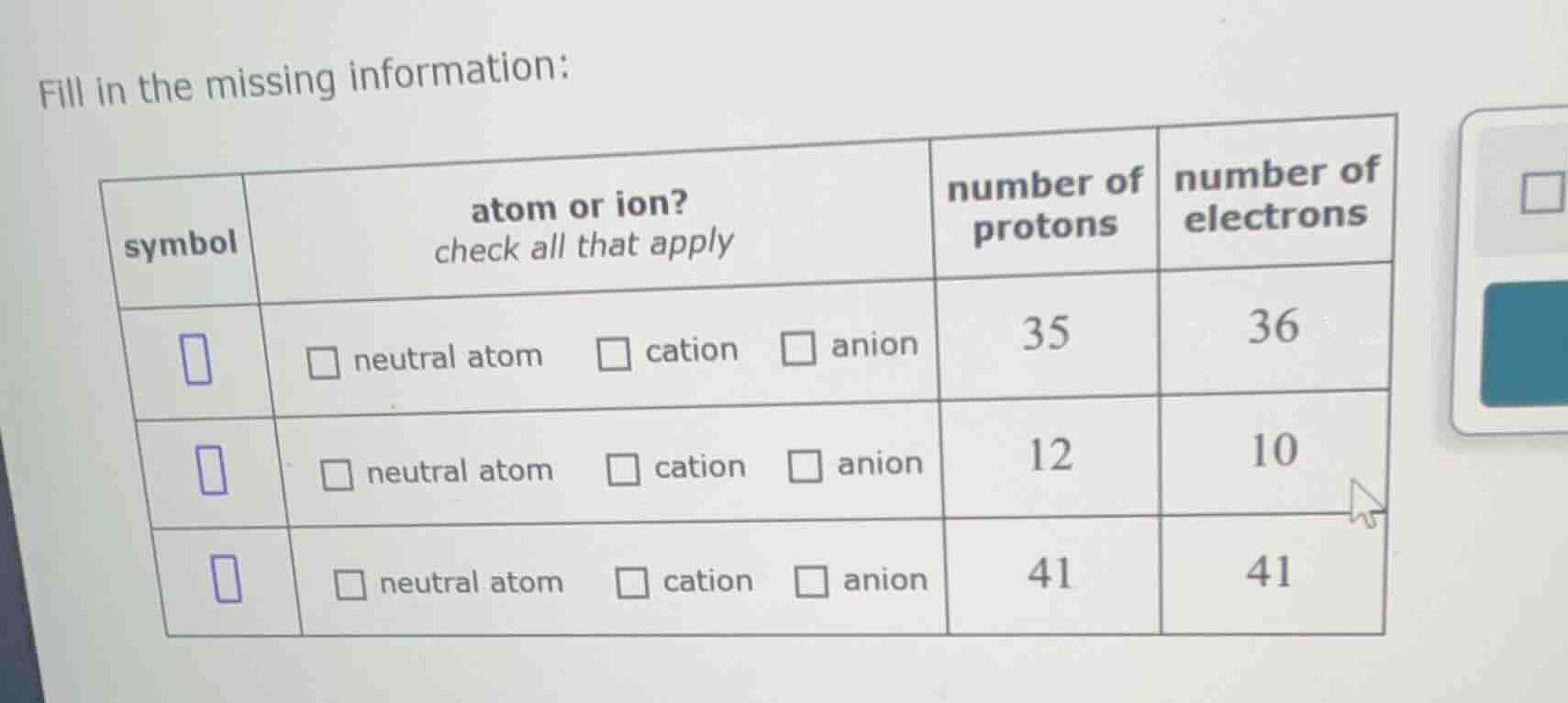
Question
fill in the missing information:
| symbol | atom or ion?
check all that apply | number of
protons | number of
electrons |
| neutral atom cation anion | 35 | 36 | |
| neutral atom cation anion | 12 | 10 | |
| neutral atom cation anion | 41 | 41 |
Step 1: Recall atomic structure rules
- The number of protons is the atomic number (Z), which determines the element.
- For a neutral atom: number of protons = number of electrons.
- For a cation: number of protons > number of electrons (lost electrons).
- For an anion: number of protons < number of electrons (gained electrons).
Step 2: Analyze the first row
- Protons = 35, Electrons = 36. Since protons < electrons, it's an anion. The element with atomic number 35 is bromine (Br). So the symbol is $\ce{Br^-}$, and check "anion".
Step 3: Analyze the second row
- Protons = 12, Electrons = 10. Since protons > electrons, it's a cation. The element with atomic number 12 is magnesium (Mg). So the symbol is $\ce{Mg^{2+}}$, and check "cation".
Step 4: Analyze the third row
- Protons = 41, Electrons = 41. Since protons = electrons, it's a neutral atom. The element with atomic number 41 is niobium (Nb). So the symbol is $\ce{Nb}$, and check "neutral atom".

Snap & solve any problem in the app
Get step-by-step solutions on Sovi AI
Photo-based solutions with guided steps
Explore more problems and detailed explanations
| symbol | atom or ion? (check all that apply) | number of protons | number of electrons |
|---|---|---|---|
| $\boldsymbol{\ce{Mg^{2+}}}$ | $\square$ neutral atom $\boldsymbol{\square}$ cation $\square$ anion | 12 | 10 |
| $\boldsymbol{\ce{Nb}}$ | $\boldsymbol{\square}$ neutral atom $\square$ cation $\square$ anion | 41 | 41 |