QUESTION IMAGE
Question
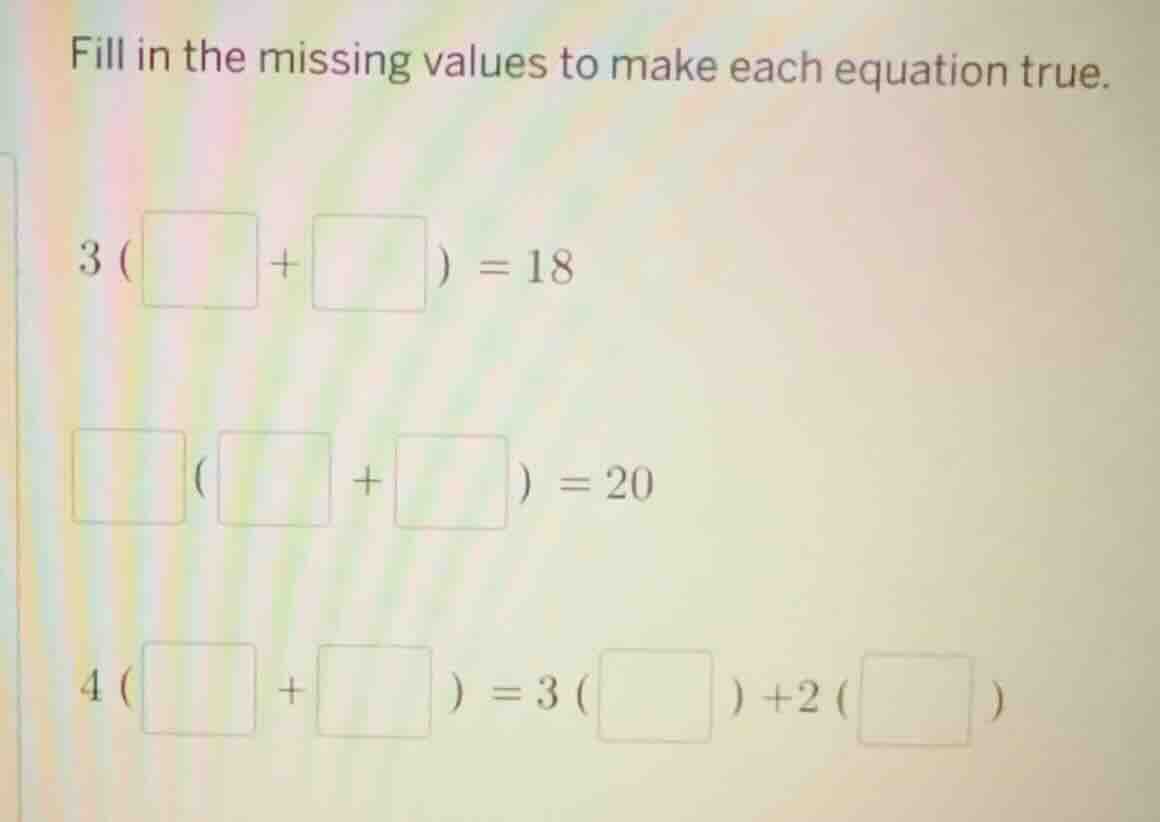
fill in the missing values to make each equation true.
$3(\square+\square)=18$
$\square(\square+\square)=20$
$4(\square+\square)=3(\square)+2(\square)$
Step1: Simplify first equation
Divide both sides by 3:
$$\square + \square = \frac{18}{3} = 6$$
Choose two numbers that sum to 6, e.g., 2 and 4.
Step2: Simplify second equation
Pick a factor of 20 as the leading coefficient, e.g., 4. Then:
$$\square + \square = \frac{20}{4} = 5$$
Choose two numbers that sum to 5, e.g., 1 and 4.
Step3: Balance third equation
Let left side sum be $a+b$, right side be $3c+2d$. Choose values where $4(a+b)=3c+2d$. Let $a=1, b=1$:
$$4(1+1)=8$$
Find $c,d$: $3(2)+2(1)=6+2=8$

Snap & solve any problem in the app
Get step-by-step solutions on Sovi AI
Photo-based solutions with guided steps
Explore more problems and detailed explanations
- $3(2 + 4) = 18$ (other pairs summing to 6 are valid)
- $4(1 + 4) = 20$ (other factor-sum combinations for 20 are valid)
- $4(1 + 1) = 3(2) + 2(1)$ (other balanced value sets are valid)