QUESTION IMAGE
Question
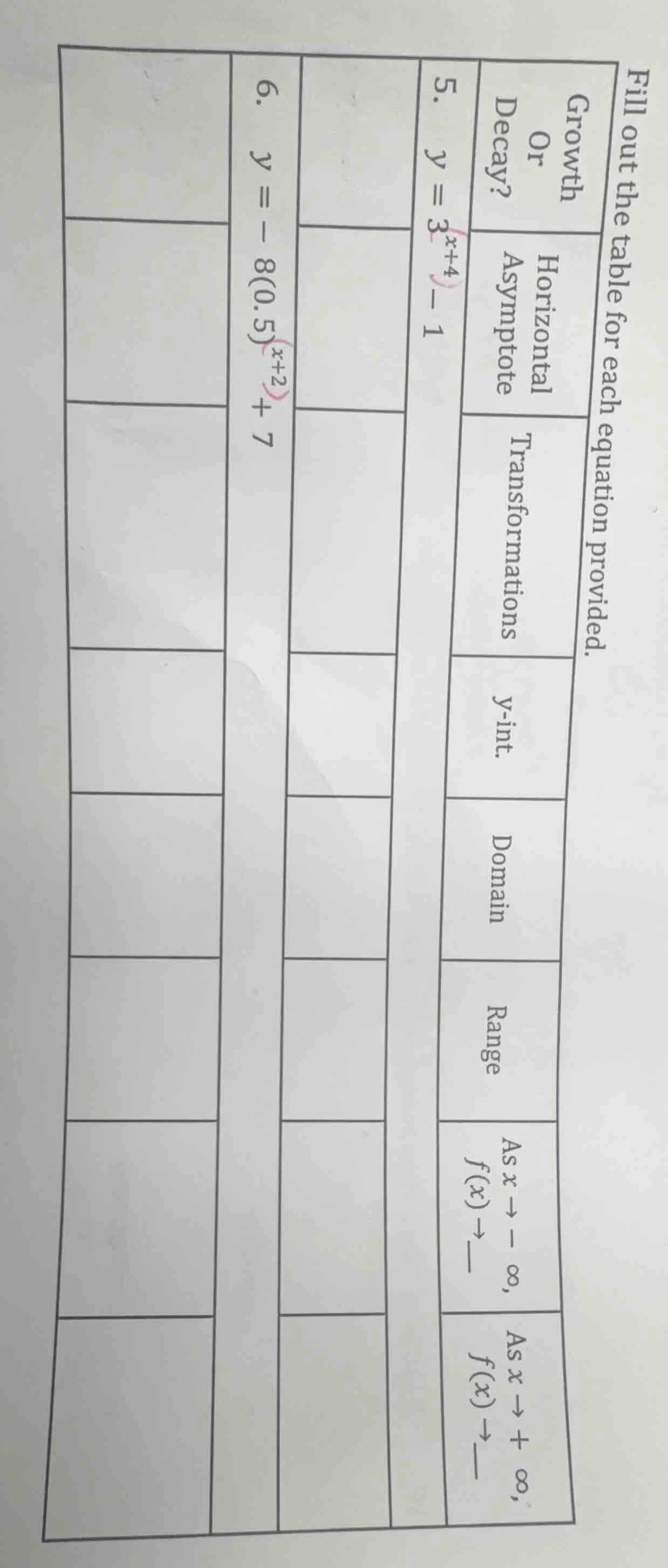
fill out the table for each equation provided.
- $y = 3^{(x+4)}-1$
- $y = - 8(0.5)^{(x+2)}+7$
| growth or decay? | horizontal asymptote | transformations | y-int. | domain | range | as $x \to - \infty$, $f(x) \to$___ | as $x \to + \infty$, $f(x) \to$___ | |
|---|---|---|---|---|---|---|---|---|
| 6. $y = - 8(0.5)^{(x+2)}+7$ |
For Equation 5: $y = 3^{(x+4)} - 1$
Step1: Identify Growth/Decay
Base $3>1$, so it is growth.
Step2: Find Horizontal Asymptote
For $y = a \cdot b^{x-h} + k$, asymptote is $y=k$. Here $k=-1$, so $y=-1$.
Step3: List Transformations
Compare to $y=3^x$: shift left 4, down 1.
Step4: Calculate y-intercept
Set $x=0$: $y=3^{(0+4)}-1=3^4 -1=81-1=80$.
Step5: Determine Domain
Exponential functions have all real $x$: $(-\infty, \infty)$.
Step6: Determine Range
$3^{(x+4)}>0$, so $3^{(x+4)}-1 > -1$: $(-1, \infty)$.
Step7: End Behavior as $x\to-\infty$
$3^{(x+4)}\to0$, so $y\to0-1=-1$.
Step8: End Behavior as $x\to+\infty$
$3^{(x+4)}\to+\infty$, so $y\to+\infty$.
---
For Equation 6: $y = -8(0.5)^{(x+2)} + 7$
Step1: Identify Growth/Decay
Base $0<0.5<1$, so it is decay.
Step2: Find Horizontal Asymptote
For $y = a \cdot b^{x-h} + k$, asymptote is $y=k$. Here $k=7$, so $y=7$.
Step3: List Transformations
Compare to $y=0.5^x$: reflect over x-axis, vertical stretch by 8, shift left 2, up7.
Step4: Calculate y-intercept
Set $x=0$: $y=-8(0.5)^{(0+2)}+7=-8(0.25)+7=-2+7=5$.
Step5: Determine Domain
Exponential functions have all real $x$: $(-\infty, \infty)$.
Step6: Determine Range
$(0.5)^{(x+2)}>0$, so $-8(0.5)^{(x+2)}<0$, so $-8(0.5)^{(x+2)}+7 <7$: $(-\infty, 7)$.
Step7: End Behavior as $x\to-\infty$
$(0.5)^{(x+2)}\to+\infty$, so $y\to-8(+\infty)+7\to-\infty$.
Step8: End Behavior as $x\to+\infty$
$(0.5)^{(x+2)}\to0$, so $y\to-8(0)+7=7$.

Snap & solve any problem in the app
Get step-by-step solutions on Sovi AI
Photo-based solutions with guided steps
Explore more problems and detailed explanations
| $y = 3^{(x+4)} - 1$ | $y = -8(0.5)^{(x+2)} + 7$ | |
|---|---|---|
| Horizontal Asymptote | $y=-1$ | $y=7$ |
| Transformations | Left 4, down 1 (from $y=3^x$) | Reflect over x-axis, stretch by 8, left 2, up7 (from $y=0.5^x$) |
| y-int. | $80$ | $5$ |
| Domain | $(-\infty, \infty)$ | $(-\infty, \infty)$ |
| Range | $(-1, \infty)$ | $(-\infty, 7)$ |
| As $x \to -\infty$, $f(x)\to$ | $-1$ | $-\infty$ |
| As $x \to +\infty$, $f(x)\to$ | $+\infty$ | $7$ |