QUESTION IMAGE
Question
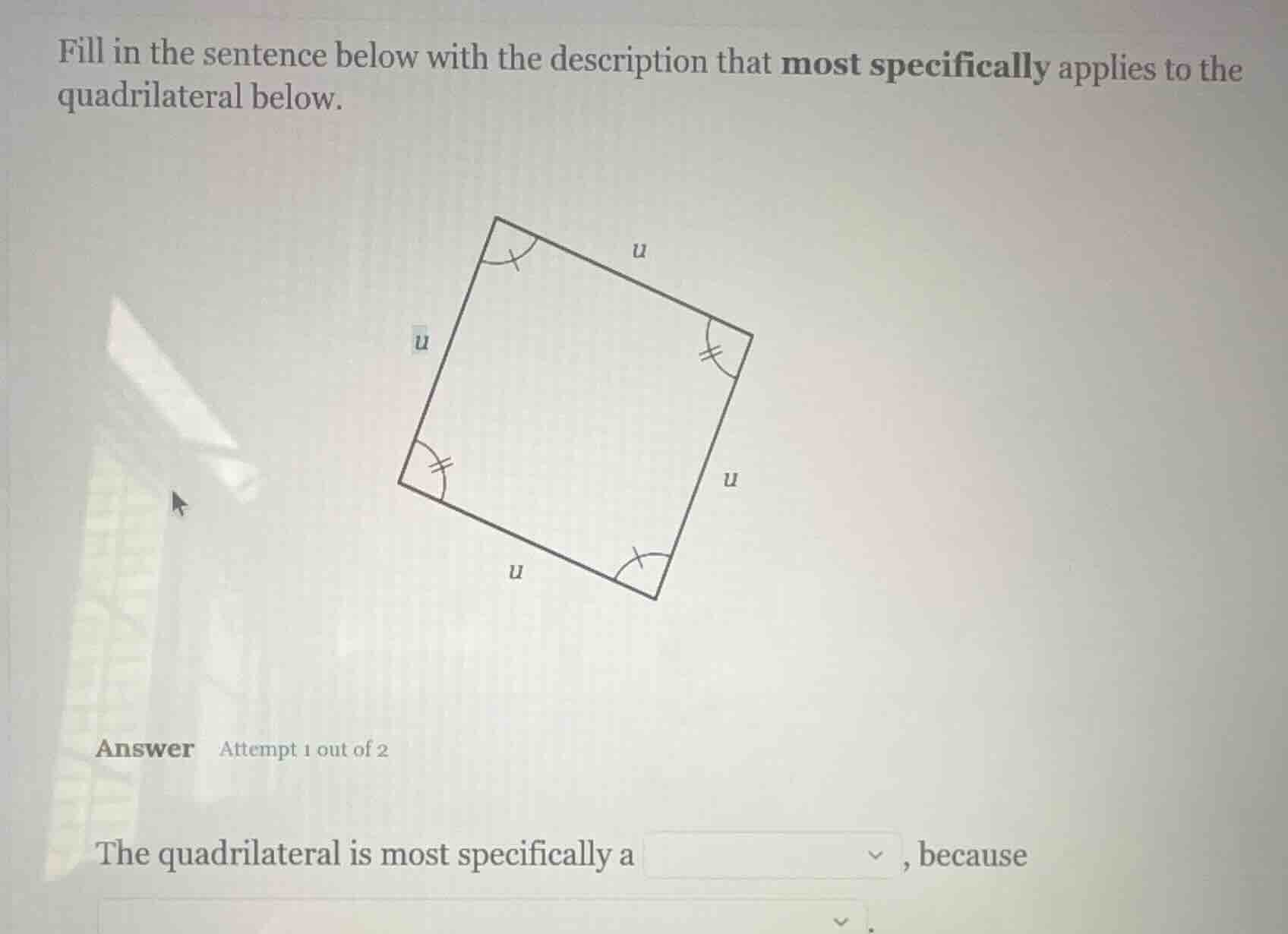
fill in the sentence below with the description that most specifically applies to the quadrilateral below.
answer attempt 1 out of 2
the quadrilateral is most specifically a , because .
Step1: Analyze side lengths
The quadrilateral has all sides labeled as \( u \), so all four sides are equal in length.
Step2: Analyze angles
Looking at the angle marks, we can see that there are right angles (the marks indicate equal angles, and in a quadrilateral with four equal sides and right angles, we check the angle properties). The angle marks suggest that the angles are right angles (since the marks for angles: some with one arc, some with two, but in a square, all angles are right angles, and all sides equal. Wait, actually, the angle marks: let's see, the quadrilateral has four sides equal (all \( u \)) and the angles: the marks on the angles, two angles with two arcs and two with one arc? Wait, no, maybe the diagram is a square. Wait, actually, in a square, all sides are equal and all angles are right angles (90 degrees). Alternatively, a rhombus has all sides equal, but if it has right angles, it's a square. Wait, let's re - examine: the side lengths are all \( u \), so all four sides are congruent. Now, the angle marks: if the angles are right angles (the marks like the right - angle marks), then a quadrilateral with four equal sides and four right angles is a square. Alternatively, if we consider that a square is a special case of a rhombus (all sides equal) and a rectangle (all angles right). But since all sides are equal and angles are right, the most specific is a square.
Wait, maybe the angle marks: let's see, the diagram has four sides of length \( u \), so \( AB = BC=CD = DA = u \). And the angles: the marks on the angles, two angles with two arcs and two with one arc? No, maybe the diagram is a square. Let's think again. A square is a quadrilateral with four equal sides and four right angles. A rhombus has four equal sides but not necessarily right angles, a rectangle has four right angles but not necessarily equal sides. Since this quadrilateral has four equal sides and (from the angle marks, which are right - angle marks) four right angles, it is a square.

Snap & solve any problem in the app
Get step-by-step solutions on Sovi AI
Photo-based solutions with guided steps
Explore more problems and detailed explanations
The quadrilateral is most specifically a \(\boldsymbol{square}\), because it has four equal - length sides (\(u\)) and four right angles (indicated by the angle marks).