QUESTION IMAGE
Question
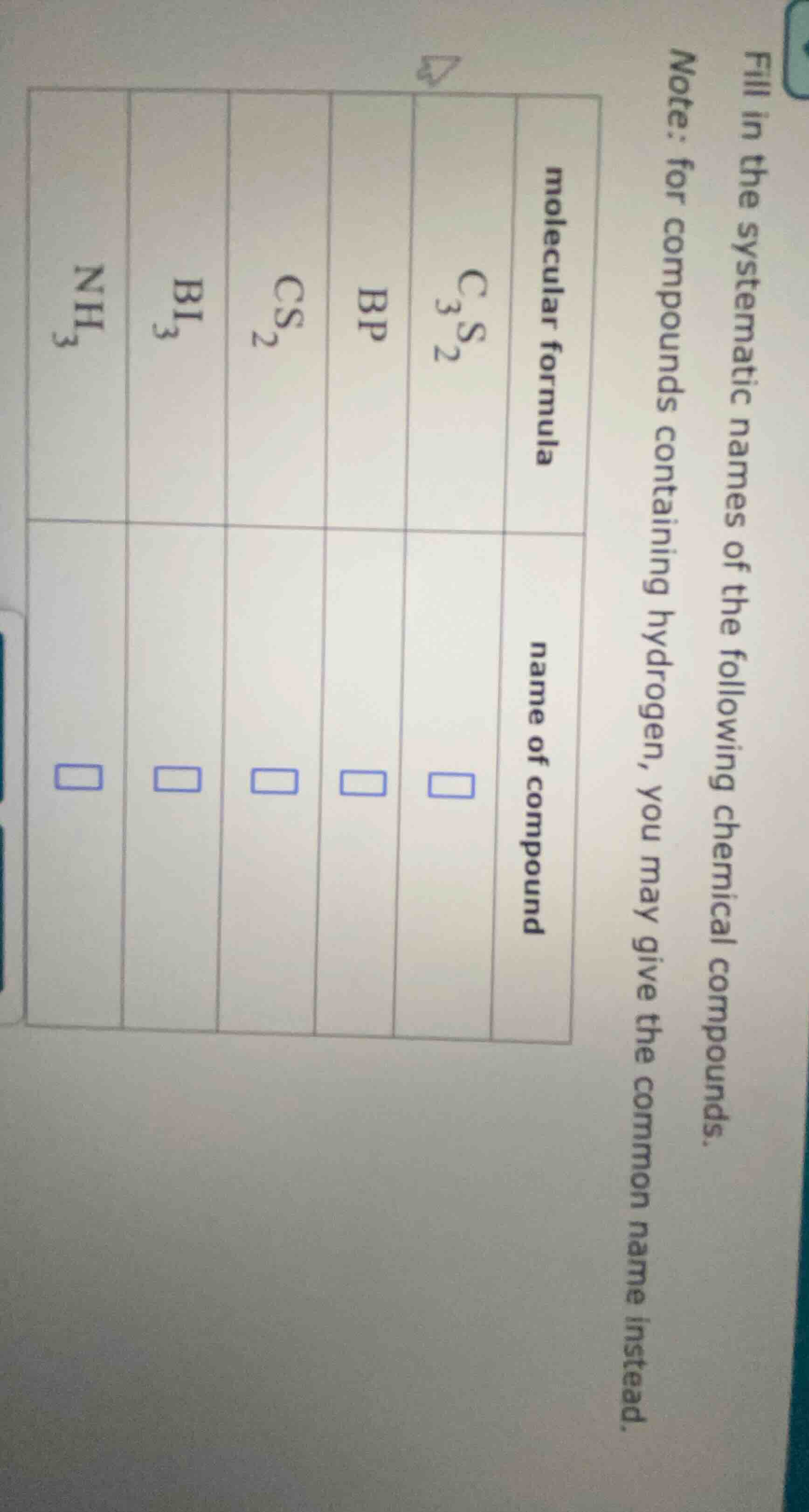
fill in the systematic names of the following chemical compounds.
note: for compounds containing hydrogen, you may give the common name instead.
| molecular formula | c₃s₂ | bp | cs₂ | bi₃ | nh₃ |
|---|
To solve the problem of naming the given molecular compounds, we follow the rules for naming molecular (covalent) compounds, which involves using prefixes to indicate the number of atoms of each element. The prefixes are: 1 - mono, 2 - di, 3 - tri, 4 - tetra, 5 - penta, etc. (Note: "mono" is only used for the second element if there is one atom of it; the first element never uses "mono" if there is one atom.)
For \( \boldsymbol{C_3S_2} \)
- The first element is carbon (C) with 3 atoms, so we use the prefix "tri-".
- The second element is sulfur (S) with 2 atoms, so we use the prefix "di-".
- Name: Tricarbon disulfide
For \( \boldsymbol{BP} \)
- The first element is boron (B) with 1 atom (no prefix needed for the first element).
- The second element is phosphorus (P) with 1 atom, so we use "mono-".
- Name: Boron monophosphide
For \( \boldsymbol{CS_2} \)
- The first element is carbon (C) with 1 atom (no prefix).
- The second element is sulfur (S) with 2 atoms, so we use "di-".
- Name: Carbon disulfide (common name is also carbon disulfide)
For \( \boldsymbol{BI_3} \)
- The first element is boron (B) with 1 atom (no prefix).
- The second element is iodine (I) with 3 atoms, so we use "tri-".
- Name: Boron triiodide
For \( \boldsymbol{NH_3} \)
- This is a common molecular compound with the common name Ammonia. Systematically, it can also be named as nitrogen trihydride (but "ammonia" is the widely accepted common name).
Final Table of Names
| Molecular Formula | Name of Compound |
|---|---|
| \( BP \) | Boron monophosphide |
| \( CS_2 \) | Carbon disulfide |
| \( BI_3 \) | Boron triiodide |
| \( NH_3 \) | Ammonia (or Nitrogen trihydride) |
(Note: For \( NH_3 \), "ammonia" is the common name, and the systematic name is nitrogen trihydride. Both are acceptable, but "ammonia" is more commonly used.)

Snap & solve any problem in the app
Get step-by-step solutions on Sovi AI
Photo-based solutions with guided steps
Explore more problems and detailed explanations
To solve the problem of naming the given molecular compounds, we follow the rules for naming molecular (covalent) compounds, which involves using prefixes to indicate the number of atoms of each element. The prefixes are: 1 - mono, 2 - di, 3 - tri, 4 - tetra, 5 - penta, etc. (Note: "mono" is only used for the second element if there is one atom of it; the first element never uses "mono" if there is one atom.)
For \( \boldsymbol{C_3S_2} \)
- The first element is carbon (C) with 3 atoms, so we use the prefix "tri-".
- The second element is sulfur (S) with 2 atoms, so we use the prefix "di-".
- Name: Tricarbon disulfide
For \( \boldsymbol{BP} \)
- The first element is boron (B) with 1 atom (no prefix needed for the first element).
- The second element is phosphorus (P) with 1 atom, so we use "mono-".
- Name: Boron monophosphide
For \( \boldsymbol{CS_2} \)
- The first element is carbon (C) with 1 atom (no prefix).
- The second element is sulfur (S) with 2 atoms, so we use "di-".
- Name: Carbon disulfide (common name is also carbon disulfide)
For \( \boldsymbol{BI_3} \)
- The first element is boron (B) with 1 atom (no prefix).
- The second element is iodine (I) with 3 atoms, so we use "tri-".
- Name: Boron triiodide
For \( \boldsymbol{NH_3} \)
- This is a common molecular compound with the common name Ammonia. Systematically, it can also be named as nitrogen trihydride (but "ammonia" is the widely accepted common name).
Final Table of Names
| Molecular Formula | Name of Compound |
|---|---|
| \( BP \) | Boron monophosphide |
| \( CS_2 \) | Carbon disulfide |
| \( BI_3 \) | Boron triiodide |
| \( NH_3 \) | Ammonia (or Nitrogen trihydride) |
(Note: For \( NH_3 \), "ammonia" is the common name, and the systematic name is nitrogen trihydride. Both are acceptable, but "ammonia" is more commonly used.)