QUESTION IMAGE
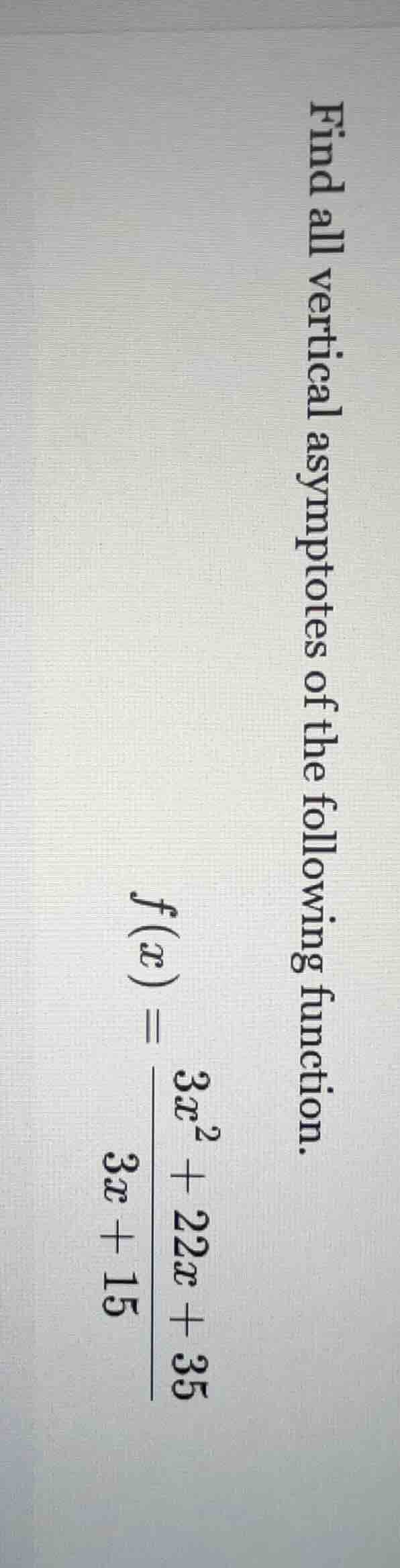
Question
find all vertical asymptotes of the following function.
$f(x) = \dfrac{3x^2 + 22x + 35}{3x + 15}$
Step1: Factor numerator and denominator
First, factor the numerator \(3x^{2}+22x + 35\) and the denominator \(3x + 15\).
For the numerator: \(3x^{2}+22x + 35\), we find two numbers that multiply to \(3\times35 = 105\) and add to \(22\). The numbers are \(15\) and \(7\). So,
\[
\]
For the denominator: \(3x+15 = 3(x + 5)\)
So the function \(f(x)=\frac{(3x + 7)(x + 5)}{3(x + 5)}\)
Step2: Simplify the function
We can cancel out the common factor \((x + 5)\) (for \(x
eq - 5\)), so \(f(x)=\frac{3x + 7}{3}\) (with a hole at \(x=-5\) since \(x = - 5\) makes the original denominator zero but is canceled out).
To find vertical asymptotes, we look for values of \(x\) that make the denominator of the simplified function (after canceling common factors) zero. But the simplified denominator is \(3\), which is never zero. Wait, but we made a mistake? Wait, no, let's re - check.
Wait, the original function is \(f(x)=\frac{3x^{2}+22x + 35}{3x + 15}\). After factoring, numerator is \((3x + 7)(x + 5)\) and denominator is \(3(x + 5)\). When we cancel \((x + 5)\), we have to note that \(x
eq - 5\). The simplified function is a linear function \(\frac{3x+7}{3}\), which has no vertical asymptotes because the denominator of the simplified function (after removing common factors) is a non - zero constant. But wait, maybe we made a mistake in factoring?
Wait, let's re - factor the numerator: \(3x^{2}+22x + 35\). The quadratic formula: for \(ax^{2}+bx + c\), \(x=\frac{-b\pm\sqrt{b^{2}-4ac}}{2a}\). Here, \(a = 3\), \(b = 22\), \(c = 35\). \(b^{2}-4ac=22^{2}-4\times3\times35=484 - 420 = 64\). So \(x=\frac{-22\pm8}{6}\). \(x=\frac{-22 + 8}{6}=\frac{-14}{6}=\frac{-7}{3}\) and \(x=\frac{-22-8}{6}=\frac{-30}{6}=-5\). So the numerator factors as \(3(x+\frac{7}{3})(x + 5)=(3x + 7)(x + 5)\), which is correct. Denominator is \(3(x + 5)\), correct.
Since the factor \((x + 5)\) is canceled out, there are no vertical asymptotes. The value \(x=-5\) is a hole, not a vertical asymptote.

Snap & solve any problem in the app
Get step-by-step solutions on Sovi AI
Photo-based solutions with guided steps
Explore more problems and detailed explanations
The function \(f(x)=\frac{3x^{2}+22x + 35}{3x + 15}\) has no vertical asymptotes (it has a hole at \(x = - 5\)).