QUESTION IMAGE
Question
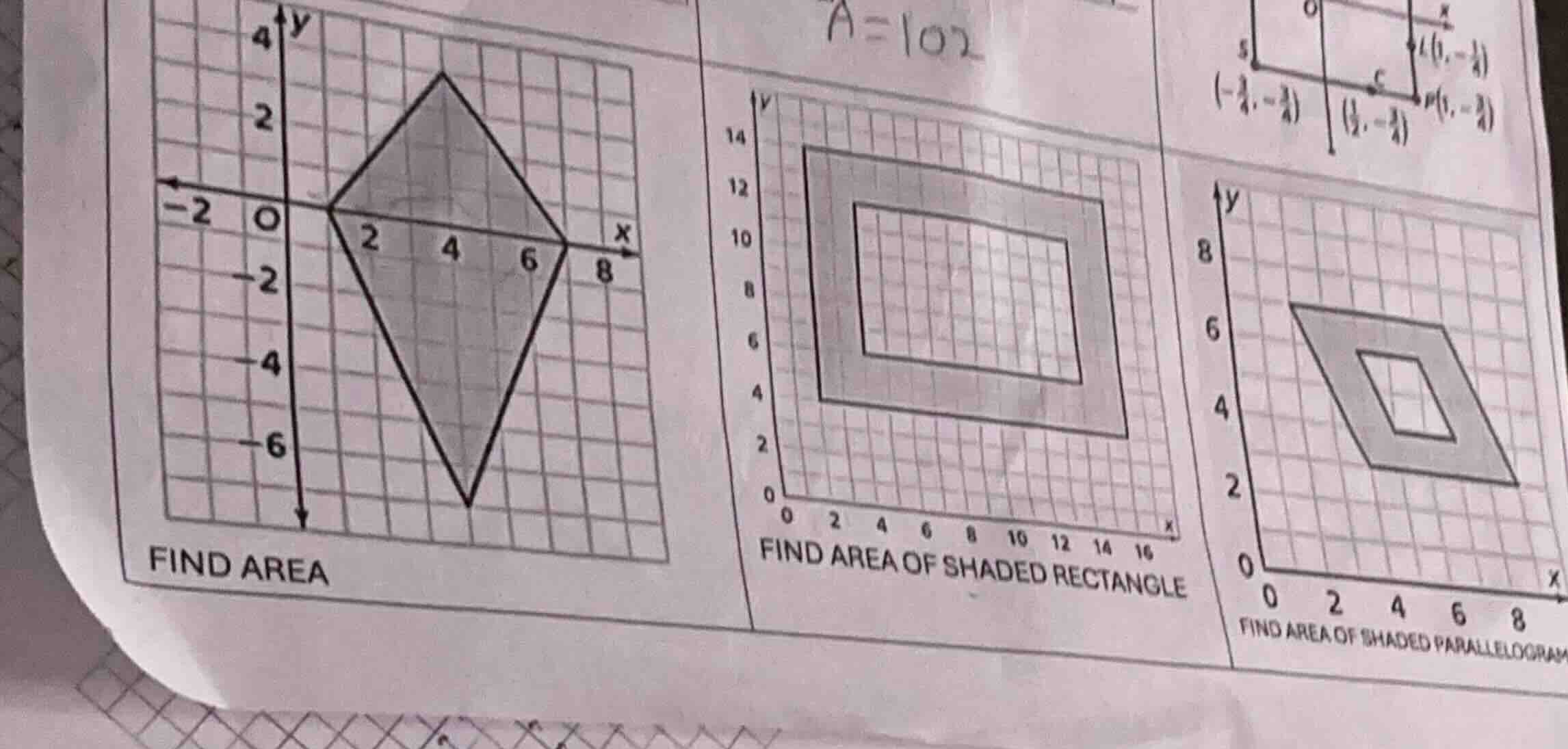
find area; find area of shaded rectangle; find area of shaded parallelogram
First Problem (Diamond/ Rhombus Area):
Step1: Identify diagonals' lengths
The diamond (rhombus) has diagonals. Let's find the length of the horizontal diagonal (along x - axis) and vertical diagonal (along y - axis).
From the graph, the horizontal diagonal \(d_1\): The points on the x - axis are at \(x = 1\) (wait, no, looking at the grid, the left vertex on x - axis is at \(x = 1\)? Wait, no, the diamond has vertices: let's see, the intersection with x - axis is at (1,0)? Wait, no, the grid: from the left, the diamond touches x - axis at (1,0)? Wait, no, the horizontal diagonal: the distance between the two x - intercepts. Wait, the right x - intercept is at \(x = 7\) (since the grid has x from - 2 to 8, and the diamond goes from x = 1 to x = 7? Wait, no, the horizontal diagonal length: let's count the units. From x = 1 to x = 7, that's \(7 - 1=6\)? Wait, no, maybe better: the vertical diagonal: from the top vertex (4,3) to the bottom vertex (4, - 7)? Wait, no, the top vertex is at (4,3) (since y = 3) and bottom at (4, - 7)? Wait, no, the grid: y from - 6 to 4. Wait, the top vertex is at (4,3) (y = 3) and bottom at (4, - 7)? No, the bottom vertex is at (4, - 7)? Wait, no, the vertical distance: from y = 3 to y=-7, that's \(3-(-7) = 10\)? Wait, no, maybe I made a mistake. Wait, the formula for the area of a rhombus is \(A=\frac{1}{2}\times d_1\times d_2\), where \(d_1\) and \(d_2\) are the lengths of the diagonals.
Looking at the first graph: the horizontal diagonal (let's call \(d_1\)): the distance between the two points where the rhombus meets the x - axis. Let's find the x - coordinates: the left point is at \(x = 1\) (since the grid has x = 1) and right at \(x = 7\), so \(d_1=7 - 1 = 6\). The vertical diagonal (\(d_2\)): the distance between the top vertex (4,3) and bottom vertex (4, - 7)? Wait, no, the top vertex is at (4,3) (y = 3) and bottom at (4, - 7)? No, the bottom vertex is at (4, - 7)? Wait, the y - coordinates: top is \(y = 3\), bottom is \(y=-7\)? Wait, no, the grid has y from - 6 to 4. Wait, the bottom vertex is at (4, - 7)? No, maybe the vertical diagonal length is from \(y = 3\) to \(y=-7\), but that can't be. Wait, maybe the top vertex is at (4,3) and bottom at (4, - 7)? No, the grid: the y - axis has marks at - 6, - 4, - 2,0,2,4. So the top vertex is at (4,3) (between y = 2 and y = 4, so y = 3) and bottom at (4, - 7)? No, the bottom vertex is at (4, - 7)? No, the grid goes down to y=-6. Wait, maybe the vertical diagonal is from y = 3 to y=-7, but that's 10 units? Wait, no, maybe I misread. Let's try again.
Wait, the first figure: the rhombus (diamond) has diagonals. The horizontal diagonal (length \(d_1\)): from x = 1 to x = 7, so \(d_1=6\) (since \(7 - 1 = 6\)). The vertical diagonal (length \(d_2\)): from y = 3 to y=-7? No, the top vertex is at (4,3) (y = 3) and bottom at (4, - 7)? No, the bottom vertex is at (4, - 7)? Wait, the grid: the y - axis has - 6 at the bottom. So maybe the bottom vertex is at (4, - 7)? No, the distance from y = 3 to y=-7 is 10, but that seems too long. Wait, maybe the vertical diagonal is from y = 3 to y=-7, but let's check the formula. The area of a rhombus is \(\frac{1}{2}\times d_1\times d_2\).
Wait, maybe the horizontal diagonal is from x = 1 to x = 7, so \(d_1 = 6\), and vertical diagonal from y = 3 to y=-7, \(d_2=10\). Then area \(A=\frac{1}{2}\times6\times10 = 30\). Wait, but let's count the grid squares. Each grid square is 1 unit. Let's see, the horizontal diagonal: from x = 1 to x = 7, that's 6 units (since 7 - 1 = 6). The vertical diagonal: from y = 3 to y=-7, that's 10 units (3 - (- 7)=10). Then area is \…
Step1: Find area of outer rectangle and inner rectangle
The shaded area is the area of the outer rectangle minus the area of the inner rectangle.
First, find the dimensions of the outer rectangle. From the graph, the outer rectangle has length \(L_1\) and width \(W_1\). Looking at the x - axis, from x = 1 to x = 15? Wait, no, the grid: x from 0 to 16, y from 0 to 14. The outer rectangle: left x = 1, right x = 15, bottom y = 3, top y = 14. So length \(L_1=15 - 1 = 14\), width \(W_1=14 - 3 = 11\)? Wait, no, better: the outer rectangle has length (along x) from x = 1 to x = 15, so length \(L_1 = 14\) (15 - 1), and height (along y) from y = 3 to y = 14, so height \(H_1=14 - 3 = 11\)? Wait, no, the outer rectangle: the top - left corner is at (1,14), bottom - right at (15,3). So length (x - direction): \(15 - 1=14\), height (y - direction): \(14 - 3 = 11\). Area of outer rectangle \(A_1=L_1\times H_1=14\times11 = 154\).
Now the inner rectangle: top - left corner at (5,12), bottom - right at (13,5). So length (x - direction): \(13 - 5 = 8\), height (y - direction): \(12 - 5 = 7\). Area of inner rectangle \(A_2=8\times7 = 56\).
Step2: Calculate shaded area
Shaded area \(A = A_1 - A_2\).
\(A=154 - 56 = 98\).
Step1: Find area of outer parallelogram and inner parallelogram
The shaded area is the area of the outer parallelogram minus the area of the inner parallelogram.
For a parallelogram, area \(A = base\times height\).
First, outer parallelogram: let's find the base and height. The base (along x - direction): from x = 4 to x = 9, so base \(b_1=9 - 4 = 5\). The height: the vertical distance between the two horizontal sides. Looking at the y - axis, from y = 3 to y = 7, so height \(h_1=7 - 3 = 4\). Wait, no, the outer parallelogram: the base is the length of the side, and height is the perpendicular distance. Alternatively, count the grid squares. The outer parallelogram has a base of 5 units (from x = 4 to x = 9) and height of 4 units (from y = 3 to y = 7). So area of outer parallelogram \(A_1=5\times4 = 20\).
Inner parallelogram: base \(b_2=2\) units (from x = 5 to x = 7) and height \(h_2=2\) units (from y = 4 to y = 6). So area of inner parallelogram \(A_2=2\times2 = 4\).
Step2: Calculate shaded area
Shaded area \(A = A_1 - A_2\).
\(A=20 - 4 = 16\).

Snap & solve any problem in the app
Get step-by-step solutions on Sovi AI
Photo-based solutions with guided steps
Explore more problems and detailed explanations
30