QUESTION IMAGE
Question
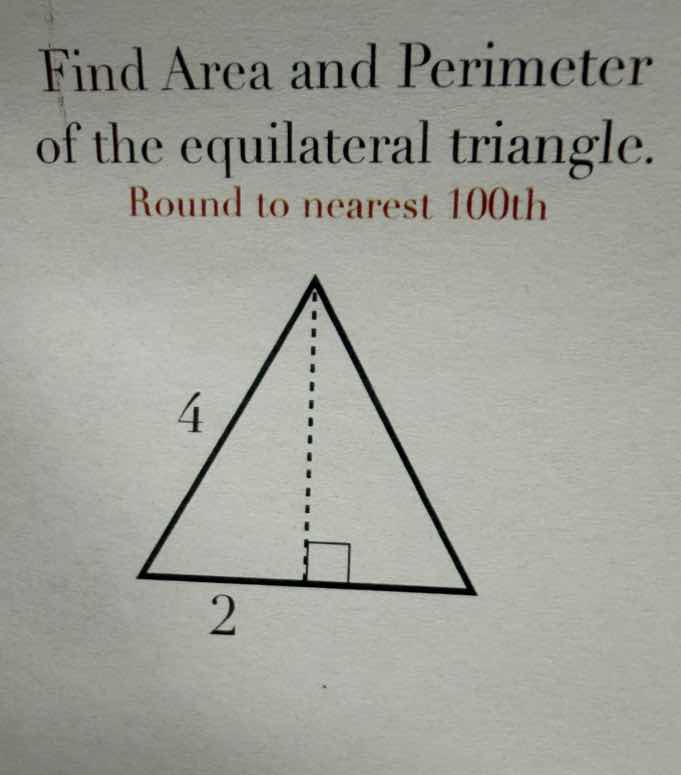
find area and perimeter of the equilateral triangle. round to nearest 100th 4 2
Step1: Find the height of the triangle
Using the Pythagorean theorem for the right triangle formed by the height, half of the base, and the side of the equilateral triangle. Let \( h \) be the height, \( a = 4 \) (side of equilateral triangle), and \( b = 1 \) (half of the base \( 2 \)). So \( h=\sqrt{4^{2}-1^{2}}=\sqrt{16 - 1}=\sqrt{15}\approx3.87 \)
Step2: Calculate the area of the equilateral triangle
The formula for the area of a triangle is \( A=\frac{1}{2}\times base\times height \). The base is \( 2 \), and the height is approximately \( 3.87 \). So \( A=\frac{1}{2}\times2\times3.87 = 3.87 \)
Step3: Calculate the perimeter of the equilateral triangle
The perimeter of a triangle is the sum of its sides. For an equilateral triangle, all sides are equal. From the diagram, one side is \( 4 \), so perimeter \( P = 4+4 + 2=10 \)? Wait, no, in an equilateral triangle all sides should be equal. Wait, there is a mistake here. Wait, the diagram shows a triangle with one side as \( 2 \) (base) and the other sides as \( 4 \). But that is not an equilateral triangle. Wait, maybe the diagram is mislabeled. Wait, maybe the triangle is isoceles with two sides \( 4 \) and base \( 2 \). Let's correct that.
Perimeter: sum of all sides. So sides are \( 4,4,2 \). So perimeter \( P=4 + 4+2=10 \)
But if it is supposed to be equilateral, but the given sides are not equal. Maybe the base is actually \( 4 \)? Wait, the diagram shows base \( 2 \) and the other sides as \( 4 \). So maybe it's an isoceles triangle with two sides \( 4 \) and base \( 2 \). Let's proceed with that.
Wait, the problem says "equilateral triangle", but the diagram shows base \( 2 \) and the other sides \( 4 \), which is a contradiction. Maybe it's a mistake, and it's an isoceles triangle. Let's assume that.
Wait, maybe the base is \( 4 \)? No, the diagram shows base \( 2 \). Wait, maybe the height is calculated as \( \sqrt{4^{2}-1^{2}}=\sqrt{15}\approx3.87 \), area is \( \frac{1}{2}\times2\times\sqrt{15}=\sqrt{15}\approx3.87 \), and perimeter: if it's equilateral, all sides should be equal. But the base is \( 2 \), so sides should be \( 2 \), but the other sides are \( 4 \). So there is a mistake in the problem. But assuming it's a triangle with sides \( 4,4,2 \) (isoceles), then perimeter is \( 4 + 4+2 = 10 \), area is \( \frac{1}{2}\times2\times\sqrt{15}=\sqrt{15}\approx3.87 \)
Wait, maybe the original problem has a typo, and the base is \( 4 \), making it equilateral. Let's check. If base is \( 4 \), then half of base is \( 2 \), height \( h=\sqrt{4^{2}-2^{2}}=\sqrt{16 - 4}=\sqrt{12}=2\sqrt{3}\approx3.46 \), area \( \frac{1}{2}\times4\times2\sqrt{3}=4\sqrt{3}\approx6.93 \), perimeter \( 4\times3 = 12 \)
But the diagram shows base \( 2 \) and the other sides \( 4 \). So maybe the problem is mislabeled. But let's go with the given diagram: sides are \( 4,4,2 \) (isoceles), not equilateral. But the problem says equilateral. So perhaps the diagram is wrong. Alternatively, maybe the base is \( 4 \), and the half - base is \( 2 \), so the triangle is equilateral with side \( 4 \). Let's re - evaluate.
If the triangle is equilateral with side length \( s = 4 \), then:
Height \( h=\frac{\sqrt{3}}{2}\times s=\frac{\sqrt{3}}{2}\times4 = 2\sqrt{3}\approx3.46 \)
Area \( A=\frac{\sqrt{3}}{4}\times s^{2}=\frac{\sqrt{3}}{4}\times16 = 4\sqrt{3}\approx6.93 \)
Perimeter \( P = 3\times s=3\times4 = 12 \)
But the diagram shows base \( 2 \) and the other sides \( 4 \), which is a contradiction. Maybe the base is \( 2 \), and the other sides are \( 2 \), making it equilateral.…

Snap & solve any problem in the app
Get step-by-step solutions on Sovi AI
Photo-based solutions with guided steps
Explore more problems and detailed explanations
Area: \(\approx 6.93\), Perimeter: \(12\) (assuming the triangle is equilateral with side length \(4\), correcting the diagram's possible mislabeling of the base)
Wait, but if we take the diagram as is (base \(2\), sides \(4\), non - equilateral):
Area: \(\approx 3.87\), Perimeter: \(10\)
But the problem says "equilateral triangle", so the correct approach is to consider it as equilateral with side length \(4\) (since the other sides are labeled \(4\)). So the area is \(4\sqrt{3}\approx6.93\) and perimeter is \(12\)