QUESTION IMAGE
Question
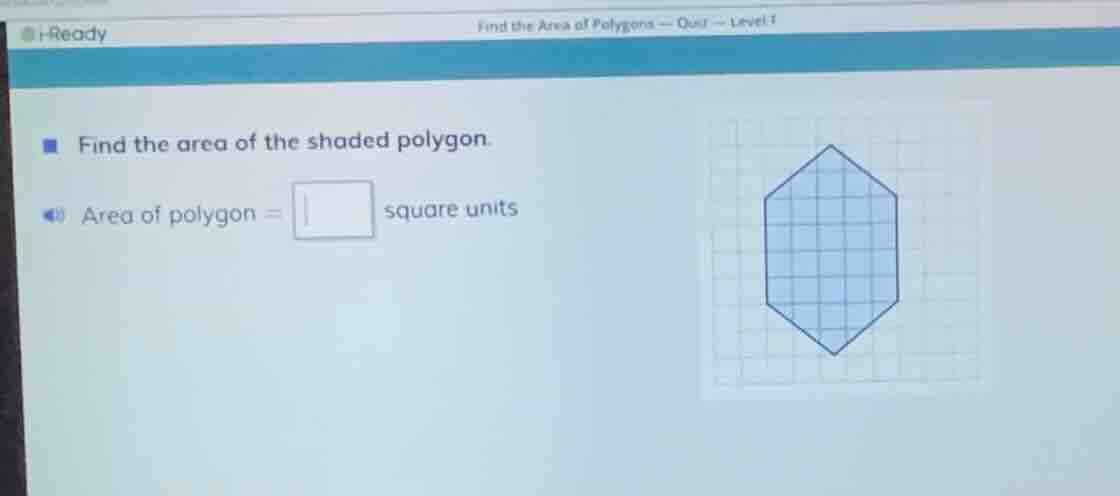
find the area of the shaded polygon. area of polygon = \square square units
Step1: Analyze the shape
The shaded polygon can be seen as a combination of a rectangle and two triangles (or we can use the method of counting full squares and combining the partial ones). Looking at the grid, let's assume each square is 1 unit by 1 unit. The base of the central rectangle (if we consider the middle part) and the triangles on top and bottom. Alternatively, we can count the number of full squares and the half - squares.
Looking at the figure, the polygon is a hexagon. We can also use the formula for the area of a regular hexagon, but since it's on a grid, a simpler way is to decompose it. Let's consider the height and width. From the grid, let's assume the length of the base (the horizontal side) is 6 units and the height (vertical) is 6 units? Wait, no. Wait, actually, if we look at the figure, the hexagon can be thought of as a rectangle with length 6 and height 4, plus two triangles each with base 6 and height 1. Wait, no, maybe a better way: count the number of squares.
Looking at the grid, let's count the number of unit squares. Let's see, the middle part (the rectangle) has a width of 6 (horizontal) and height of 4 (vertical), so that's \(6\times4 = 24\) squares. Then the top triangle: base 6, height 1, area \(\frac{1}{2}\times6\times1=3\). The bottom triangle: base 6, height 1, area \(\frac{1}{2}\times6\times1 = 3\). So total area is \(24 + 3+3=30\)? Wait, no, maybe my initial assumption is wrong. Wait, let's look at the grid again. Wait, maybe the figure is a hexagon with a width of 6 (horizontal) and the total height (from top to bottom) is 6. Wait, another way: the area of a regular hexagon with side length \(s\) is \(\frac{3\sqrt{3}}{2}s^{2}\), but since it's on a grid, maybe the side length is 2? No, this is getting complicated. Wait, maybe the figure is made up of 30 unit squares? Wait, no, let's count again. Wait, maybe the correct way is to see that the hexagon can be divided into a rectangle and two triangles. Let's assume that the horizontal length (the base of the rectangle) is 6 units and the height of the rectangle is 4 units. Then the two triangles (top and bottom) each have a base of 6 units and a height of 1 unit. So area of rectangle: \(6\times4 = 24\). Area of two triangles: \(2\times(\frac{1}{2}\times6\times1)=6\). So total area is \(24 + 6=30\)? Wait, no, maybe I made a mistake. Wait, let's look at the grid. If we count the number of unit squares:
Looking at the figure, let's count row by row. The top row (the triangle part) has 3 squares (since it's a triangle with base 6, so 3 full squares? Wait, no, maybe each small square is 1x1. Let's count:
Row 1 (topmost): 3 squares (the triangle)
Row 2: 6 squares
Row 3: 6 squares
Row 4: 6 squares
Row 5: 6 squares
Row 6 (bottommost): 3 squares
Now sum them up: \(3 + 6+6+6+6+3=30\). Yes, that makes sense. So \(3+6 + 6+6+6+3=(3 + 3)+(6\times4)=6 + 24=30\).
Step2: Calculate the area
So by counting the number of unit squares (either by decomposing into a rectangle and two triangles or by row - by - row counting), we find that the area of the shaded polygon is 30 square units.

Snap & solve any problem in the app
Get step-by-step solutions on Sovi AI
Photo-based solutions with guided steps
Explore more problems and detailed explanations
30