QUESTION IMAGE
Question
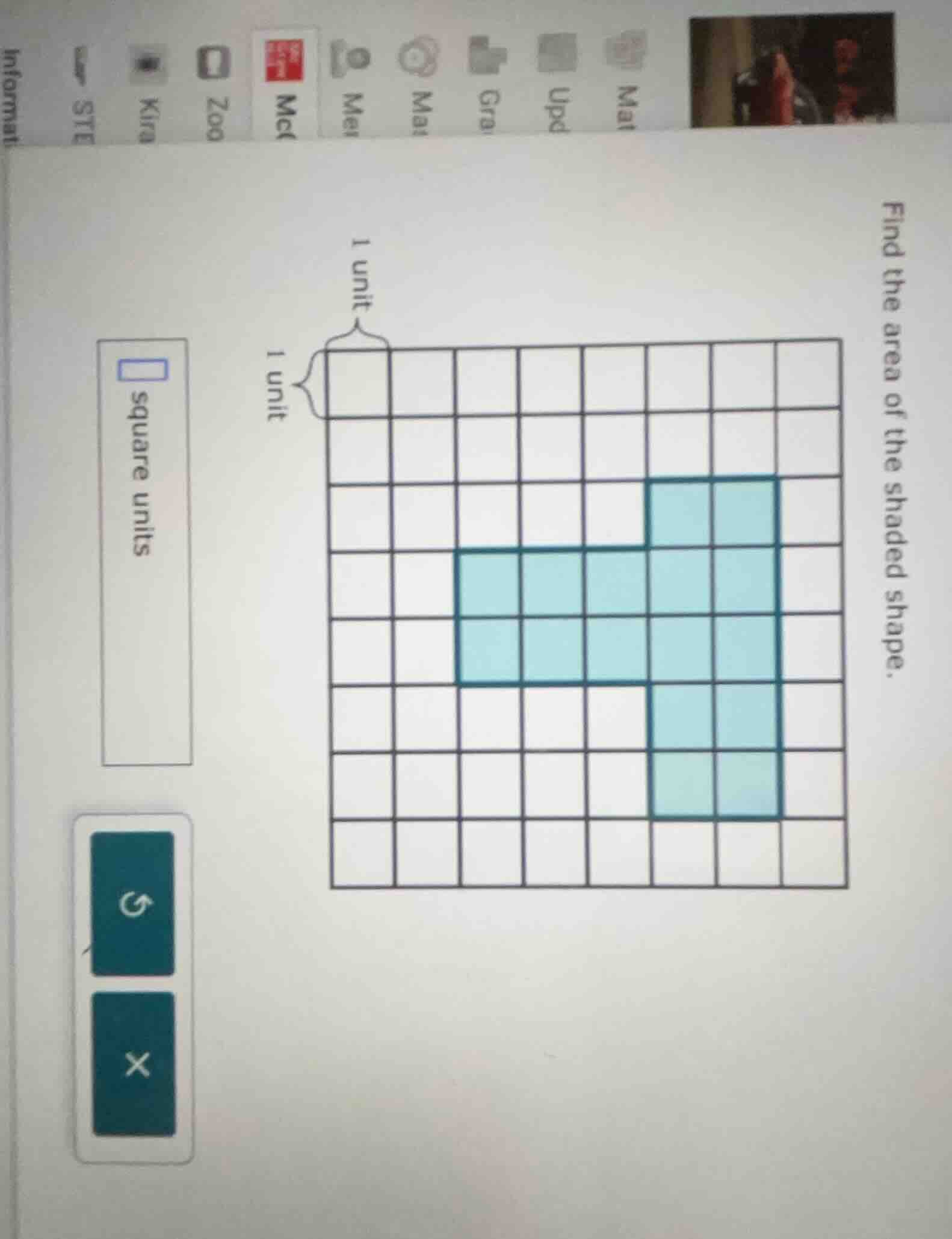
find the area of the shaded shape. square units
Step1: Count the number of shaded squares in each row.
- Row 1 (top - most shaded row): 2 squares.
- Row 2: 5 squares.
- Row 3: 5 squares.
- Row 4: 2 squares.
- Row 5: 2 squares. Wait, no, let's re - examine the grid. Wait, actually, let's count the shaded cells properly. Let's list the number of shaded cells in each horizontal row (from top to bottom of the shaded region):
First, the top - most shaded row (let's say row 1 of the shaded part): 2 cells.
Second row: 5 cells.
Third row: 5 cells.
Fourth row: 2 cells? No, wait, maybe a better way is to count the number of shaded squares by looking at the grid. Each square has an area of 1 square unit (since each side is 1 unit, area of a square is \(1\times1 = 1\) square unit).
Let's count the shaded squares:
Looking at the grid, the shaded region:
- The top - most part (first horizontal layer of shaded): 2 squares.
- Then a middle part with two rows of 5 squares each: \(2\times5=10\)
- Then a bottom part with two rows of 2 squares each? Wait, no, let's count again. Wait, maybe I made a mistake. Let's count the number of shaded squares one by one.
Wait, let's look at the columns. Let's see the x - coordinates (horizontal) and y - coordinates (vertical).
Alternatively, let's count the number of shaded cells:
First, the top two squares (in the right - upper part), then a block of 5x2 (5 columns, 2 rows), then a block of 2x2 (2 columns, 2 rows)? No, let's count:
Wait, the correct way is:
Looking at the grid, the shaded squares:
- Row 1 (shaded, top): 2 squares.
- Row 2 (shaded): 5 squares.
- Row 3 (shaded): 5 squares.
- Row 4 (shaded): 2 squares.
- Row 5 (shaded): 2 squares? No, that can't be. Wait, maybe I miscounted. Let's do it step by step.
Wait, let's count the number of shaded cells:
First, the top - most shaded row (let's index the rows from top to bottom of the entire grid, but the shaded part is in the middle - right). Let's list the number of shaded cells in each row (of the entire grid) that has shaded cells:
- Row 3 (of the entire grid, assuming the grid has rows numbered from top as row 1): 2 shaded cells.
- Row 4: 5 shaded cells.
- Row 5: 5 shaded cells.
- Row 6: 2 shaded cells.
- Row 7: 2 shaded cells? No, this is getting confusing. Wait, let's use a better approach. Let's count the total number of shaded squares.
Looking at the grid, the shaded region can be divided into parts:
- A rectangle of 5 columns and 2 rows: \(5\times2 = 10\)
- A rectangle of 2 columns and 2 rows: \(2\times2=4\)
- A rectangle of 2 columns and 2 rows: \(2\times2 = 4\)? No, that's not right. Wait, no, let's count the number of shaded squares:
Wait, let's count:
Top - most shaded: 2
Then a middle block: 5 + 5=10
Then bottom - most shaded: 2+2 = 4
Total: \(2 + 10+4=16\)? Wait, no, let's count again. Wait, maybe I made a mistake. Let's count the number of shaded squares by looking at the image:
Looking at the grid, the shaded squares:
- First, the two squares on the top (right - upper), then a block of 5 squares in the next row, then 5 in the row below that, then 2 in the next row, then 2 in the bottom - most shaded row. Wait, 2+5 + 5+2+2=16? Wait, no, 2+5=7, 7 + 5=12, 12+2=14, 14 + 2=16. Wait, but let's check again.
Wait, another way: each small square has area 1. Let's count the number of shaded small squares.
Looking at the grid:
- The top - most shaded row (horizontal) has 2 squares.
- The next two rows (middle) have 5 squares each: \(2\times5 = 10\)
- The bottom two rows have 2 squares each: \(2\times2=4\)
Total: \(2 + 10+4=16\). Wait, but let's count the…

Snap & solve any problem in the app
Get step-by-step solutions on Sovi AI
Photo-based solutions with guided steps
Explore more problems and detailed explanations
16 square units