QUESTION IMAGE
Question
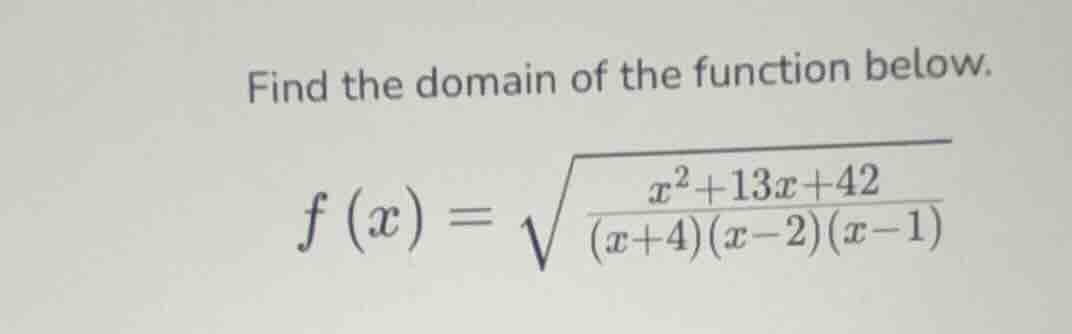
find the domain of the function below.
$f(x) = \sqrt{\frac{x^2 + 13x + 42}{(x + 4)(x - 2)(x - 1)}}$
Step1: Factor the numerator
First, factor the quadratic expression in the numerator: \(x^{2}+13x + 42=(x + 6)(x+7)\)
So the function becomes \(f(x)=\sqrt{\frac{(x + 6)(x + 7)}{(x + 4)(x - 2)(x - 1)}}\)
Step2: Determine the conditions for the square root
For the square root to be defined, the expression inside the square root must be non - negative, i.e., \(\frac{(x + 6)(x + 7)}{(x + 4)(x - 2)(x - 1)}\geq0\) and also the denominator \((x + 4)(x - 2)(x - 1)
eq0\) (since division by zero is not allowed).
Analyze the denominator:
The denominator \((x + 4)(x - 2)(x - 1)=0\) when \(x=-4\), \(x = 2\) or \(x=1\). So these values are excluded from the domain.
Analyze the sign of the rational function:
We find the critical points by setting the numerator and denominator equal to zero. The critical points are \(x=-7\), \(x=-6\), \(x=-4\), \(x = 1\), \(x=2\)
We divide the real number line into intervals based on these critical points:
- Interval \((-\infty,-7)\):
Choose a test point \(x=-8\). Then \((-8 + 6)(-8 + 7)=(-2)\times(-1) = 2>0\) and \((-8 + 4)(-8 - 2)(-8 - 1)=(-4)\times(-10)\times(-9)=-360<0\). So \(\frac{(x + 6)(x + 7)}{(x + 4)(x - 2)(x - 1)}=\frac{2}{-360}<0\)
- Interval \((-7,-6)\):
Choose a test point \(x=-6.5\). Then \((-6.5 + 6)(-6.5 + 7)=(-0.5)\times(0.5)=-0.25<0\) and \((-6.5 + 4)(-6.5 - 2)(-6.5 - 1)=(-2.5)\times(-8.5)\times(-7.5)=-159.375<0\). So \(\frac{(x + 6)(x + 7)}{(x + 4)(x - 2)(x - 1)}=\frac{-0.25}{-159.375}>0\)
- Interval \((-6,-4)\):
Choose a test point \(x=-5\). Then \((-5 + 6)(-5 + 7)=(1)\times(2)=2>0\) and \((-5 + 4)(-5 - 2)(-5 - 1)=(-1)\times(-7)\times(-6)=-42<0\). So \(\frac{(x + 6)(x + 7)}{(x + 4)(x - 2)(x - 1)}=\frac{2}{-42}<0\)
- Interval \((-4,1)\):
Choose a test point \(x = 0\). Then \((0+6)(0 + 7)=42>0\) and \((0 + 4)(0 - 2)(0 - 1)=(4)\times(-2)\times(-1)=8>0\). So \(\frac{(x + 6)(x + 7)}{(x + 4)(x - 2)(x - 1)}=\frac{42}{8}>0\)
- Interval \((1,2)\):
Choose a test point \(x = 1.5\). Then \((1.5+6)(1.5 + 7)=(7.5)\times(8.5)=63.75>0\) and \((1.5 + 4)(1.5 - 2)(1.5 - 1)=(5.5)\times(-0.5)\times(0.5)=-1.375<0\). So \(\frac{(x + 6)(x + 7)}{(x + 4)(x - 2)(x - 1)}=\frac{63.75}{-1.375}<0\)
- Interval \((1,2)\):
Wait, we already considered \((-4,1)\), now interval \((1,2)\):
Choose a test point \(x = 1.5\) (wait, \(x = 1.5\) is in \((1,2)\)). Wait, let's re - choose. Let \(x=1.5\) is in \((1,2)\). \((1.5 + 6)(1.5+7)=7.5\times8.5 = 63.75>0\), \((1.5 + 4)(1.5 - 2)(1.5 - 1)=(5.5)\times(-0.5)\times(0.5)=-1.375<0\), so the fraction is negative.
- Interval \((2,\infty)\):
Choose a test point \(x = 3\). Then \((3+6)(3 + 7)=9\times10 = 90>0\) and \((3 + 4)(3 - 2)(3 - 1)=(7)\times(1)\times(2)=14>0\). So \(\frac{(x + 6)(x + 7)}{(x + 4)(x - 2)(x - 1)}=\frac{90}{14}>0\)
Also, we check the values at the critical points:
- At \(x=-7\): \(\frac{(-7 + 6)(-7 + 7)}{(-7 + 4)(-7 - 2)(-7 - 1)}=\frac{(-1)\times0}{(-3)\times(-9)\times(-8)} = 0\)
- At \(x=-6\): \(\frac{(-6 + 6)(-6 + 7)}{(-6 + 4)(-6 - 2)(-6 - 1)}=\frac{0\times1}{(-2)\times(-8)\times(-7)}=0\)
The expression inside the square root is non - negative when \(x\in[-7,-6]\cup(-4,1)\cup(2,\infty)\) (we include \(x = - 7\) and \(x=-6\) because the numerator is zero there, making the whole expression zero, which is allowed under the square root, and we exclude \(x=-4\), \(x = 1\), \(x = 2\) because the denominator is zero there)

Snap & solve any problem in the app
Get step-by-step solutions on Sovi AI
Photo-based solutions with guided steps
Explore more problems and detailed explanations
The domain of the function is \([-7,-6]\cup(-4,1)\cup(2,\infty)\)