QUESTION IMAGE
Question
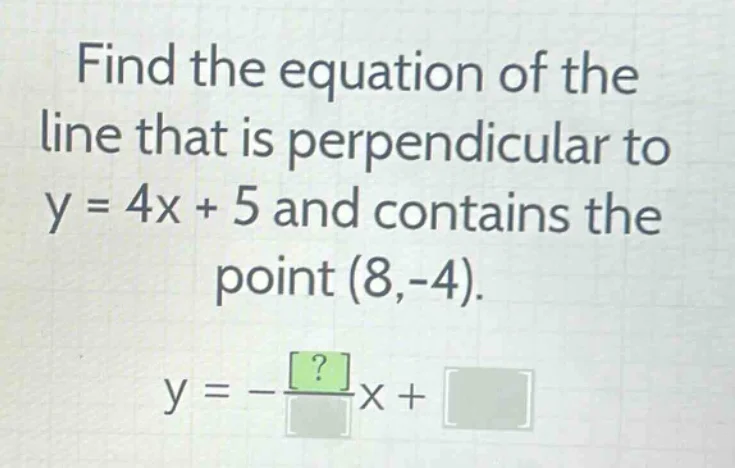
find the equation of the line that is perpendicular to y = 4x + 5 and contains the point (8,-4). y = -\frac{?}{?}x + square
Step1: Find the slope of the perpendicular line
The slope of the given line \( y = 4x + 5 \) is \( m_1 = 4 \). For two perpendicular lines, the product of their slopes is \( -1 \), i.e., \( m_1 \times m_2=-1 \). Let the slope of the perpendicular line be \( m_2 \). So, \( 4\times m_2=-1 \), which gives \( m_2 = -\frac{1}{4} \). In the form \( y = -\frac{a}{b}x + c \), comparing with \( m_2 = -\frac{1}{4} \), we have \( a = 1 \) and \( b = 4 \).
Step2: Find the y - intercept
We know the slope \( m_2=-\frac{1}{4} \) and the line passes through the point \( (8,-4) \). Using the slope - intercept form \( y = mx + c \), substitute \( x = 8 \), \( y=-4 \) and \( m = -\frac{1}{4} \) into it:
\( -4=-\frac{1}{4}\times8 + c \)
First, calculate \( -\frac{1}{4}\times8=-2 \). Then the equation becomes \( -4=-2 + c \).
To solve for \( c \), add 2 to both sides: \( c=-4 + 2=-2 \).

Snap & solve any problem in the app
Get step-by-step solutions on Sovi AI
Photo-based solutions with guided steps
Explore more problems and detailed explanations
In the equation \( y = -\frac{\boldsymbol{1}}{\boldsymbol{4}}x+\boldsymbol{(-2)} \) (or \( y = -\frac{1}{4}x - 2 \)), the numerator of the fraction is \( 1 \), the denominator is \( 4 \), and the constant term is \( - 2 \). So the filled - in form is \( y = -\frac{\boldsymbol{1}}{4}x+\boldsymbol{(-2)} \) (or \( y = -\frac{1}{4}x - 2 \)).