QUESTION IMAGE
Question
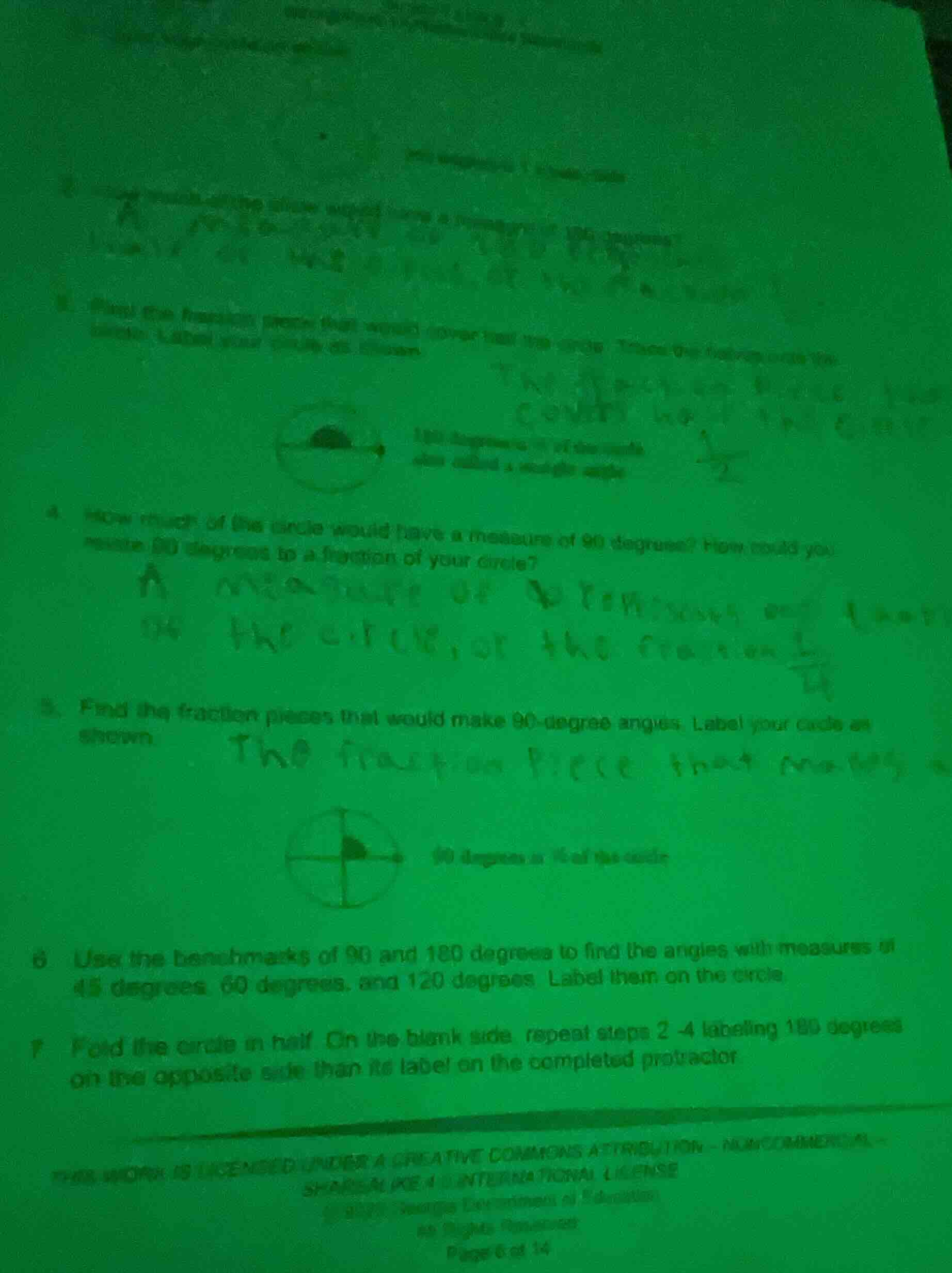
- find the fraction piece that would cover half the circle. trace the fraction on the circle. label your circle as shown.
- how much of the circle would have a measure of 90 degrees? how would you write 90 degrees as a fraction of your circle?
- find the fraction pieces that would make 90 - degree angles. label your circle as shown.
- use the benchmarks of 90 and 180 degrees to find the angles with measures of 45 degrees, 60 degrees, and 120 degrees. label them on the circle.
- fold the circle in half. on the blank side, repeat steps 2 - 4 labelling 180 degrees on the opposite side than its label on the completed protractor.
Question 4:
Step1: Recall the total degrees in a circle
A full circle has \( 360^\circ \).
Step2: Calculate the fraction for \( 90^\circ \)
To find the fraction of the circle that \( 90^\circ \) represents, we divide \( 90^\circ \) by \( 360^\circ \). So the fraction is \( \frac{90}{360} \).
Step3: Simplify the fraction
Simplify \( \frac{90}{360} \) by dividing both the numerator and the denominator by their greatest common divisor, which is 90. \( \frac{90\div90}{360\div90}=\frac{1}{4} \).
Step1: Recall the fraction for \( 90^\circ \)
From question 4, we know that \( 90^\circ \) is \( \frac{1}{4} \) of a full circle (\( 360^\circ \)).
Step2: Determine the fraction pieces
To make \( 90^\circ \) angles, we need to divide the circle into parts where each part is \( \frac{1}{4} \) of the circle (since \( 90^\circ=\frac{1}{4}\times360^\circ \)). So the fraction pieces are \( \frac{1}{4} \) of the circle. When we divide the circle into 4 equal parts (by drawing two perpendicular diameters, like a plus sign in the circle), each part will have a central angle of \( 90^\circ \).
Step1: Analyze \( 45^\circ \)
We know that \( 90^\circ \) is a benchmark. \( 45^\circ \) is half of \( 90^\circ \). So to find \( 45^\circ \), we can bisect a \( 90^\circ \) angle. If we have a \( 90^\circ \) sector (from question 4 or 5), we can divide it into two equal parts, and each part will be \( 45^\circ \).
Step2: Analyze \( 60^\circ \)
We know that a full circle is \( 360^\circ \), and an equilateral triangle has internal angles of \( 60^\circ \). Also, we can use the relationship with \( 90^\circ \) and \( 180^\circ \). Since \( 180^\circ \) is a straight angle (half of the circle), and \( 60^\circ=\frac{1}{3}\times180^\circ \). So we can divide the semicircle (\( 180^\circ \)) into 3 equal parts, each part will be \( 60^\circ \).
Step3: Analyze \( 120^\circ \)
\( 120^\circ = 180^\circ - 60^\circ \), or \( 120^\circ=\frac{2}{3}\times180^\circ \). We can also think of it as \( 90^\circ+ 30^\circ \), but more simply, since \( 120^\circ=\frac{1}{3}\times360^\circ \) (because \( 360\div3 = 120 \)) or as \( 180 - 60 \). To label \( 120^\circ \), we can find a \( 60^\circ \) angle and then the supplementary angle to it (with respect to \( 180^\circ \)) will be \( 120^\circ \), or we can divide the circle into 3 equal parts (each \( 120^\circ \)) or use the \( 90^\circ \) and \( 30^\circ \) (but \( 30^\circ \) can be derived from \( 90^\circ\div3 \)) to build up \( 120^\circ=90 + 30 \).

Snap & solve any problem in the app
Get step-by-step solutions on Sovi AI
Photo-based solutions with guided steps
Explore more problems and detailed explanations
The measure of \( 90^\circ \) is \( \frac{1}{4} \) of the circle.