QUESTION IMAGE
Question
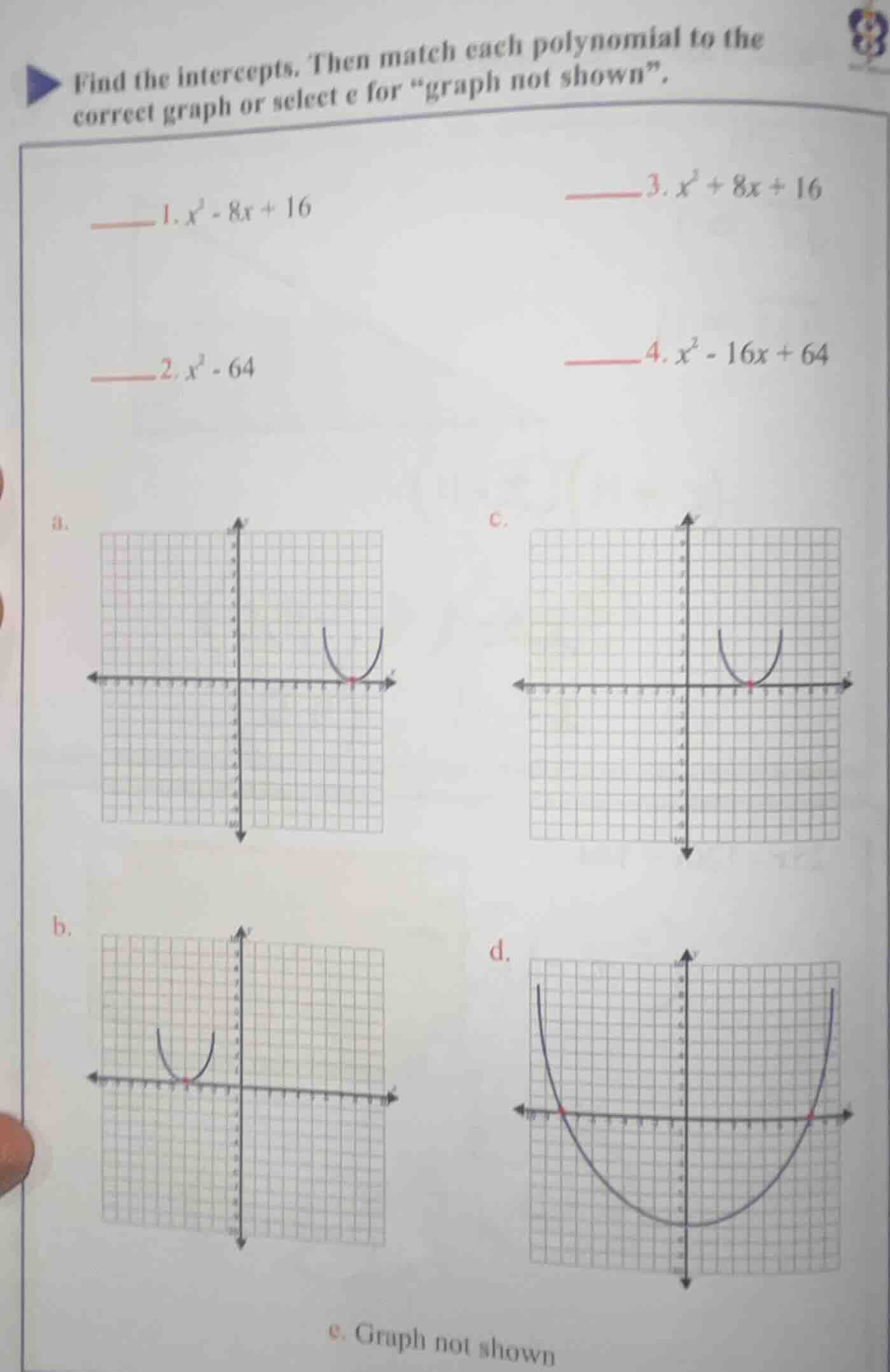
find the intercepts. then match each polynomial to the correct graph or select e for \graph not shown\.
______1. (x^2 - 8x + 16)
______2. (x^2 - 64)
______3. (x^2 + 8x + 16)
______4. (x^2 - 16x + 64)
(images of graphs labeled a, b, c, d and option e: graph not shown)
Problem 1: \( y = x^2 - 8x + 16 \)
Step 1: Find the x - intercepts
Set \( y = 0 \), so we have the equation \( x^2 - 8x + 16=0 \). Notice that this is a perfect square trinomial, since \( x^2 - 8x + 16=(x - 4)^2 \). Setting \( (x - 4)^2 = 0 \), we get \( x=4 \) (a repeated root).
Step 2: Find the y - intercept
Set \( x = 0 \), then \( y=0^2-8\times0 + 16 = 16 \).
Step 3: Match the graph
The parabola has a vertex at \( x = 4 \) (from the vertex form \( y=(x - 4)^2 \)) and \( y \) - intercept at \( y = 16 \)? Wait, no, when \( x = 4 \), \( y = 0 \). Wait, let's re - calculate the vertex. For a quadratic \( y=ax^2+bx + c \), the x - coordinate of the vertex is \( x=-\frac{b}{2a} \). For \( y=x^2-8x + 16 \), \( a = 1 \), \( b=-8 \), so \( x=-\frac{-8}{2\times1}=4 \), and \( y=(4)^2-8\times4 + 16=16-32 + 16 = 0 \). So the vertex is at \( (4,0) \), and the y - intercept is at \( (0,16) \). Looking at the graphs, graph a has a vertex at \( x = 8 \)? Wait, maybe I misread. Wait, let's check the graphs again. Wait, graph a: the vertex is at \( x = 8 \)? No, maybe the first graph (a) has vertex at \( x = 8 \)? Wait, no, let's re - do the factoring. \( x^2-8x + 16=(x - 4)^2 \), so the vertex is at \( (4,0) \). Wait, maybe the graph labeled 'a' has vertex at \( x = 8 \)? No, perhaps I made a mistake. Wait, let's check the second polynomial first.
Problem 2: \( y=x^2 - 64 \)
Step 1: Find the x - intercepts
Set \( y = 0 \), so \( x^2-64 = 0 \). This is a difference of squares, \( x^2-64=(x - 8)(x + 8) \). Setting \( (x - 8)(x + 8)=0 \), we get \( x = 8 \) or \( x=-8 \).
Step 2: Find the y - intercept
Set \( x = 0 \), then \( y=0^2-64=-64 \).
Step 3: Match the graph
The parabola \( y=x^2-64 \) opens upwards (since \( a = 1>0 \)) and has x - intercepts at \( x = 8 \) and \( x=-8 \), and y - intercept at \( y=-64 \). This matches graph d, which has two x - intercepts, one at \( x=-8 \) and one at \( x = 8 \) (approximately, from the grid) and opens upwards.
Problem 3: \( y=x^2 + 8x + 16 \)
Step 1: Find the x - intercepts
Set \( y = 0 \), so \( x^2+8x + 16 = 0 \). This is a perfect square trinomial, \( x^2+8x + 16=(x + 4)^2 \). Setting \( (x + 4)^2=0 \), we get \( x=-4 \) (a repeated root).
Step 2: Find the y - intercept
Set \( x = 0 \), then \( y=0^2+8\times0 + 16 = 16 \).
Step 3: Match the graph
The vertex of the parabola \( y=(x + 4)^2 \) is at \( x=-4 \), \( y = 0 \). Looking at the graphs, graph b has a vertex at \( x=-4 \) (from the grid, the vertex is at \( x=-4 \) approximately) and opens upwards.
Problem 4: \( y=x^2-16x + 64 \)

Snap & solve any problem in the app
Get step-by-step solutions on Sovi AI
Photo-based solutions with guided steps
Explore more problems and detailed explanations
- For \( x^2 - 8x + 16 \): The x - intercept is \( x = 4 \) (repeated), y - intercept is \( y = 16 \). The graph with vertex at \( (4,0) \) (assuming graph a? Wait, maybe I had a mix - up earlier. Wait, let's re - assign:
- 1. \( x^2 - 8x + 16=(x - 4)^2 \), vertex at \( (4,0) \), so it should match graph a (if graph a has vertex at \( x = 4 \)).
- 2. \( x^2 - 64=(x - 8)(x + 8) \), x - intercepts at \( x=-8 \) and \( x = 8 \), y - intercept at \( y=-64 \), matches graph d.
- 3. \( x^2 + 8x + 16=(x + 4)^2 \), vertex at \( (-4,0) \), matches graph b.
- 4. \( x^2 - 16x + 64=(x - 8)^2 \), vertex at \( (8,0) \), matches graph c.
So:
- a
- d
- b
- c