QUESTION IMAGE
Question
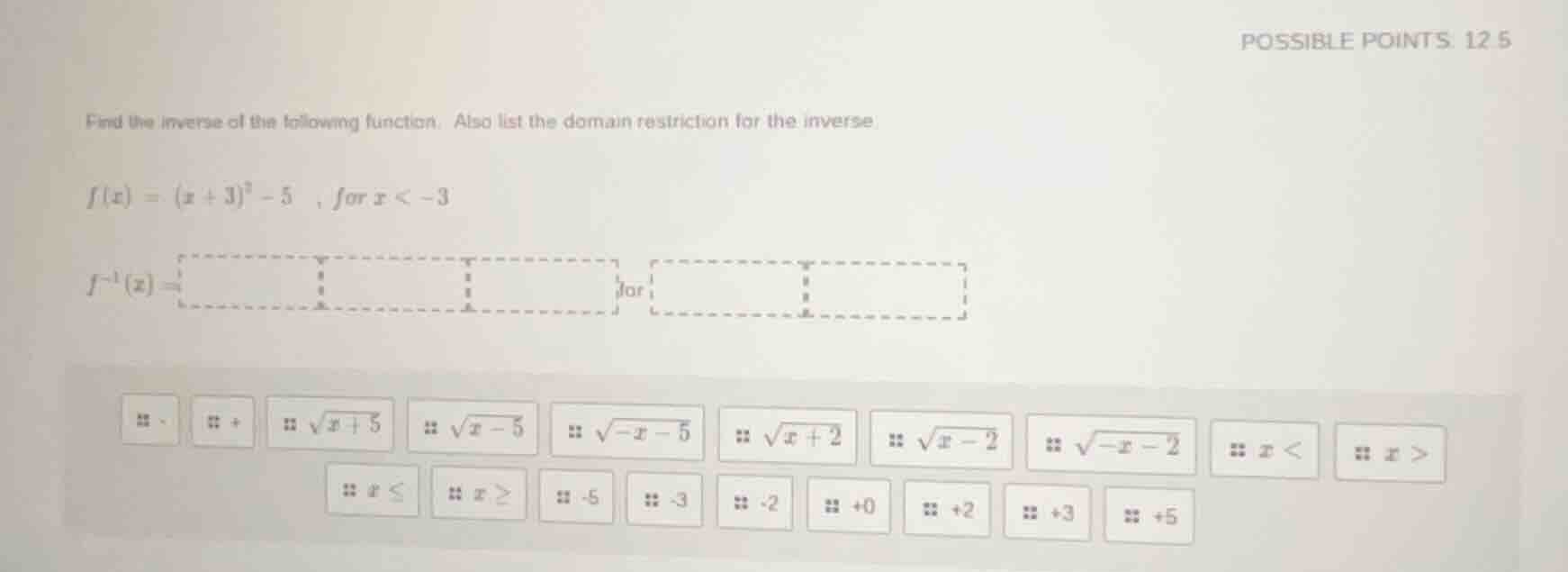
find the inverse of the following function. also list the domain restriction for the inverse.
$f(x) = (x + 3)^2 - 5$, for $x < -3$
$f^{-1}(x) = \boxed{quad}$ for $\boxed{quad}$
Step1: Replace \( f(x) \) with \( y \)
We start by writing the function as \( y=(x + 3)^{2}-5 \) with the domain \( x < - 3 \).
Step2: Swap \( x \) and \( y \)
To find the inverse, we swap \( x \) and \( y \), so we get \( x=(y + 3)^{2}-5 \).
Step3: Solve for \( y \)
First, add 5 to both sides of the equation: \( x + 5=(y + 3)^{2} \).
Since the original domain is \( x < - 3 \), then \( y+3<0 \) (because \( x< - 3\) implies \( y + 3=x+3<0\)). So when we take the square root, we take the negative square root.
Taking the square root of both sides, we have \( y+3=-\sqrt{x + 5}\) (we take the negative root because \( y + 3<0\) from the original domain \( x < - 3\)).
Then, subtract 3 from both sides: \( y=-\sqrt{x + 5}-3\)? Wait, no, wait. Wait, original function is \( y=(x + 3)^{2}-5\), \( x < - 3\). Let's re - do the solving.
Starting from \( x=(y + 3)^{2}-5\), add 5 to both sides: \( x + 5=(y + 3)^{2}\).
Now, we need to solve for \( y \). Take square roots: \( y + 3=\pm\sqrt{x + 5}\). But from the original function, \( x < - 3\), so \( y+3=x + 3<0\), so \( y + 3\) is negative. So we take \( y+3=-\sqrt{x + 5}\)? Wait, no, wait. Wait, if \( x < - 3\), then \( y=(x + 3)^{2}-5\). Let's find the range of the original function. Since \( x < - 3\), \( x + 3<0\), so \((x + 3)^{2}>0\) (because square of a negative number is positive), and as \( x\) becomes more negative, \((x + 3)^{2}\) becomes larger. So the range of \( f(x)\) is \( y>-5\) (because \((x + 3)^{2}>0\) implies \( y=(x + 3)^{2}-5>-5\)).
Now, back to solving \( x=(y + 3)^{2}-5\) for \( y \).
\( x+5=(y + 3)^{2}\)
\( y + 3=\pm\sqrt{x + 5}\)
But since in the original function, \( x < - 3\), then \( y+3=x + 3<0\), so \( y + 3\) is negative. So we take \( y+3=-\sqrt{x + 5}\)? Wait, no, that can't be. Wait, let's think about the original function's graph. The function \( y=(x + 3)^{2}-5\) is a parabola opening upwards with vertex at \((-3,-5)\). The domain is \( x < - 3\), so we are looking at the left - hand side of the vertex. The range of this part of the function: when \( x\) approaches \(-\infty\), \((x + 3)^{2}\) approaches \(+\infty\), so \( y\) approaches \(+\infty\), and when \( x=-3\), \( y=-5\) (but \( x=-3\) is not in the domain). So the range of \( f(x)\) for \( x < - 3\) is \( y>-5\).
Now, when we find the inverse, the domain of the inverse function is the range of the original function, and the range of the inverse function is the domain of the original function.
So, from \( x=(y + 3)^{2}-5\), we can also solve it as follows:
\( (y + 3)^{2}=x + 5\)
Since \( y+3<0\) (because \( x < - 3\) in the original function, so \( y=x\) in the inverse - swapping step, wait no, we swapped \( x\) and \( y\). Wait, original \( x < - 3\), so in the inverse, the range of \( f^{-1}(x)\) is \( x < - 3\) (since the range of inverse is domain of original). And the domain of \( f^{-1}(x)\) is the range of original, which is \( y>-5\) (i.e., \( x>-5\) for the inverse function's domain).
Now, solving \( (y + 3)^{2}=x + 5\) for \( y\) with \( y+3<0\) (because the range of inverse is \( y < - 3\) (since original domain is \( x < - 3\))). So \( y+3=-\sqrt{x + 5}\)? No, wait, if \( y+3<0\), then \( y+3=-\sqrt{x + 5}\) would give \( y=-\sqrt{x + 5}-3\), but let's check with the original function. Let's take a value from the original domain, say \( x=-4\) (which is less than - 3). Then \( f(-4)=(-4 + 3)^{2}-5=(-1)^{2}-5=1 - 5=-4\). Now, if we plug \( x=-4\) into the inverse function, we should get \( y=-4\). Let's see, if the inverse function is \( y=-\sqrt{x + 5}-3\), plug \( x=-4\): \( y=-\s…

Snap & solve any problem in the app
Get step-by-step solutions on Sovi AI
Photo-based solutions with guided steps
Explore more problems and detailed explanations
The inverse function \( f^{-1}(x)=-\sqrt{x + 5}-3\)