QUESTION IMAGE
Question
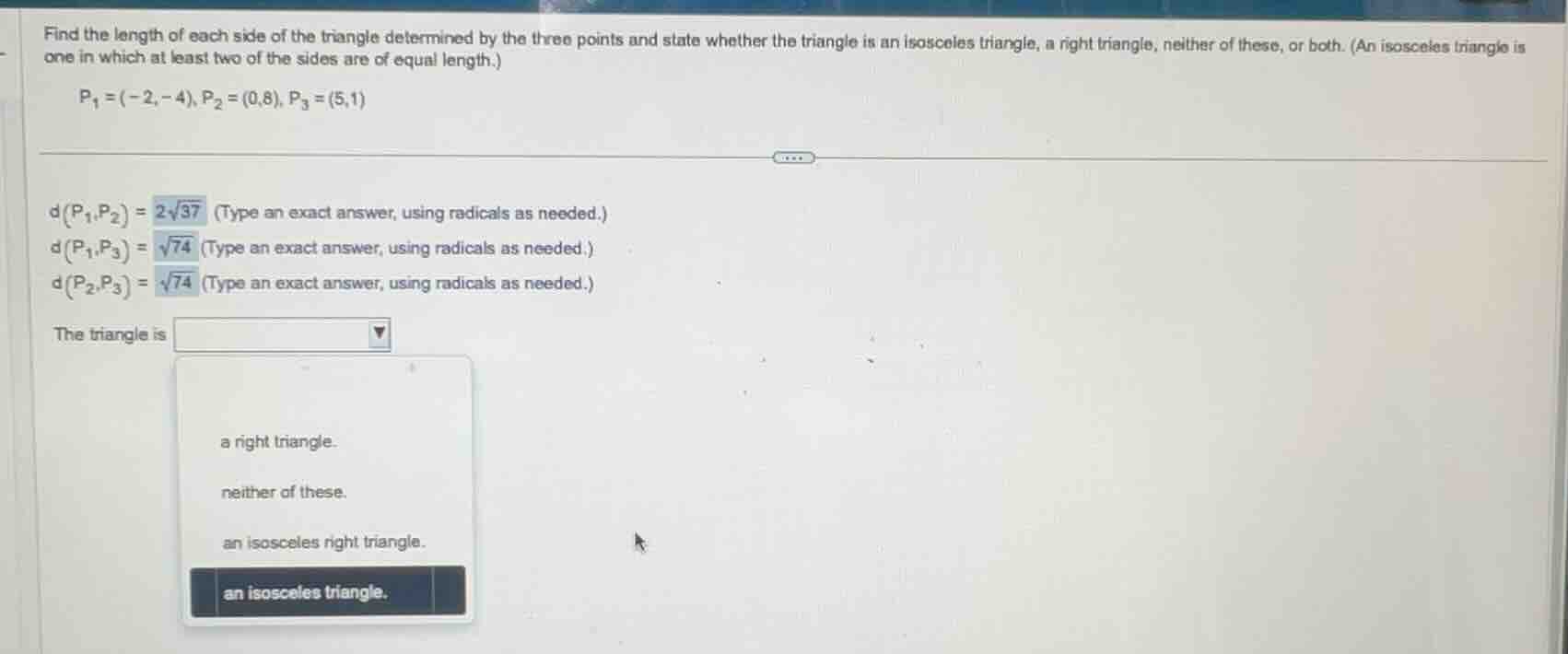
find the length of each side of the triangle determined by the three points and state whether the triangle is an isosceles triangle, a right triangle, neither of these, or both. (an isosceles triangle is one in which at least two of the sides are of equal length.)
$p_1 = (-2, -4), p_2 = (0, 8), p_3 = (5, 1)$
$d(p_1, p_2) = 2sqrt{37}$ (type an exact answer, using radicals as needed.)
$d(p_1, p_3) = sqrt{74}$ (type an exact answer, using radicals as needed.)
$d(p_2, p_3) = sqrt{74}$ (type an exact answer, using radicals as needed.)
the triangle is
options: a right triangle, neither of these, an isosceles right triangle, an isosceles triangle.
Step1: Verify side lengths
Given:
$d(P_1,P_2)=2\sqrt{37}$, $d(P_1,P_3)=\sqrt{74}$, $d(P_2,P_3)=\sqrt{74}$
Step2: Check isosceles condition
Two sides ($d(P_1,P_3)$ and $d(P_2,P_3)$) are equal, so it is isosceles.
Step3: Check right triangle condition
Test Pythagorean theorem:
$$(2\sqrt{37})^2 = 4\times37=148$$
$$(\sqrt{74})^2+(\sqrt{74})^2=74+74=148$$
Since $(d(P_1,P_2))^2=(d(P_1,P_3))^2+(d(P_2,P_3))^2$, it is a right triangle.

Snap & solve any problem in the app
Get step-by-step solutions on Sovi AI
Photo-based solutions with guided steps
Explore more problems and detailed explanations
an isosceles right triangle.