QUESTION IMAGE
Question
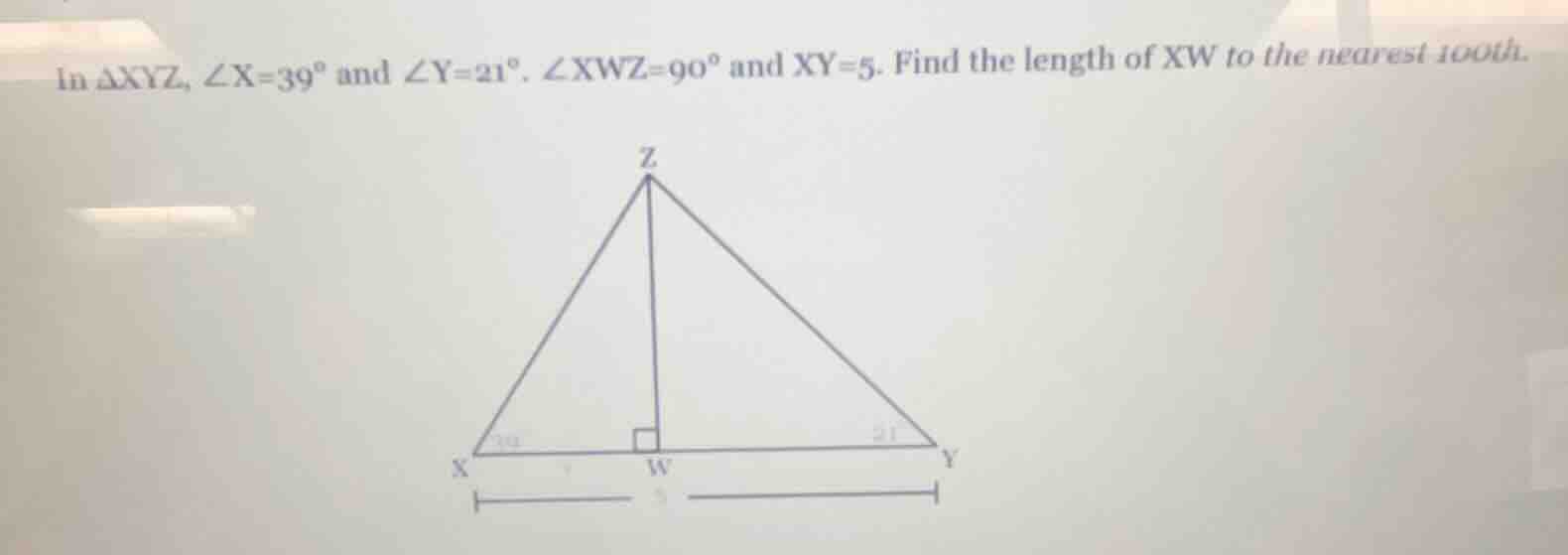
in $\triangle xyz$, $\angle x = 39^{\circ}$ and $\angle y = 21^{\circ}$. $\angle xwz = 90^{\circ}$ and $xy = 5$. find the length of $xw$ to the nearest hundredth.
Step1: Find angle at Z in triangle XYZ
In triangle \( XYZ \), the sum of angles is \( 180^\circ \). So \( \angle Z = 180^\circ - \angle X - \angle Y = 180^\circ - 39^\circ - 21^\circ = 120^\circ \). But maybe better to use trigonometry in right triangles. Wait, \( XWZ \) is right-angled at \( W \), so triangle \( XWZ \) is right-angled at \( W \), and triangle \( YWZ \) is also right-angled at \( W \). Let \( XW = x \), \( WY = 5 - x \), \( ZW = h \).
In triangle \( XWZ \): \( \cos(39^\circ) = \frac{XW}{XZ} \), \( \sin(39^\circ) = \frac{h}{XZ} \)
In triangle \( YWZ \): \( \cos(21^\circ) = \frac{WY}{YZ} \), \( \sin(21^\circ) = \frac{h}{YZ} \)
Also, in triangle \( XYZ \), using the Law of Sines: \( \frac{XY}{\sin(\angle Z)} = \frac{XZ}{\sin(21^\circ)} = \frac{YZ}{\sin(39^\circ)} \)
\( \angle Z = 120^\circ \), so \( \frac{5}{\sin(120^\circ)} = \frac{XZ}{\sin(21^\circ)} \)
\( XZ = \frac{5 \sin(21^\circ)}{\sin(120^\circ)} \)
Then in triangle \( XWZ \), \( \cos(39^\circ) = \frac{XW}{XZ} \), so \( XW = XZ \cos(39^\circ) = \frac{5 \sin(21^\circ) \cos(39^\circ)}{\sin(120^\circ)} \)
Wait, maybe easier: Let's denote \( XW = x \), \( WY = 5 - x \). In right triangle \( XWZ \), \( \tan(39^\circ) = \frac{ZW}{x} \), so \( ZW = x \tan(39^\circ) \). In right triangle \( YWZ \), \( \tan(21^\circ) = \frac{ZW}{5 - x} \), so \( ZW = (5 - x) \tan(21^\circ) \). Therefore, \( x \tan(39^\circ) = (5 - x) \tan(21^\circ) \)
Step2: Solve for x
\( x \tan(39^\circ) + x \tan(21^\circ) = 5 \tan(21^\circ) \)
\( x (\tan(39^\circ) + \tan(21^\circ)) = 5 \tan(21^\circ) \)
\( x = \frac{5 \tan(21^\circ)}{\tan(39^\circ) + \tan(21^\circ)} \)
Calculate \( \tan(39^\circ) \approx 0.8098 \), \( \tan(21^\circ) \approx 0.3839 \)
So numerator: \( 5 \times 0.3839 \approx 1.9195 \)
Denominator: \( 0.8098 + 0.3839 \approx 1.1937 \)
\( x \approx \frac{1.9195}{1.1937} \approx 1.61 \) Wait, no, wait, maybe I mixed up. Wait, in triangle \( XWZ \), angle at X is 39°, so adjacent side is XW, opposite is ZW. In triangle \( YWZ \), angle at Y is 21°, adjacent side is WY, opposite is ZW. So \( ZW = XW \tan(39^\circ) = (XY - XW) \tan(21^\circ) \)
So \( x \tan(39^\circ) = (5 - x) \tan(21^\circ) \)
\( x \tan(39^\circ) + x \tan(21^\circ) = 5 \tan(21^\circ) \)
\( x (\tan(39^\circ) + \tan(21^\circ)) = 5 \tan(21^\circ) \)
\( x = \frac{5 \tan(21^\circ)}{\tan(39^\circ) + \tan(21^\circ)} \)
Wait, but maybe another approach: Use the Law of Sines in triangle \( XYZ \) to find XZ, then use cosine in triangle \( XWZ \).
Law of Sines: \( \frac{XY}{\sin(\angle Z)} = \frac{XZ}{\sin(\angle Y)} \)
\( \angle Z = 180 - 39 - 21 = 120^\circ \), so \( \frac{5}{\sin(120^\circ)} = \frac{XZ}{\sin(21^\circ)} \)
\( XZ = \frac{5 \sin(21^\circ)}{\sin(120^\circ)} \)
\( \sin(120^\circ) = \sin(60^\circ) = \frac{\sqrt{3}}{2} \approx 0.8660 \)
\( \sin(21^\circ) \approx 0.3584 \)
So \( XZ \approx \frac{5 \times 0.3584}{0.8660} \approx \frac{1.792}{0.8660} \approx 2.07 \)
Then in triangle \( XWZ \), right-angled at W, \( \cos(39^\circ) = \frac{XW}{XZ} \)
\( XW = XZ \cos(39^\circ) \)
\( \cos(39^\circ) \approx 0.7771 \)
So \( XW \approx 2.07 \times 0.7771 \approx 1.61 \). Wait, but let's check with the first method.
First method: \( \tan(39) \approx 0.8098 \), \( \tan(21) \approx 0.3839 \)
\( x = \frac{5 \times 0.3839}{0.8098 + 0.3839} = \frac{1.9195}{1.1937} \approx 1.61 \). Same result.
Wait, but maybe I made a mistake. Wait, let's check the angle at Z. Wait, in triangle XYZ, angles are 39, 21, so 120. Then, the height ZW splits XY into XW and WY. Let's denote XW = x, WY = 5 - x. Then, in tria…

Snap & solve any problem in the app
Get step-by-step solutions on Sovi AI
Photo-based solutions with guided steps
Explore more problems and detailed explanations
\( \boxed{1.61} \)