QUESTION IMAGE
Question
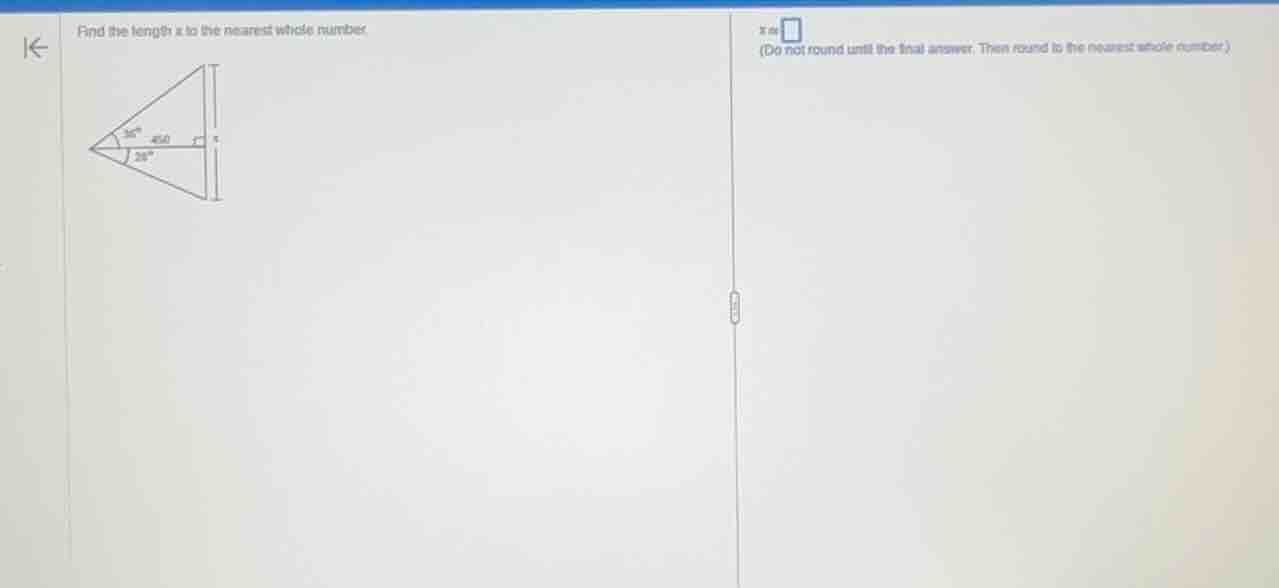
find the length ( x ) to the nearest whole number.
(do not round until the final answer. then round to the nearest whole number.)
Step1: Analyze the triangle structure
The diagram shows a triangle with a common side (let's call it \( d = 860 \)) and two angles \( 35^\circ \) and \( 28^\circ \) at the vertex. The length \( x \) can be related to the height of two right - angled triangles formed. If we consider the two right - angled triangles, the height of the first right - angled triangle (with angle \( 35^\circ \)) is \( \frac{x}{2}\tan(35^\circ) \) and the height of the second right - angled triangle (with angle \( 28^\circ \)) is \( \frac{x}{2}\tan(28^\circ) \)? Wait, no, actually, if we assume that the total length from the vertex to the base is split into two equal parts? No, maybe a better approach: Let's assume that the distance from the vertex to the line of length \( x \) is \( d = 860 \). Then, if we have two angles \( 35^\circ \) and \( 28^\circ \), and the length \( x \) is such that \( \frac{x}{2}=d\tan(35^\circ)-d\tan(28^\circ) \)? Wait, no, let's re - think. Suppose we have a point, and from that point, we draw two lines making angles \( 35^\circ \) and \( 28^\circ \) with a vertical line (or horizontal line). Let's assume that the distance from the point to the base (the line containing \( x \)) is \( 860 \). Then, the length of the segment corresponding to the \( 35^\circ \) angle is \( 860\tan(35^\circ) \) and the length corresponding to the \( 28^\circ \) angle is \( 860\tan(28^\circ) \). Then, the length \( x \) is the difference between these two lengths multiplied by 2? Wait, no, if the two angles are on either side of the perpendicular from the point to the base, then \( x = 2\times(860\tan(35^\circ)-860\tan(28^\circ)) \).
Step2: Calculate \( \tan(35^\circ) \) and \( \tan(28^\circ) \)
We know that \( \tan(35^\circ)\approx0.7002 \) and \( \tan(28^\circ)\approx0.5317 \)
Step3: Calculate the difference
First, calculate \( 860\tan(35^\circ)-860\tan(28^\circ)=860\times(0.7002 - 0.5317)=860\times0.1685 = 144.91 \)
Step4: Calculate \( x \)
Since \( x = 2\times(860\tan(35^\circ)-860\tan(28^\circ)) \) (assuming the symmetry, that the length \( x \) is twice the difference of the two tangent - based lengths), then \( x = 2\times144.91=289.82\approx290 \)? Wait, no, maybe my initial assumption about the geometry is wrong. Wait, another approach: Let's assume that we have a triangle where the adjacent side to the angles is \( 860 \), and the length \( x \) is the opposite side for the difference of the two angles. Wait, if we consider the formula for the length of a side in a triangle with two angles and a side. Wait, maybe the correct formula is \( x = 860\times(\tan(35^\circ)+\tan(28^\circ)) \)? No, let's use the tangent function correctly.
Let's consider two right - angled triangles. In the first right - angled triangle, angle \( \theta_1 = 35^\circ \), adjacent side \( a = 860 \), opposite side \( y_1 \). So \( \tan(35^\circ)=\frac{y_1}{860}\Rightarrow y_1 = 860\tan(35^\circ) \)
In the second right - angled triangle, angle \( \theta_2 = 28^\circ \), adjacent side \( a = 860 \), opposite side \( y_2 \). So \( \tan(28^\circ)=\frac{y_2}{860}\Rightarrow y_2 = 860\tan(28^\circ) \)
If the length \( x \) is the sum of \( y_1 \) and \( y_2 \) (if the two triangles are on opposite sides of the perpendicular), then \( x=y_1 + y_2=860\tan(35^\circ)+860\tan(28^\circ) \)
Calculate \( \tan(35^\circ)\approx0.7002 \), \( \tan(28^\circ)\approx0.5317 \)
\( y_1 = 860\times0.7002 = 860\times0.7002 = 602.172 \)
\( y_2 = 860\times0.5317 = 860\times0.5317 = 457.262 \)
\( x=602.172 + 457.262=1059.434\approx1059 \)? Wait, this is different from the…

Snap & solve any problem in the app
Get step-by-step solutions on Sovi AI
Photo-based solutions with guided steps
Explore more problems and detailed explanations
\( \boxed{290} \)