QUESTION IMAGE
Question
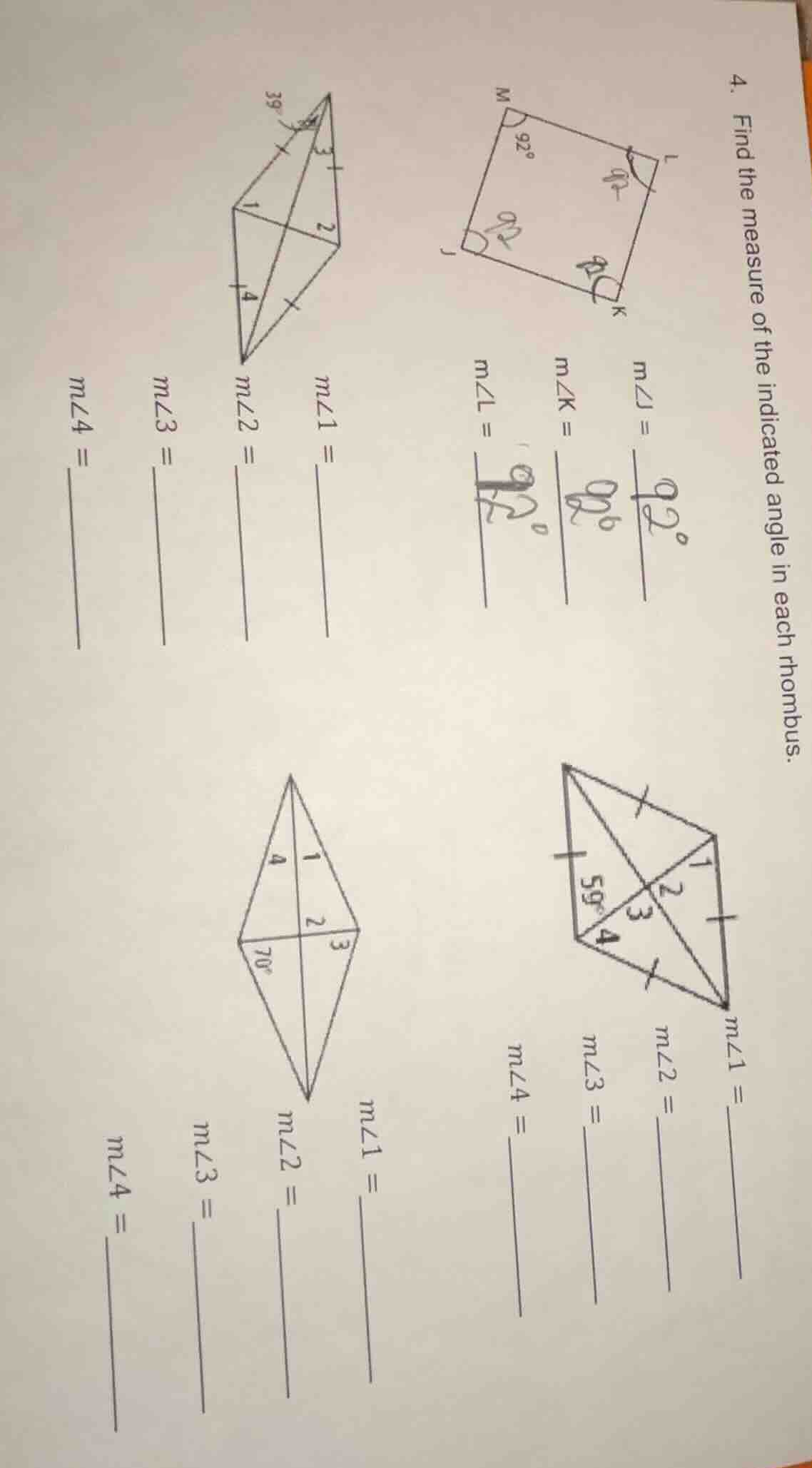
- find the measure of the indicated angle in each rhombus.
for the first rhombus (top left with 39° and angles 1,2,3,4):
$m\angle1 = \underline{\quad}$
$m\angle2 = \underline{\quad}$
$m\angle3 = \underline{\quad}$
$m\angle4 = \underline{\quad}$
for the rhombus with angle 92° at m (top right, vertices l, m, j, k):
$m\angle j = \underline{92^\circ}$
$m\angle k = \underline{\quad}$
$m\angle l = \underline{\quad}$
for the rhombus with 59° and angles 1,2,3,4 (middle right):
$m\angle1 = \underline{\quad}$
$m\angle2 = \underline{\quad}$
$m\angle3 = \underline{\quad}$
$m\angle4 = \underline{\quad}$
for the rhombus with 70° (bottom left, angles 1,2,3,4):
$m\angle1 = \underline{\quad}$
$m\angle2 = \underline{\quad}$
$m\angle3 = \underline{\quad}$
$m\angle4 = \underline{\quad}$
Part 1: Rhombus \( LMJK \) (Top - Right)
In a rhombus, opposite angles are equal, and adjacent angles are supplementary (\( \text{sum} = 180^\circ \)). Also, opposite angles are equal.
- \( \angle M = 92^\circ \). In a rhombus, \( \angle J=\angle M = 92^\circ \) (opposite angles equal).
- \( \angle K \) and \( \angle M \) are adjacent, so \( m\angle K=180^\circ - 92^\circ = 88^\circ \).
- \( \angle L=\angle K = 88^\circ \) (opposite angles equal).
Part 2: Rhombus with \( 39^\circ \) angle (Top - Left)
In a rhombus, the diagonals bisect the angles and are perpendicular bisectors of each other. Also, the diagonals bisect the vertex angles.
- The diagonal divides the \( 39^\circ \) angle into two equal parts? Wait, no, the diagonals bisect the angles. Also, the triangles formed by the diagonals are congruent. Since the sides are equal (rhombus has all sides equal), the triangles are isosceles or congruent.
- \( \angle 1 \): Since the triangles are congruent (SSS, as diagonals bisect each other and sides are equal), \( m\angle 1 = 39^\circ \) (corresponding angles).
- \( \angle 2 \): In a rhombus, adjacent angles are supplementary? Wait, no, the diagonals are perpendicular? Wait, no, in a rhombus, diagonals are perpendicular. So \( \angle 2 = 90^\circ \) (diagonals of a rhombus are perpendicular).
- \( \angle 3 \): Since the diagonals bisect the angles, and the triangles are congruent, \( \angle 3 = 90^\circ - 39^\circ=51^\circ \)? Wait, no, maybe better to recall: In a rhombus, diagonals bisect the angles and are perpendicular. So if one angle is \( 39^\circ \), the adjacent angle is \( 180 - 39 = 141^\circ \), and the diagonals bisect them. But maybe the triangles are congruent, so \( \angle 1 = 39^\circ \), \( \angle 2 = 90^\circ \) (diagonals perpendicular), \( \angle 3 = 51^\circ \) (since \( 90 - 39 = 51 \)), and \( \angle 4=\angle 1 = 39^\circ \) (congruent triangles).
Part 3: Rhombus with \( 59^\circ \) angle (Bottom - Right)
- \( \angle 1 \): The triangle is isosceles (sides equal), so \( m\angle 1 = 59^\circ \) (base angles equal? Wait, no, the diagonal bisects the angle. Wait, the given angle is \( 59^\circ \), and the triangle formed by the diagonal has two equal sides (rhombus sides), so \( \angle 1 = 59^\circ \).
- \( \angle 2 \): Diagonals of a rhombus are perpendicular, so \( m\angle 2 = 90^\circ \).
- \( \angle 3 = 90^\circ \) (diagonals intersect at right angles).
- \( \angle 4 = 59^\circ \) (congruent triangles, so corresponding angles equal).
Part 4: Rhombus with \( 70^\circ \) angle (Bottom - Left)
- \( \angle 1 \): The diagonal bisects the \( 70^\circ \) angle? Wait, no, the \( 70^\circ \) angle is at the vertex, and the diagonal bisects it? Wait, in a rhombus, diagonals bisect the vertex angles. So if one angle is \( 70^\circ \), the diagonal bisects it into \( 35^\circ \). But maybe the triangles are congruent. Wait, the diagonals are perpendicular, so \( \angle 2 = 90^\circ \) (diagonals of rhombus are perpendicular).
- \( \angle 1 \): Let's see, the triangle has a \( 70^\circ \) angle, and the diagonal bisects it? No, maybe the \( 70^\circ \) is one of the angles formed by the diagonal. Wait, the rhombus has a vertex angle of \( 70^\circ \), so the diagonal bisects it into \( 35^\circ \), so \( m\angle 1 = 35^\circ \).
- \( \angle 2 = 90^\circ \) (diagonals perpendicular).
- \( \angle 3 = 90^\circ - 35^\circ = 55^\circ \)? Wait, no, maybe \( \angle 3 = 70^\circ \)? Wait, no, let's recall properties:
- In a rhombus, diagonals bisect the angles.
- Diagonals are perpendicular.
- Opposite…

Snap & solve any problem in the app
Get step-by-step solutions on Sovi AI
Photo-based solutions with guided steps
Explore more problems and detailed explanations
Part 1: Rhombus \( LMJK \) (Top - Right)
In a rhombus, opposite angles are equal, and adjacent angles are supplementary (\( \text{sum} = 180^\circ \)). Also, opposite angles are equal.
- \( \angle M = 92^\circ \). In a rhombus, \( \angle J=\angle M = 92^\circ \) (opposite angles equal).
- \( \angle K \) and \( \angle M \) are adjacent, so \( m\angle K=180^\circ - 92^\circ = 88^\circ \).
- \( \angle L=\angle K = 88^\circ \) (opposite angles equal).
Part 2: Rhombus with \( 39^\circ \) angle (Top - Left)
In a rhombus, the diagonals bisect the angles and are perpendicular bisectors of each other. Also, the diagonals bisect the vertex angles.
- The diagonal divides the \( 39^\circ \) angle into two equal parts? Wait, no, the diagonals bisect the angles. Also, the triangles formed by the diagonals are congruent. Since the sides are equal (rhombus has all sides equal), the triangles are isosceles or congruent.
- \( \angle 1 \): Since the triangles are congruent (SSS, as diagonals bisect each other and sides are equal), \( m\angle 1 = 39^\circ \) (corresponding angles).
- \( \angle 2 \): In a rhombus, adjacent angles are supplementary? Wait, no, the diagonals are perpendicular? Wait, no, in a rhombus, diagonals are perpendicular. So \( \angle 2 = 90^\circ \) (diagonals of a rhombus are perpendicular).
- \( \angle 3 \): Since the diagonals bisect the angles, and the triangles are congruent, \( \angle 3 = 90^\circ - 39^\circ=51^\circ \)? Wait, no, maybe better to recall: In a rhombus, diagonals bisect the angles and are perpendicular. So if one angle is \( 39^\circ \), the adjacent angle is \( 180 - 39 = 141^\circ \), and the diagonals bisect them. But maybe the triangles are congruent, so \( \angle 1 = 39^\circ \), \( \angle 2 = 90^\circ \) (diagonals perpendicular), \( \angle 3 = 51^\circ \) (since \( 90 - 39 = 51 \)), and \( \angle 4=\angle 1 = 39^\circ \) (congruent triangles).
Part 3: Rhombus with \( 59^\circ \) angle (Bottom - Right)
- \( \angle 1 \): The triangle is isosceles (sides equal), so \( m\angle 1 = 59^\circ \) (base angles equal? Wait, no, the diagonal bisects the angle. Wait, the given angle is \( 59^\circ \), and the triangle formed by the diagonal has two equal sides (rhombus sides), so \( \angle 1 = 59^\circ \).
- \( \angle 2 \): Diagonals of a rhombus are perpendicular, so \( m\angle 2 = 90^\circ \).
- \( \angle 3 = 90^\circ \) (diagonals intersect at right angles).
- \( \angle 4 = 59^\circ \) (congruent triangles, so corresponding angles equal).
Part 4: Rhombus with \( 70^\circ \) angle (Bottom - Left)
- \( \angle 1 \): The diagonal bisects the \( 70^\circ \) angle? Wait, no, the \( 70^\circ \) angle is at the vertex, and the diagonal bisects it? Wait, in a rhombus, diagonals bisect the vertex angles. So if one angle is \( 70^\circ \), the diagonal bisects it into \( 35^\circ \). But maybe the triangles are congruent. Wait, the diagonals are perpendicular, so \( \angle 2 = 90^\circ \) (diagonals of rhombus are perpendicular).
- \( \angle 1 \): Let's see, the triangle has a \( 70^\circ \) angle, and the diagonal bisects it? No, maybe the \( 70^\circ \) is one of the angles formed by the diagonal. Wait, the rhombus has a vertex angle of \( 70^\circ \), so the diagonal bisects it into \( 35^\circ \), so \( m\angle 1 = 35^\circ \).
- \( \angle 2 = 90^\circ \) (diagonals perpendicular).
- \( \angle 3 = 90^\circ - 35^\circ = 55^\circ \)? Wait, no, maybe \( \angle 3 = 70^\circ \)? Wait, no, let's recall properties:
- In a rhombus, diagonals bisect the angles.
- Diagonals are perpendicular.
- Opposite angles are equal, adjacent angles are supplementary.
Let's re - solve each part step by step:
Part 1 (Rhombus \( LMJK \)):
- \( m\angle J \): In a rhombus, opposite angles are equal. \( \angle M = 92^\circ \), so \( m\angle J=\angle M = 92^\circ \).
- \( m\angle K \): Adjacent angles in a rhombus are supplementary. So \( m\angle K = 180^\circ-92^\circ = 88^\circ \).
- \( m\angle L \): Opposite angles are equal, so \( m\angle L=\angle K = 88^\circ \).
Part 2 (Top - Left Rhombus):
- \( m\angle 1 \): The triangles formed by the diagonals are congruent (SSS: sides of rhombus are equal, diagonals bisect each other). So \( m\angle 1 = 39^\circ \) (corresponding angles).
- \( m\angle 2 \): Diagonals of a rhombus are perpendicular, so \( m\angle 2 = 90^\circ \).
- \( m\angle 3 \): In the right - triangle formed by the diagonals, \( m\angle 3=90^\circ - 39^\circ = 51^\circ \).
- \( m\angle 4 \): By congruence of triangles, \( m\angle 4 = m\angle 1 = 39^\circ \).
Part 3 (Bottom - Right Rhombus):
- \( m\angle 1 \): The triangle with the \( 59^\circ \) angle has two equal sides (sides of rhombus), so it is isosceles with \( m\angle 1 = 59^\circ \) (base angle equal to the given angle? Wait, no, the diagonal bisects the angle. Wait, the given angle is \( 59^\circ \), and the triangle is isosceles, so \( m\angle 1 = 59^\circ \).
- \( m\angle 2 \): Diagonals of a rhombus are perpendicular, so \( m\angle 2 = 90^\circ \).
- \( m\angle 3 \): Diagonals intersect at right angles, so \( m\angle 3 = 90^\circ \).
- \( m\angle 4 \): By congruence of triangles, \( m\angle 4 = m\angle 1 = 59^\circ \).
Part 4 (Bottom - Left Rhombus):
- \( m\angle 1 \): The diagonal bisects the \( 70^\circ \) angle? Wait, no, the \( 70^\circ \) is a vertex angle, and the diagonal bisects it, so \( m\angle 1=\frac{70^\circ}{2}=35^\circ \).
- \( m\angle 2 \): Diagonals of a rhombus are perpendicular, so \( m\angle 2 = 90^\circ \).
- \( m\angle 3 \): In the right - triangle, \( m\angle 3 = 90^\circ - 35^\circ = 55^\circ \).
- \( m\angle 4 \): By congruence of triangles, \( m\angle 4 = m\angle 1 = 35^\circ \).
Final Answers:
Part 1:
- \( m\angle J=\boldsymbol{92^\circ} \)
- \( m\angle K=\boldsymbol{88^\circ} \)
- \( m\angle L=\boldsymbol{88^\circ} \)
Part 2:
- \( m\angle 1=\boldsymbol{39^\circ} \)
- \( m\angle 2=\boldsymbol{90^\circ} \)
- \( m\angle 3=\boldsymbol{51^\circ} \)
- \( m\angle 4=\boldsymbol{39^\circ} \)
Part 3:
- \( m\angle 1=\boldsymbol{59^\circ} \)
- \( m\angle 2=\boldsymbol{90^\circ} \)
- \( m\angle 3=\boldsymbol{90^\circ} \)
- \( m\angle 4=\boldsymbol{59^\circ} \)
Part 4:
- \( m\angle 1=\boldsymbol{35^\circ} \)
- \( m\angle 2=\boldsymbol{90^\circ} \)
- \( m\angle 3=\boldsymbol{55^\circ} \)
- \( m\angle 4=\boldsymbol{35^\circ} \)