QUESTION IMAGE
Question
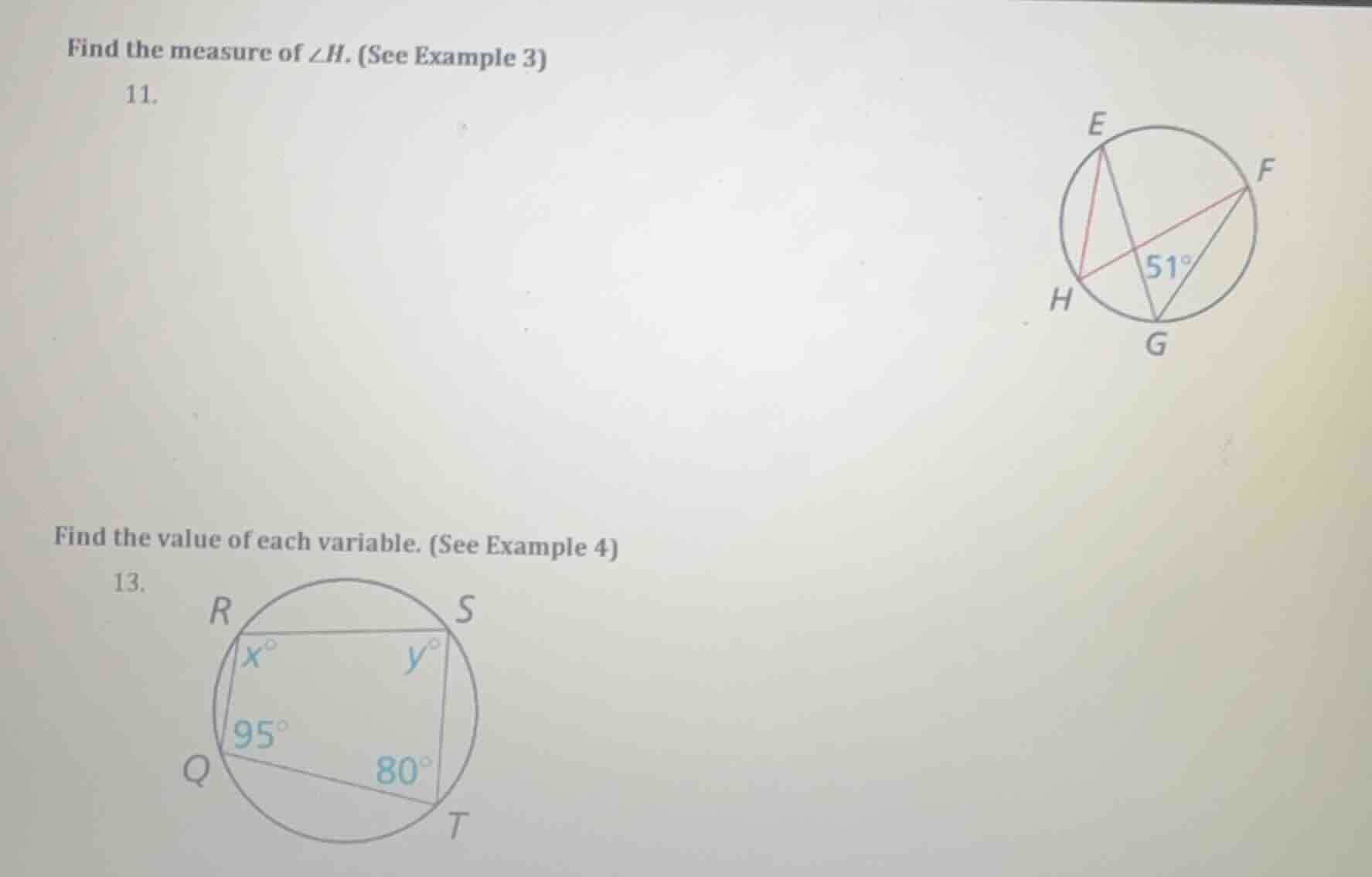
find the measure of $\angle h$. (see example 3)
11.
find the value of each variable. (see example 4)
13.
Problem 11: Find the measure of \( \angle H \)
Step 1: Recall Inscribed Angle Theorem
In a circle, inscribed angles that subtend the same arc are equal. Also, the measure of an inscribed angle is half the measure of its subtended arc. But here, \( \angle EGF = 51^\circ \) and \( \angle EHF \) (which is \( \angle H \)) subtends the same arc \( EF \) as \( \angle EGF \)? Wait, no, actually, \( \angle EHG \) and \( \angle EFG \)? Wait, no, looking at the diagram, \( \angle H \) and the \( 51^\circ \) angle: Wait, maybe they are inscribed angles subtended by the same arc, or maybe vertical angles? Wait, no, the key is that angles subtended by the same arc are equal. Wait, actually, \( \angle EHG \) and \( \angle EFG \)? Wait, no, the angle at \( G \) is \( 51^\circ \), and \( \angle H \) is an inscribed angle. Wait, maybe the triangle or the arcs. Wait, actually, in a circle, if two angles subtend the same arc, they are equal. Wait, maybe \( \angle H \) and the angle at \( F \)? No, wait, the diagram shows \( \angle EGF = 51^\circ \), and \( \angle EHF \) (which is \( \angle H \)): Wait, maybe it's a typo, but actually, the correct approach is that \( \angle H \) and \( \angle F \) or \( \angle E \)? Wait, no, the angle at \( G \) is \( 51^\circ \), and \( \angle H \) is equal to \( 51^\circ \)? Wait, no, maybe I made a mistake. Wait, the inscribed angle theorem: the measure of an inscribed angle is half the measure of its intercepted arc. But if the angle at \( G \) is a central angle? No, it's an inscribed angle. Wait, maybe the two angles \( \angle EHG \) and \( \angle EFG \) are equal because they subtend arc \( EG \). Wait, no, the diagram has \( E, F, G, H \) on the circle. So \( \angle EHG \) and \( \angle EFG \) subtend arc \( EG \), so they are equal. But the angle at \( G \) is \( 51^\circ \), which is \( \angle EGF = 51^\circ \). Wait, maybe \( \angle H = 51^\circ \)? Wait, no, maybe I'm overcomplicating. Wait, the problem is to find \( \angle H \), and the angle at \( G \) is \( 51^\circ \). Since \( \angle H \) and \( \angle F \) or \( \angle E \)? Wait, maybe the answer is \( 51^\circ \)? Wait, no, maybe not. Wait, let's think again. The inscribed angle theorem: if two angles subtend the same arc, they are equal. So \( \angle EHG \) and \( \angle EFG \) subtend arc \( EG \), so they are equal. But the angle at \( G \) is \( 51^\circ \), which is \( \angle EGF = 51^\circ \). Wait, maybe \( \angle H = 51^\circ \). Wait, maybe that's the case. So the measure of \( \angle H \) is \( 51^\circ \).
Step 2: Confirm with Inscribed Angle Theorem
Since \( \angle H \) and \( \angle EGF \) subtend the same arc (or are equal because of the circle's properties), \( \angle H = 51^\circ \).
Step 1: Recall Cyclic Quadrilateral Properties
In a cyclic quadrilateral (a quadrilateral inscribed in a circle), the sum of opposite angles is \( 180^\circ \). So, for quadrilateral \( QRST \) inscribed in a circle, \( \angle Q + \angle S = 180^\circ \) and \( \angle R + \angle T = 180^\circ \). Wait, the angles given are \( \angle Q = 95^\circ \), \( \angle T = 80^\circ \), \( \angle R = x^\circ \), \( \angle S = y^\circ \).
Step 2: Find \( y \) (angle at \( S \))
Since \( \angle Q \) and \( \angle S \) are opposite angles in a cyclic quadrilateral, their sum is \( 180^\circ \). So:
\( \angle Q + \angle S = 180^\circ \)
\( 95^\circ + y^\circ = 180^\circ \)
\( y = 180 - 95 = 85^\circ \)
Step 3: Find \( x \) (angle at \( R \))
Similarly, \( \angle R \) and \( \angle T \) are opposite angles, so their sum is \( 180^\circ \):
\( \angle R + \angle T = 180^\circ \)
\( x^\circ + 80^\circ = 180^\circ \)
\( x = 180 - 80 = 100^\circ \)

Snap & solve any problem in the app
Get step-by-step solutions on Sovi AI
Photo-based solutions with guided steps
Explore more problems and detailed explanations
\( 51^\circ \)