QUESTION IMAGE
Question
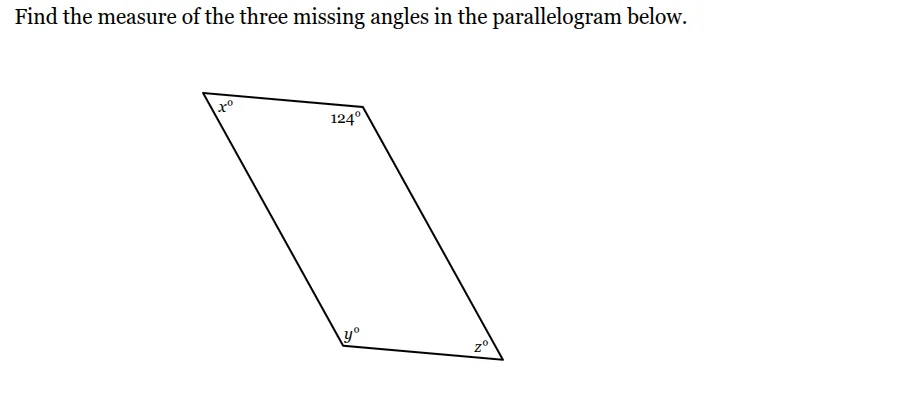
find the measure of the three missing angles in the parallelogram below.
(an image of a parallelogram with one angle labeled 124°, and the other three angles labeled x°, y°, z°)
Step1: Recall properties of parallelograms
In a parallelogram, opposite angles are equal, and consecutive angles are supplementary (sum to \(180^\circ\)).
Step2: Find angle \(x\) and \(z\)
The angle given is \(124^\circ\). The angle opposite to \(124^\circ\) (let's say \(y\) or \(z\)? Wait, no, let's label correctly. In the parallelogram, the angle adjacent to \(124^\circ\) (like \(x\)) will be supplementary. Wait, actually, in a parallelogram, opposite angles are equal. So the angle \(x\) and the angle \(z\) (wait, no, let's see the diagram: the top left is \(x\), top right is \(124^\circ\), bottom left is \(y\), bottom right is \(z\). So in a parallelogram, opposite angles are equal: so \(x = z\), and \(124^\circ = y\)? Wait no, wait consecutive angles are supplementary. So top right is \(124^\circ\), top left is \(x\): they are consecutive, so \(x + 124^\circ = 180^\circ\). So \(x = 180 - 124 = 56^\circ\). Then, opposite angles: \(x = z = 56^\circ\), and \(124^\circ = y\) (since opposite angles are equal). Wait, let's confirm:
In a parallelogram, \(AB \parallel CD\) and \(AD \parallel BC\). So consecutive angles (like \(\angle A\) and \(\angle B\)) are supplementary. So if one angle is \(124^\circ\), the consecutive angle is \(180 - 124 = 56^\circ\). Then opposite angles are equal: so the angle opposite \(124^\circ\) is also \(124^\circ\), and the angle opposite \(56^\circ\) is also \(56^\circ\).
So:
- Angle \(x\): consecutive to \(124^\circ\), so \(x = 180 - 124 = 56^\circ\)
- Angle \(y\): opposite to \(124^\circ\), so \(y = 124^\circ\)
- Angle \(z\): opposite to \(x\), so \(z = 56^\circ\)
Wait, let's check again. Let's denote the parallelogram vertices as \(A(x^\circ)\), \(B(124^\circ)\), \(C(y^\circ)\), \(D(z^\circ)\). Then \(AB \parallel CD\) and \(AD \parallel BC\). So \(\angle A + \angle B = 180^\circ\) (consecutive angles), so \(x + 124 = 180\) ⇒ \(x = 56\). Then \(\angle A = \angle C\) (opposite angles), so \(x = z = 56\). \(\angle B = \angle D\)? Wait no, \(\angle B = \angle C\)? Wait no, I think I mixed up. Wait, in a parallelogram, opposite angles are equal: \(\angle A = \angle C\), \(\angle B = \angle D\). So if \(A\) is \(x\), \(B\) is \(124\), then \(C\) (which is \(y\)) is equal to \(B\)? No, wait \(A\) and \(C\) are opposite, \(B\) and \(D\) are opposite. So \(A = C\) (x = y? No, the diagram: top left is \(x\), top right is \(124\), bottom left is \(y\), bottom right is \(z\). So \(x\) (top left) and \(y\) (bottom left) are same side? No, \(x\) and \(124\) are top, \(y\) and \(z\) are bottom. So \(x\) (top left) and \(z\) (bottom right) are opposite? Wait, maybe the diagram is a parallelogram with sides: left side from \(x\) to \(y\), right side from \(124\) to \(z\), top from \(x\) to \(124\), bottom from \(y\) to \(z\). So then, \(x\) and \(z\) are opposite? No, in a parallelogram, opposite angles are those not adjacent. So \(x\) (top left) is adjacent to top right (\(124\)) and bottom left (\(y\)). So top left (\(x\)) and bottom right (\(z\)) are opposite. Top right (\(124\)) and bottom left (\(y\)) are opposite. Therefore, \(x = z\) and \(124 = y\). Also, consecutive angles: \(x + 124 = 180\) (since they are adjacent, same side interior angles, so supplementary). So \(x = 180 - 124 = 56\). Then \(z = x = 56\), and \(y = 124\).
So:
- \(x = 56^\circ\)
- \(y = 124^\circ\)
- \(z = 56^\circ\)

Snap & solve any problem in the app
Get step-by-step solutions on Sovi AI
Photo-based solutions with guided steps
Explore more problems and detailed explanations
The three missing angles are \(x = 56^\circ\), \(y = 124^\circ\), and \(z = 56^\circ\).