QUESTION IMAGE
Question
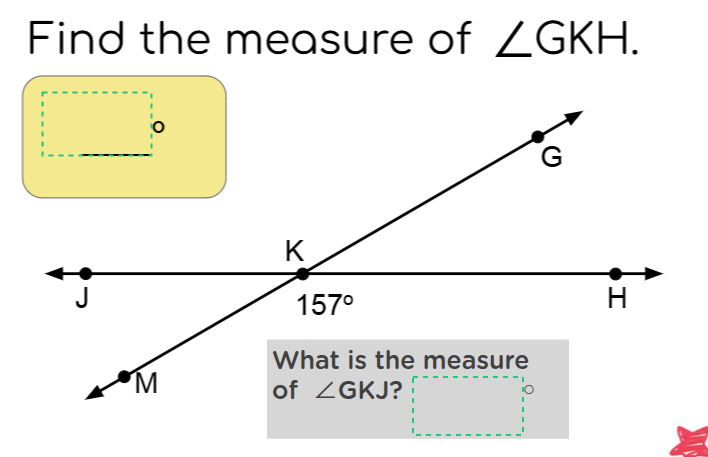
find the measure of $\angle gkh$. what is the measure of $\angle gkj$?
Step1: Identify supplementary angles
∠GKH and the 157° angle are supplementary (they form a linear pair), so their sum is 180°. Let \( x = \angle GKH \). Then \( x + 157^\circ = 180^\circ \).
Step2: Solve for x
Subtract 157° from both sides: \( x = 180^\circ - 157^\circ \).
\( x = 23^\circ \)? Wait, no—wait, the question in the image (the gray box) is "What is the measure of ∠GKJ?" Wait, maybe I misread. Wait, the original problem (the first line) is "Find the measure of ∠GKH", but the gray box is about ∠GKJ. Wait, let's re-examine the diagram:
- Line JH is horizontal, with K in the middle.
- Line GM (with M and G) intersects JH at K.
- The angle between KH and KM is 157°, so ∠HKM = 157°.
- ∠GKH and ∠HKM: Wait, no—∠GKH and ∠JK M? Wait, J---K---H (horizontal), M---K---G (the other line). So ∠HKM is 157°, so ∠GKH and ∠HKM are adjacent? No, ∠GKH and ∠JK M? Wait, maybe ∠GKJ: J---K---G? Wait, J is left of K, G is above K (or in the diagram, the line GK goes up-right, MK goes down-left). So ∠GKJ: angle at K between GK and JK.
Wait, the angle ∠HKM is 157°, so ∠GKJ is equal to ∠HKM? No, wait, vertical angles or linear pairs. Wait, ∠GKJ and the 157° angle: are they supplementary? Wait, no—JKH is a straight line (180°), so ∠GKJ + ∠GKH = 180°? No, maybe I messed up. Wait, let's clarify the diagram:
- J---K---H: straight line (180°).
- M---K---G: straight line (180°).
- So ∠HKM = 157°, so ∠GKH is adjacent to ∠HKM? Wait, no—∠HKM is between KH and KM, so ∠GKH is between KG and KH. So ∠GKH + ∠HKM = 180°? No, because KG and KM are a straight line (M---K---G), so ∠MKG is 180°. So ∠HKM (157°) and ∠GKH: ∠HKM + ∠GKH = 180°? Wait, no—∠HKM is 157°, so ∠GKH = 180° - 157° = 23°? But the gray box is about ∠GKJ. Wait, ∠GKJ: angle at K between GK and JK (J is left of K, G is up-right). So ∠GKJ: J---K---G. Since J---K---H is straight (180°), and ∠GKH is 23°, then ∠GKJ would be equal to ∠HKM? Wait, no—vertical angles. Wait, ∠GKJ and ∠HKM: are they vertical angles? Wait, ∠GKJ is at K, between JK and GK; ∠HKM is at K, between HK and KM. Since JK is opposite to HK? No, J and H are on the same line, so JK is the same as KH but opposite direction. Wait, JK is from J to K, KH is from K to H, so JK and KH are a straight line (180°). Similarly, GK and MK are a straight line (180°). So ∠GKJ (angle between JK and GK) and ∠HKM (angle between HK and MK) are vertical angles? Wait, no—vertical angles are opposite each other when two lines intersect. So the two lines are JH (J-K-H) and GM (G-K-M). So the vertical angles are ∠GKJ and ∠HKM, and ∠GKH and ∠JKM. Wait, no—when two lines intersect, the vertical angles are equal. So ∠GKJ and ∠HKM: are they vertical? Let's see:
- Intersection at K: lines JH and GM.
- Angles formed: ∠GKJ (between JK and GK), ∠GKH (between GK and HK), ∠HKM (between HK and MK), ∠JKM (between MK and JK).
So vertical angles: ∠GKJ and ∠HKM (opposite), ∠GKH and ∠JKM (opposite). Therefore, ∠GKJ = ∠HKM = 157°? Wait, no—wait, ∠HKM is 157°, so if ∠GKJ is opposite to ∠HKM, then they are equal? But that can't be, because JK and HK are a straight line (180°), so ∠GKJ + ∠GKH = 180°. Wait, maybe I made a mistake in the angle label. Let's check the diagram again (as per the user's image):
- The angle marked 157° is between KH (right along JH) and KM (down-left along GM). So ∠HKM = 157°.
- Then ∠GKH is the angle between KG (up-right along GM) and KH (right along JH). Since GM is a straight line (KG and KM are colinear), ∠GKH + ∠HKM = 180°, so ∠GKH = 180° - 157° = 23°. But the gray box asks for ∠GKJ, which is the angle between KG (up-right) and JK (left along…

Snap & solve any problem in the app
Get step-by-step solutions on Sovi AI
Photo-based solutions with guided steps
Explore more problems and detailed explanations
23°