QUESTION IMAGE
Question
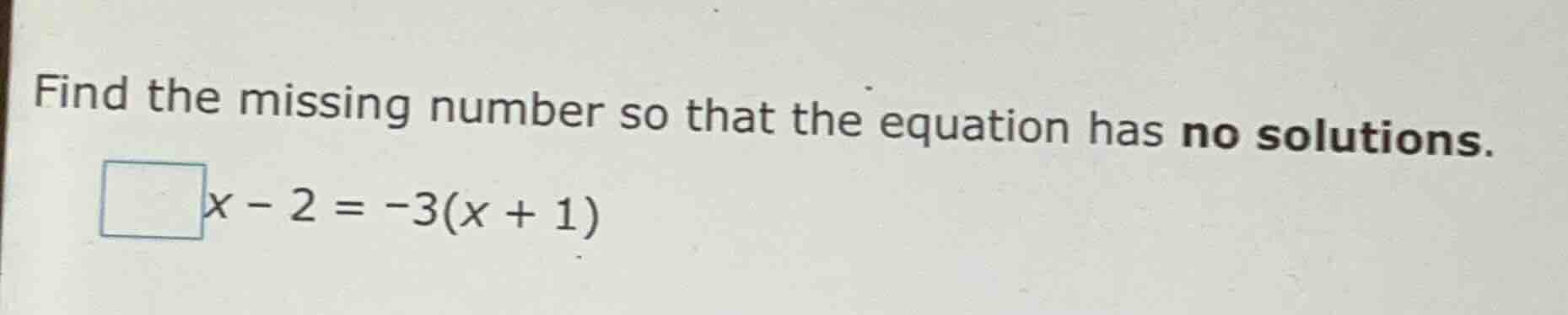
find the missing number so that the equation has no solutions.
\boxed{}x - 2 = -3(x + 1)
Step1: Expand the right side
First, we expand the right - hand side of the equation \(-3(x + 1)\) using the distributive property \(a(b + c)=ab+ac\). So, \(-3(x + 1)=-3x-3\). The equation becomes \(\square x-2=-3x - 3\).
Step2: Rearrange the equation
Let's move all the \(x\) terms to one side. Add \(3x\) to both sides of the equation: \(\square x+3x-2=-3x + 3x-3\), which simplifies to \((\square + 3)x-2=-3\). Then add 2 to both sides: \((\square + 3)x-2 + 2=-3 + 2\), so \((\square + 3)x=-1\).
Step3: Determine the condition for no solution
For a linear equation of the form \(ax = b\) (where \(a\) and \(b\) are constants and \(x\) is the variable), the equation has no solution when \(a = 0\) and \(b
eq0\). In our equation \((\square + 3)x=-1\), we want the coefficient of \(x\) (i.e., \(\square + 3\)) to be equal to 0, and the right - hand side \(-1
eq0\) (which is already true). So we set \(\square+3 = 0\).
Step4: Solve for the missing number
Solve the equation \(\square+3 = 0\) for \(\square\). Subtract 3 from both sides: \(\square=0 - 3=-3\).

Snap & solve any problem in the app
Get step-by-step solutions on Sovi AI
Photo-based solutions with guided steps
Explore more problems and detailed explanations
\(-3\)