QUESTION IMAGE
Question
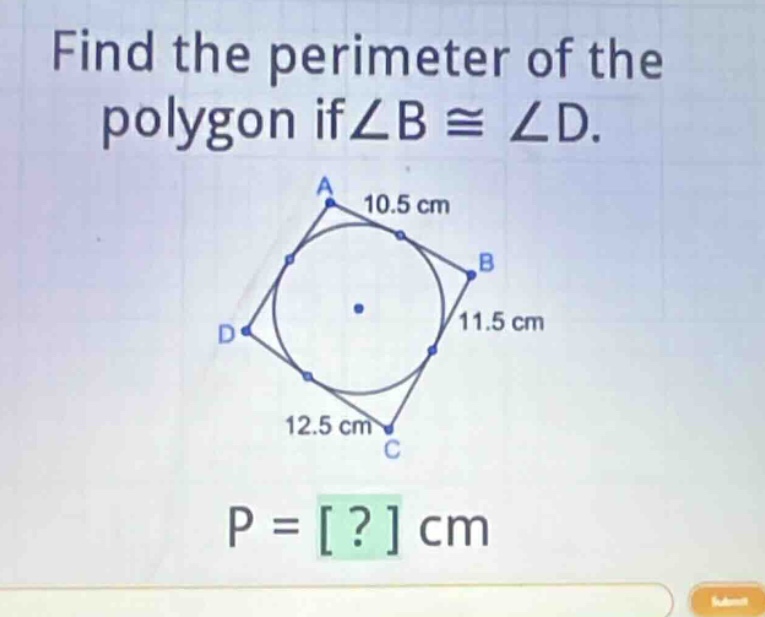
find the perimeter of the polygon if $\angle b \cong \angle d$.
a 10.5 cm
d
12.5 cm c
b 11.5 cm
$p = ?$ cm
Step1: Identify the polygon type
The polygon is a tangential quadrilateral (has an incircle), and since \( \angle B \cong \angle D \), and in a tangential quadrilateral with two pairs of equal angles (here \( \angle B \cong \angle D \), and likely \( \angle A \cong \angle C \) by symmetry or properties), the opposite sides related to the equal angles should be equal? Wait, actually, in a tangential quadrilateral, the sum of the lengths of opposite sides are equal? No, the property is that the sums of the lengths of the two pairs of opposite sides are equal? Wait, no, the correct property for a tangential quadrilateral (a quadrilateral with an incircle) is that the sum of the lengths of the two opposite sides are equal? Wait, no, the formula for the perimeter of a tangential quadrilateral is \( P = 2(a + b) \) where \( a \) and \( b \) are the sums of adjacent sides? Wait, no, let's look at the given sides. The sides are \( AB = 10.5 \), \( BC = 11.5 \), \( CD = 12.5 \), and since \( \angle B \cong \angle D \), the quadrilateral is symmetric with respect to the angle bisector, so \( AD = BC = 11.5 \)? Wait, no, maybe the pairs of opposite sides: in a tangential quadrilateral with \( \angle B \cong \angle D \), the sides \( AB \) and \( CD \) are one pair, and \( BC \) and \( AD \) are the other? Wait, no, let's think again. The polygon has an incircle, so it's a tangential quadrilateral. In a tangential quadrilateral, the sum of the lengths of the two opposite sides are equal? Wait, no, the correct property is that the sum of the lengths of the two adjacent sides (forming a pair) is equal to the sum of the other two adjacent sides. Wait, actually, for a tangential quadrilateral, \( AB + CD = BC + AD \). Wait, let's check the given sides. \( AB = 10.5 \), \( BC = 11.5 \), \( CD = 12.5 \). Let's assume that \( AD = BC = 11.5 \)? No, that might not be right. Wait, maybe the quadrilateral is a kite? No, because \( \angle B \cong \angle D \). Wait, another approach: since the polygon has an incircle, the lengths of the tangents from a vertex to the incircle are equal. So, from \( A \), the tangents to the circle are equal, from \( B \) are equal, from \( C \) are equal, from \( D \) are equal. Let's denote the tangent lengths: from \( A \): \( x \), from \( B \): \( y \), from \( C \): \( z \), from \( D \): \( w \). Then \( AB = x + y \), \( BC = y + z \), \( CD = z + w \), \( DA = w + x \). Then the perimeter \( P = AB + BC + CD + DA = (x + y) + (y + z) + (z + w) + (w + x) = 2(x + y + z + w) \). Now, since \( \angle B \cong \angle D \), the quadrilateral is symmetric with respect to the angle bisector, so \( x = z \) and \( y = w \)? Wait, maybe. If \( \angle B \cong \angle D \), then the tangents from \( B \) and \( D \) should be equal, so \( y = w \), and tangents from \( A \) and \( C \) should be equal, so \( x = z \). Then \( AB = x + y \), \( BC = y + x \) (since \( z = x \)), \( CD = x + y \) (since \( z = x \) and \( w = y \)), \( DA = y + x \). Wait, no, that would make it a kite, but the given sides are \( AB = 10.5 \), \( BC = 11.5 \), \( CD = 12.5 \). Wait, that doesn't match. Wait, maybe I made a mistake. Wait, the problem says \( \angle B \cong \angle D \), so the quadrilateral is symmetric in angles, so the sides adjacent to \( \angle B \) and \( \angle D \) should be equal. So \( AB = CD \) and \( BC = AD \)? Wait, \( AB = 10.5 \), \( CD = 12.5 \), that's not equal. Wait, maybe not. Wait, let's look at the given lengths. The sides are \( AB = 10.5 \), \( BC = 11.5 \), \( CD = 12.5 \), and we need to find \( AD \). Sin…

Snap & solve any problem in the app
Get step-by-step solutions on Sovi AI
Photo-based solutions with guided steps
Explore more problems and detailed explanations
46