QUESTION IMAGE
Question
find k.
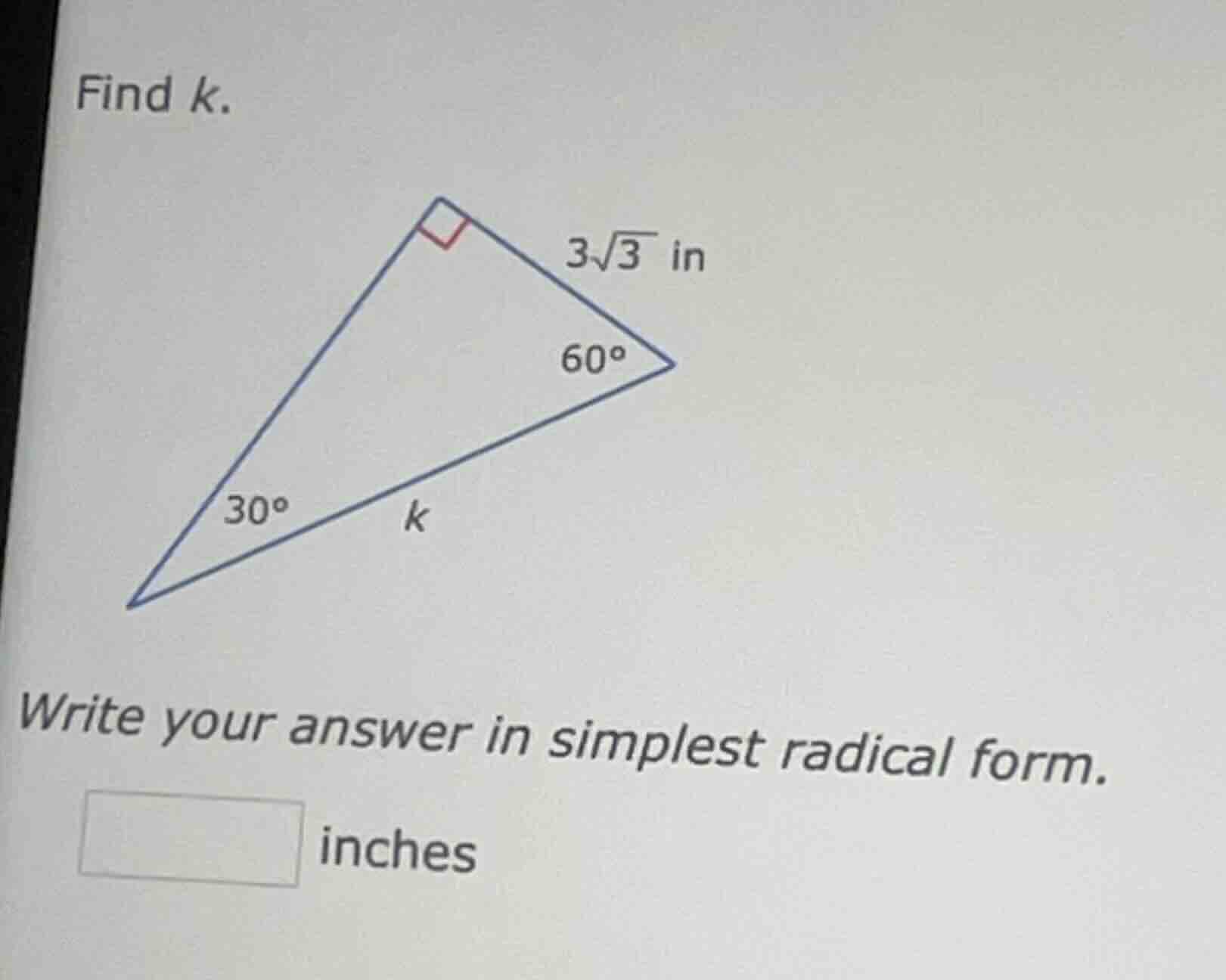
right triangle with angles 30°, 60°, right angle; side adjacent to 30° is 3√3 in, hypotenuse is k
write your answer in simplest radical form.
blank inches
Step1: Identify triangle type
This is a 30 - 60 - 90 right triangle. In a 30 - 60 - 90 triangle, the sides are in the ratio \(1:\sqrt{3}:2\), where the side opposite \(30^{\circ}\) is the shortest side (let's call it \(x\)), the side opposite \(60^{\circ}\) is \(x\sqrt{3}\), and the hypotenuse is \(2x\).
Step2: Determine which side is given
The side given is \(3\sqrt{3}\) inches, and it is opposite the \(30^{\circ}\) angle? Wait, no. Wait, the right angle is between the side of length \(3\sqrt{3}\) and the other leg. Wait, let's label the triangle. Let the right angle be at \(C\), the \(30^{\circ}\) angle at \(A\), and \(60^{\circ}\) angle at \(B\). Then side \(BC = 3\sqrt{3}\) (adjacent to \(60^{\circ}\), opposite to \(30^{\circ}\)), side \(AC\) is the other leg, and hypotenuse \(AB=k\).
In a 30 - 60 - 90 triangle, \(\cos(60^{\circ})=\frac{\text{adjacent}}{\text{hypotenuse}}\). The adjacent side to \(60^{\circ}\) is \(3\sqrt{3}\), and hypotenuse is \(k\). We know that \(\cos(60^{\circ})=\frac{1}{2}\). So \(\cos(60^{\circ})=\frac{3\sqrt{3}}{k}\)
Step3: Solve for \(k\)
We have \(\frac{1}{2}=\frac{3\sqrt{3}}{k}\). Cross - multiplying gives \(k = 2\times3\sqrt{3}\)? Wait, no, that's wrong. Wait, maybe using sine. \(\sin(30^{\circ})=\frac{\text{opposite}}{\text{hypotenuse}}\). The opposite side to \(30^{\circ}\) is \(3\sqrt{3}\)? Wait, no, let's re - examine.
Wait, in a 30 - 60 - 90 triangle, the side opposite \(30^{\circ}\) is the shortest side. Let's say the side opposite \(30^{\circ}\) is \(a\), opposite \(60^{\circ}\) is \(a\sqrt{3}\), hypotenuse is \(2a\).
Looking at the triangle, the side with length \(3\sqrt{3}\) is opposite the \(30^{\circ}\) angle? No, wait the angle of \(30^{\circ}\) is at the vertex where the hypotenuse \(k\) and the other leg meet. Wait, the right angle is between the leg of length \(3\sqrt{3}\) and the leg opposite to \(30^{\circ}\). Wait, maybe using tangent. \(\tan(30^{\circ})=\frac{\text{opposite}}{\text{adjacent}}\). The opposite side to \(30^{\circ}\) is \(3\sqrt{3}\)? No, I think I made a mistake.
Wait, another approach: In a 30 - 60 - 90 triangle, the hypotenuse is twice the length of the shorter leg (the leg opposite \(30^{\circ}\)). Let the shorter leg (opposite \(30^{\circ}\)) be \(x\), then hypotenuse \(= 2x\), and the longer leg (opposite \(60^{\circ}\)) is \(x\sqrt{3}\).
Looking at the triangle, the side of length \(3\sqrt{3}\) is the longer leg (opposite \(60^{\circ}\)), so \(x\sqrt{3}=3\sqrt{3}\), which means \(x = 3\). Then the hypotenuse \(k = 2x=6\)? Wait, no, wait. Wait, if the longer leg (opposite \(60^{\circ}\)) is \(x\sqrt{3}=3\sqrt{3}\), then \(x = 3\). Then the hypotenuse (opposite the right angle) is \(2x = 6\)? Wait, no, the hypotenuse is opposite the right angle. Wait, the right angle is between the two legs. So the legs are \(x\) (opposite \(30^{\circ}\)) and \(x\sqrt{3}\) (opposite \(60^{\circ}\)), hypotenuse is \(2x\).
Given that the leg opposite \(60^{\circ}\) is \(3\sqrt{3}\), so \(x\sqrt{3}=3\sqrt{3}\implies x = 3\). Then the hypotenuse \(k = 2x=6\)? Wait, no, let's use trigonometry. Let's take angle \(60^{\circ}\). \(\sin(60^{\circ})=\frac{\text{opposite}}{\text{hypotenuse}}\). The opposite side to \(60^{\circ}\) is the leg opposite, which is the leg adjacent to \(30^{\circ}\). Wait, maybe I confused the sides.
Wait, let's label the triangle properly. Let \(\angle A = 30^{\circ}\), \(\angle B=60^{\circ}\), \(\angle C = 90^{\circ}\). Then side \(BC\) is opposite \(\angle A\) (30°), so \(BC=x\), side \(AC\) is opposite \(\angle B\) (60°), so \(AC = x\sqrt{3}\…

Snap & solve any problem in the app
Get step-by-step solutions on Sovi AI
Photo-based solutions with guided steps
Explore more problems and detailed explanations
\(6\)