QUESTION IMAGE
Question
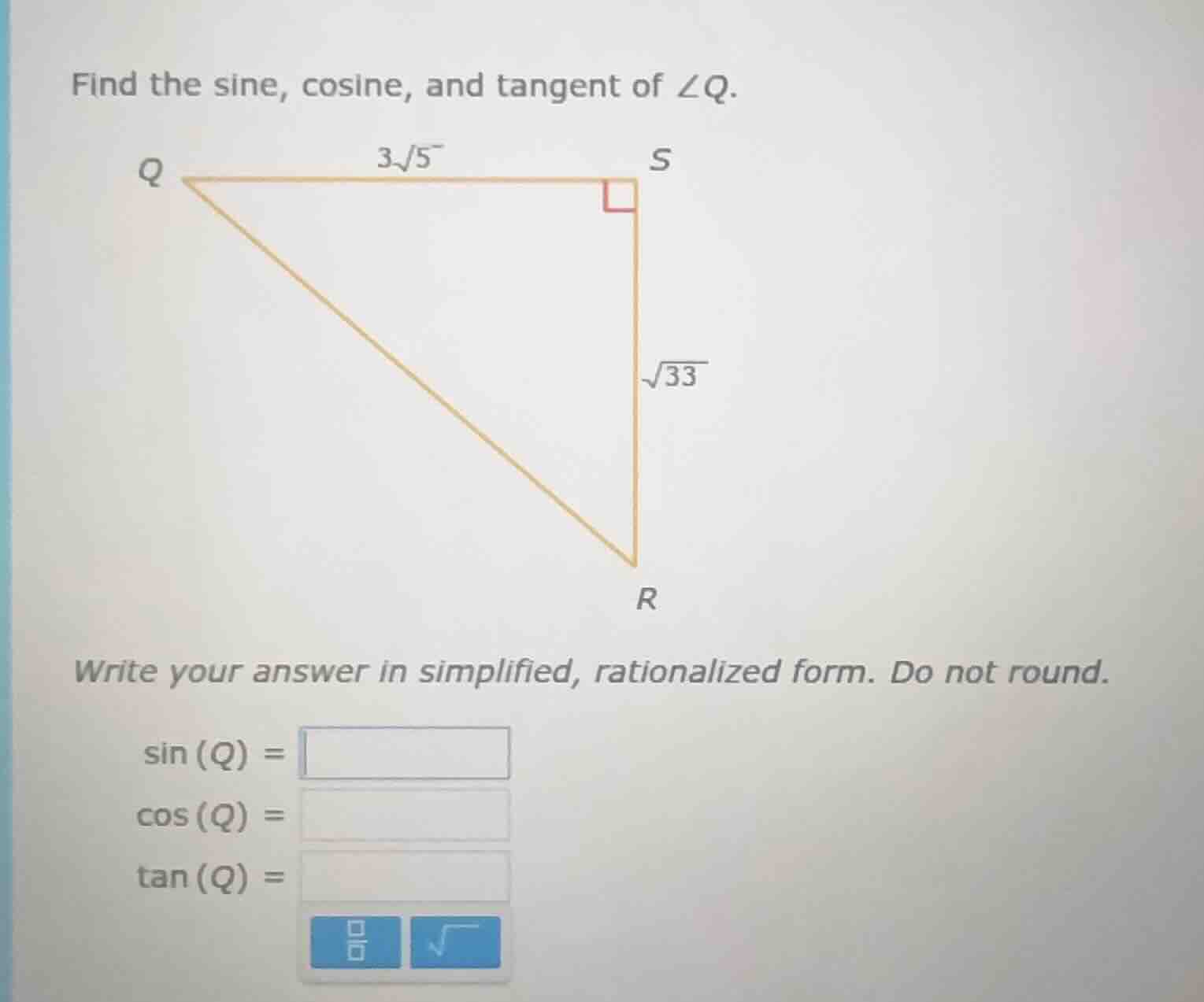
find the sine, cosine, and tangent of $\angle q$.
right triangle qsr with right angle at s, qs = $3\sqrt{5}$, sr = $\sqrt{33}$
write your answer in simplified, rationalized form. do not round.
$\sin(q) = \square$
$\cos(q) = \square$
$\tan(q) = \square$
Step1: Find the hypotenuse \( QR \)
In right triangle \( QSR \), by Pythagorean theorem \( QR^2 = QS^2 + SR^2 \). Given \( QS = 3\sqrt{5} \), \( SR=\sqrt{33} \).
\[
\]
So \( QR=\sqrt{78} = \sqrt{6\times13}= \sqrt{6}\times\sqrt{13}\) (but we can keep it as \(\sqrt{78}\) for now).
Step2: Calculate \( \sin(Q) \)
\(\sin(Q)=\frac{\text{opposite}}{\text{hypotenuse}}=\frac{SR}{QR}\)
\[
\]
Wait, maybe a simpler way: simplify \( \frac{\sqrt{33}}{\sqrt{78}}=\frac{\sqrt{33}}{\sqrt{33\times2.36...}} \) no, better to simplify \( \sqrt{78}=\sqrt{3\times26}=\sqrt{3\times2\times13} \), \( \sqrt{33}=\sqrt{3\times11} \). So \( \frac{\sqrt{33}}{\sqrt{78}}=\frac{\sqrt{3\times11}}{\sqrt{3\times26}}=\frac{\sqrt{11}}{\sqrt{26}}=\frac{\sqrt{11}\times\sqrt{26}}{26}=\frac{\sqrt{286}}{26} \) (same as before). Wait, maybe I made a mistake in Pythagorean theorem. Wait \( (3\sqrt{5})^2 = 9*5=45 \), \( (\sqrt{33})^2=33 \), 45 +33=78, correct.
Wait, alternatively, let's re - express:
\(\sin(Q)=\frac{SR}{QR}=\frac{\sqrt{33}}{\sqrt{78}}=\frac{\sqrt{33}}{\sqrt{33\times2.36}} \) no, wait 78 = 33 + 45, yes. Wait, maybe factor 78 and 33: 33 = 311, 78=326. So \( \frac{\sqrt{33}}{\sqrt{78}}=\frac{\sqrt{3\times11}}{\sqrt{3\times26}}=\frac{\sqrt{11}}{\sqrt{26}}=\frac{\sqrt{11}\times\sqrt{26}}{26}=\frac{\sqrt{286}}{26} \)
Step3: Calculate \( \cos(Q) \)
\(\cos(Q)=\frac{\text{adjacent}}{\text{hypotenuse}}=\frac{QS}{QR}\)
\[
\]
Alternatively, \( \frac{3\sqrt{5}}{\sqrt{78}}=\frac{3\sqrt{5}}{\sqrt{5\times15.6}} \) no, 78 = 515.6 no, 78=515.6 is wrong. 78 divided by 5 is 15.6, no. Wait 78 = 326, 515.6 is not helpful. Wait, 3\sqrt{5} over \sqrt{78} can be rationalized as \( \frac{3\sqrt{5}\times\sqrt{78}}{78}=\frac{3\sqrt{390}}{78}=\frac{\sqrt{390}}{26} \) (since 390 = 578, 78=326, so \(\sqrt{390}=\sqrt{5\times3\times26}\))
Step4: Calculate \( \tan(Q) \)
\(\tan(Q)=\frac{\text{opposite}}{\text{adjacent}}=\frac{SR}{QS}\)
\[
\]
Wait, maybe I messed up the hypotenuse calculation. Wait, let's check again: \( QS = 3\sqrt{5} \), \( SR=\sqrt{33} \), right triangle at S. So \( QR^2=QS^2 + SR^2=(3\sqrt{5})^2+(\sqrt{33})^2 = 45 + 33=78 \), correct. So \( QR=\sqrt{78} \)
Now, \( \sin(Q)=\frac{SR}{QR}=\frac{\sqrt{33}}{\sqrt{78}}=\frac{\sqrt{33}}{\sqrt{33\times2.36...}} \) no, \( \sqrt{78}=\sqrt{33 + 45}=\sqrt{33+ (3\sqrt{5})^2} \), correct.
Wait, another approach: simplify \( \frac{\sqrt{33}}{\sqrt{78}}=\frac{\sqrt{33}}{\sqrt{33\times2.36}} \) no, 78 = 332.36 is not an integer. Wait, 78 = 332 + 12? No, 332=66, 78-66=12. No, 78= 239=2313, 33=3*11. So \( \frac{\sqrt{33}}{\sqrt{78}}=\frac{\sqrt{3\times11}}{\sqrt{2\times3\times13}}=\frac{\s…

Snap & solve any problem in the app
Get step-by-step solutions on Sovi AI
Photo-based solutions with guided steps
Explore more problems and detailed explanations
\( \sin(Q)=\boldsymbol{\frac{\sqrt{286}}{26}} \)
\( \cos(Q)=\boldsymbol{\frac{\sqrt{390}}{26}} \)
\( \tan(Q)=\boldsymbol{\frac{\sqrt{165}}{15}} \)