QUESTION IMAGE
Question
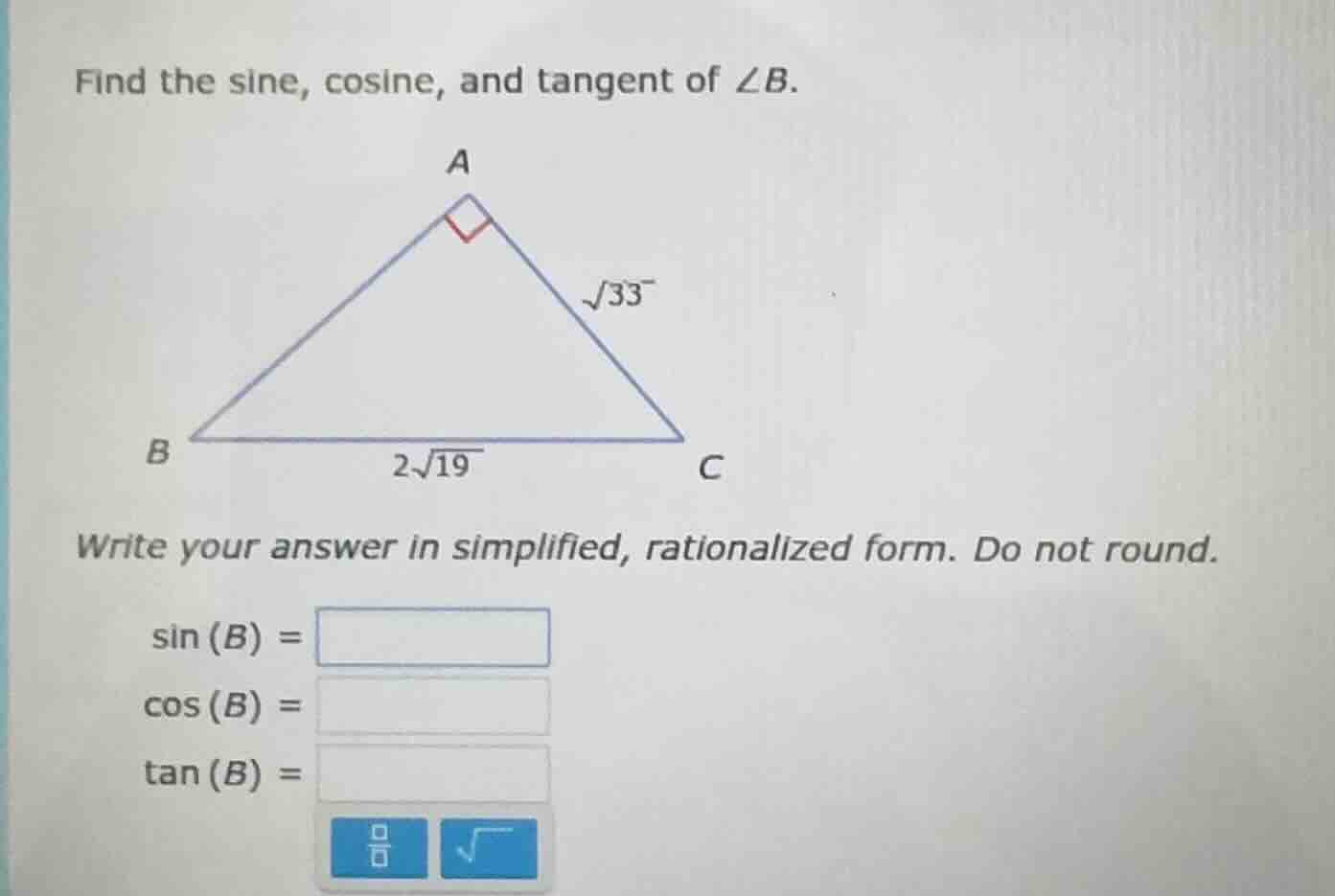
find the sine, cosine, and tangent of ∠b.
triangle with right angle at a, side ac = √33, side bc = 2√19, vertices b, a, c
write your answer in simplified, rationalized form. do not round.
sin (b) =
cos (b) =
tan (b) =
fraction and square root buttons
Step1: Find the length of AB
In right triangle \(ABC\) with \(\angle A = 90^\circ\), by the Pythagorean theorem \(BC^2=AB^2 + AC^2\). We know \(BC = 2\sqrt{19}\), \(AC=\sqrt{33}\). Let \(AB = x\), then \((2\sqrt{19})^2=x^2+(\sqrt{33})^2\). Calculate: \(4\times19=x^2 + 33\), \(76=x^2+33\), so \(x^2=76 - 33 = 43\), then \(x=\sqrt{43}\) (since length is positive).
Step2: Calculate \(\sin(B)\)
In a right triangle, \(\sin(B)=\frac{\text{opposite}}{\text{hypotenuse}}\). For \(\angle B\), the opposite side is \(AC=\sqrt{33}\), hypotenuse is \(BC = 2\sqrt{19}\). So \(\sin(B)=\frac{\sqrt{33}}{2\sqrt{19}}\). Rationalize the denominator: multiply numerator and denominator by \(\sqrt{19}\), we get \(\frac{\sqrt{33}\times\sqrt{19}}{2\times19}=\frac{\sqrt{627}}{38}\). Wait, actually, \(\sqrt{33\times19}=\sqrt{627}\), but maybe we can check again. Wait, no, let's re - check the Pythagorean theorem. Wait, \(BC\) is the hypotenuse, \(AC\) and \(AB\) are the legs. So \(BC^2=AB^2 + AC^2\), so \(AB=\sqrt{BC^2 - AC^2}=\sqrt{(2\sqrt{19})^2-(\sqrt{33})^2}=\sqrt{4\times19 - 33}=\sqrt{76 - 33}=\sqrt{43}\), that's correct.
Step3: Calculate \(\cos(B)\)
\(\cos(B)=\frac{\text{adjacent}}{\text{hypotenuse}}\). The adjacent side to \(\angle B\) is \(AB = \sqrt{43}\), hypotenuse is \(BC = 2\sqrt{19}\). So \(\cos(B)=\frac{\sqrt{43}}{2\sqrt{19}}\). Rationalize the denominator: multiply numerator and denominator by \(\sqrt{19}\), we get \(\frac{\sqrt{43}\times\sqrt{19}}{2\times19}=\frac{\sqrt{817}}{38}\).
Step4: Calculate \(\tan(B)\)
\(\tan(B)=\frac{\text{opposite}}{\text{adjacent}}=\frac{AC}{AB}=\frac{\sqrt{33}}{\sqrt{43}}\). Rationalize the denominator: multiply numerator and denominator by \(\sqrt{43}\), we get \(\frac{\sqrt{33}\times\sqrt{43}}{43}=\frac{\sqrt{1419}}{43}\). Wait, no, wait, let's re - express:
Wait, \(\sin(B)=\frac{AC}{BC}=\frac{\sqrt{33}}{2\sqrt{19}}=\frac{\sqrt{33}\sqrt{19}}{2\times19}=\frac{\sqrt{627}}{38}\) (because \(\sqrt{a}\times\sqrt{b}=\sqrt{ab}\)), \(\cos(B)=\frac{AB}{BC}=\frac{\sqrt{43}}{2\sqrt{19}}=\frac{\sqrt{43}\sqrt{19}}{2\times19}=\frac{\sqrt{817}}{38}\), \(\tan(B)=\frac{AC}{AB}=\frac{\sqrt{33}}{\sqrt{43}}=\frac{\sqrt{33\times43}}{43}=\frac{\sqrt{1419}}{43}\). Wait, but maybe I made a mistake in the Pythagorean theorem. Wait, \(BC = 2\sqrt{19}\), so \(BC^2=4\times19 = 76\), \(AC^2 = 33\), so \(AB^2=76 - 33=43\), so \(AB=\sqrt{43}\), that's correct.
Wait, let's re - calculate \(\sin(B)\): opposite side to \(B\) is \(AC=\sqrt{33}\), hypotenuse is \(BC = 2\sqrt{19}\), so \(\sin(B)=\frac{\sqrt{33}}{2\sqrt{19}}=\frac{\sqrt{33}\times\sqrt{19}}{2\times19}=\frac{\sqrt{627}}{38}\). \(\cos(B)=\frac{AB}{BC}=\frac{\sqrt{43}}{2\sqrt{19}}=\frac{\sqrt{43}\times\sqrt{19}}{2\times19}=\frac{\sqrt{817}}{38}\). \(\tan(B)=\frac{AC}{AB}=\frac{\sqrt{33}}{\sqrt{43}}=\frac{\sqrt{33\times43}}{43}=\frac{\sqrt{1419}}{43}\). Alternatively, we can write \(\sin(B)=\frac{\sqrt{627}}{38}\), \(\cos(B)=\frac{\sqrt{817}}{38}\), \(\tan(B)=\frac{\sqrt{1419}}{43}\). But let's check if we can simplify \(\sqrt{627}\), \(\sqrt{817}\), \(\sqrt{1419}\) further. \(627 = 3\times11\times19\), \(817=19\times43\), \(1419 = 3\times11\times43\). So no further simplification.
Wait, maybe I made a mistake in identifying the sides. Wait, in right triangle \(ABC\), right - angled at \(A\), so the sides: \(AB\) and \(AC\) are legs, \(BC\) is hypotenuse. So for angle \(B\):
- Opposite side: \(AC\)
- Adjacent side: \(AB\)
- Hypotenuse: \(BC\)
So \(\sin(B)=\frac{AC}{BC}=\frac{\sqrt{33}}{2\sqrt{19}}=\frac{\sqrt{33}\sqrt{19}}{2\times19}=\frac{\sqrt{627}}{38}\)
\(\cos(B)=\frac…

Snap & solve any problem in the app
Get step-by-step solutions on Sovi AI
Photo-based solutions with guided steps
Explore more problems and detailed explanations
\(\sin(B)=\boldsymbol{\frac{\sqrt{627}}{38}}\)
\(\cos(B)=\boldsymbol{\frac{\sqrt{817}}{38}}\)
\(\tan(B)=\boldsymbol{\frac{\sqrt{1419}}{43}}\)
(Alternatively, if we don't rationalize the denominator at first, \(\sin(B)=\frac{\sqrt{33}}{2\sqrt{19}}\), \(\cos(B)=\frac{\sqrt{43}}{2\sqrt{19}}\), \(\tan(B)=\frac{\sqrt{33}}{\sqrt{43}}\), but the problem asks for rationalized form. Wait, actually, when rationalizing \(\frac{\sqrt{33}}{2\sqrt{19}}\), multiply numerator and denominator by \(\sqrt{19}\): \(\frac{\sqrt{33}\times\sqrt{19}}{2\times19}=\frac{\sqrt{627}}{38}\), since \(33\times19 = 627\), \(43\times19=817\), \(33\times43 = 1419\))