QUESTION IMAGE
Question
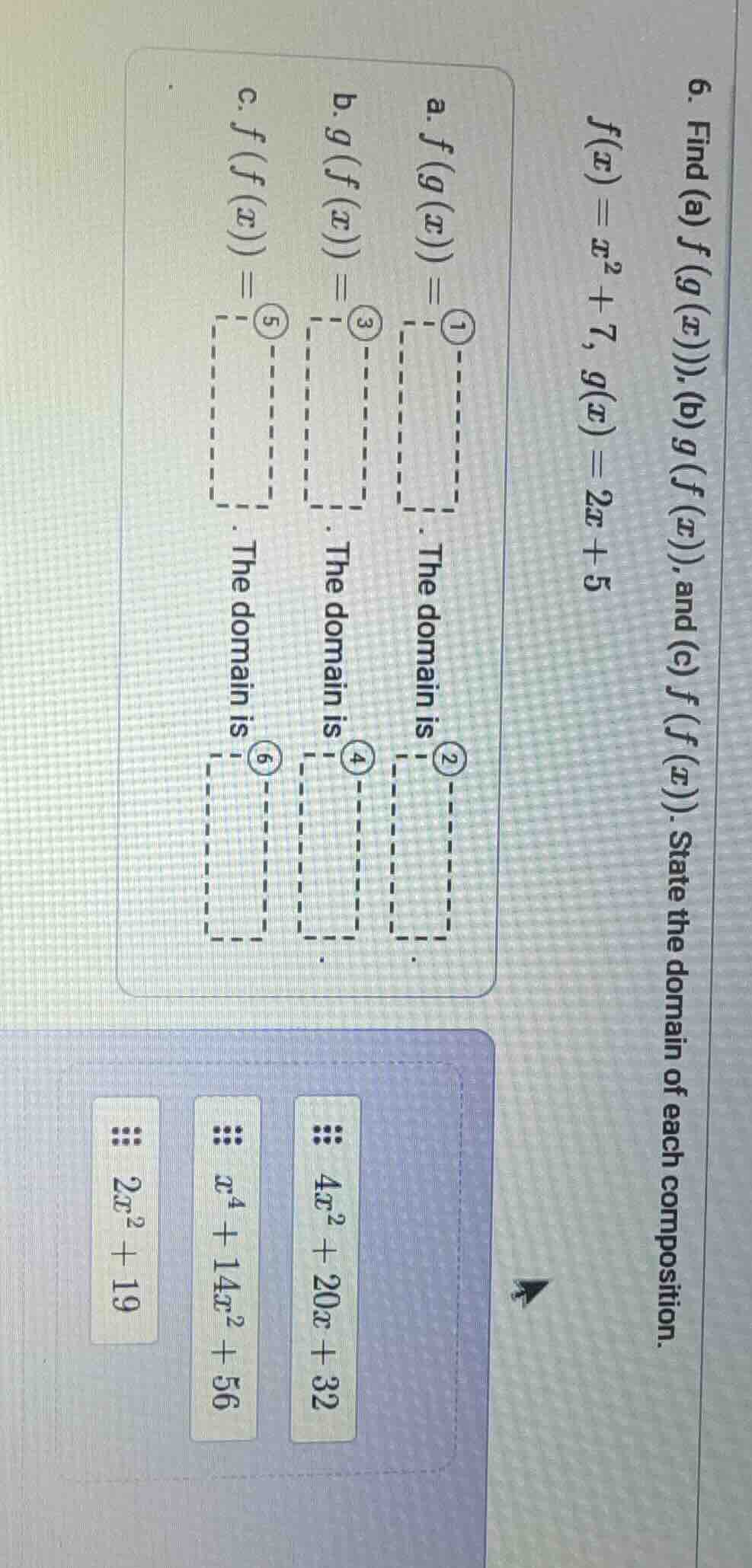
- find (a) ( f(g(x)) ), (b) ( g(f(x)) ), and (c) ( f(f(x)) ). state the domain of each composition. ( f(x) = x^2 + 7 ), ( g(x) = 2x + 5 )
a. ( f(g(x)) = \boxed{1} ). the domain is \boxed{2}.
b. ( g(f(x)) = \boxed{3} ). the domain is \boxed{4}.
c. ( f(f(x)) = \boxed{5} ). the domain is \boxed{6}.
options: ( 4x^2 + 20x + 32 ), ( x^4 + 14x^2 + 56 ), ( 2x^2 + 19 )
Part (a): \( f(g(x)) \)
Step 1: Substitute \( g(x) \) into \( f(x) \)
We know \( f(x) = x^2 + 7 \) and \( g(x) = 2x + 5 \). To find \( f(g(x)) \), we replace \( x \) in \( f(x) \) with \( g(x) \). So we have:
\( f(g(x)) = (g(x))^2 + 7 \)
Substitute \( g(x)=2x + 5 \) into the above formula:
\( f(g(x))=(2x + 5)^2+7 \)
Step 2: Expand \( (2x + 5)^2 \)
Using the formula \( (a + b)^2=a^2+2ab + b^2 \), where \( a = 2x \) and \( b = 5 \), we get:
\( (2x + 5)^2=(2x)^2+2\times(2x)\times5+5^2=4x^2 + 20x+25 \)
Step 3: Simplify the expression
Now we substitute the expanded form back into \( f(g(x)) \):
\( f(g(x))=4x^2 + 20x + 25+7=4x^2+20x + 32 \)
Step 4: Determine the domain
The function \( g(x)=2x + 5 \) is a linear function, and \( f(x)=x^2+7 \) is a quadratic function. The composition \( f(g(x)) \) is a polynomial function. The domain of a polynomial function is all real numbers, \( (-\infty,\infty) \)
Part (b): \( g(f(x)) \)
Step 1: Substitute \( f(x) \) into \( g(x) \)
We know \( g(x)=2x + 5 \) and \( f(x)=x^2+7 \). To find \( g(f(x)) \), we replace \( x \) in \( g(x) \) with \( f(x) \). So we have:
\( g(f(x))=2(f(x))+5 \)
Substitute \( f(x)=x^2 + 7 \) into the above formula:
\( g(f(x))=2(x^2 + 7)+5 \)
Step 2: Simplify the expression
Using the distributive property \( a(b + c)=ab+ac \), we get:
\( g(f(x))=2x^2+14 + 5=2x^2+19 \)
Step 3: Determine the domain
The function \( f(x)=x^2 + 7 \) is a quadratic function, and \( g(x)=2x + 5 \) is a linear function. The composition \( g(f(x)) \) is a polynomial function. The domain of a polynomial function is all real numbers, \( (-\infty,\infty) \)
Part (c): \( f(f(x)) \)
Step 1: Substitute \( f(x) \) into \( f(x) \)
We know \( f(x)=x^2 + 7 \). To find \( f(f(x)) \), we replace \( x \) in \( f(x) \) with \( f(x) \). So we have:
\( f(f(x))=(f(x))^2+7 \)
Substitute \( f(x)=x^2 + 7 \) into the above formula:
\( f(f(x))=(x^2 + 7)^2+7 \)
Step 2: Expand \( (x^2 + 7)^2 \)
Using the formula \( (a + b)^2=a^2+2ab + b^2 \), where \( a=x^2 \) and \( b = 7 \), we get:
\( (x^2+7)^2=(x^2)^2+2\times x^2\times7 + 7^2=x^4+14x^2 + 49 \)
Step 3: Simplify the expression
Now we substitute the expanded form back into \( f(f(x)) \):
\( f(f(x))=x^4+14x^2 + 49+7=x^4+14x^2+56 \)
Step 4: Determine the domain
The function \( f(x)=x^2 + 7 \) is a quadratic function. The composition \( f(f(x)) \) is a polynomial function. The domain of a polynomial function is all real numbers, \( (-\infty,\infty) \)
Final Answers:
a. \( f(g(x))=\boldsymbol{4x^2 + 20x+32} \), Domain: \( \boldsymbol{(-\infty,\infty)} \)
b. \( g(f(x))=\boldsymbol{2x^2+19} \), Domain: \( \boldsymbol{(-\infty,\infty)} \)
c. \( f(f(x))=\boldsymbol{x^4 + 14x^2+56} \), Domain: \( \boldsymbol{(-\infty,\infty)} \)

Snap & solve any problem in the app
Get step-by-step solutions on Sovi AI
Photo-based solutions with guided steps
Explore more problems and detailed explanations
Step 1: Substitute \( f(x) \) into \( f(x) \)
We know \( f(x)=x^2 + 7 \). To find \( f(f(x)) \), we replace \( x \) in \( f(x) \) with \( f(x) \). So we have:
\( f(f(x))=(f(x))^2+7 \)
Substitute \( f(x)=x^2 + 7 \) into the above formula:
\( f(f(x))=(x^2 + 7)^2+7 \)
Step 2: Expand \( (x^2 + 7)^2 \)
Using the formula \( (a + b)^2=a^2+2ab + b^2 \), where \( a=x^2 \) and \( b = 7 \), we get:
\( (x^2+7)^2=(x^2)^2+2\times x^2\times7 + 7^2=x^4+14x^2 + 49 \)
Step 3: Simplify the expression
Now we substitute the expanded form back into \( f(f(x)) \):
\( f(f(x))=x^4+14x^2 + 49+7=x^4+14x^2+56 \)
Step 4: Determine the domain
The function \( f(x)=x^2 + 7 \) is a quadratic function. The composition \( f(f(x)) \) is a polynomial function. The domain of a polynomial function is all real numbers, \( (-\infty,\infty) \)
Final Answers:
a. \( f(g(x))=\boldsymbol{4x^2 + 20x+32} \), Domain: \( \boldsymbol{(-\infty,\infty)} \)
b. \( g(f(x))=\boldsymbol{2x^2+19} \), Domain: \( \boldsymbol{(-\infty,\infty)} \)
c. \( f(f(x))=\boldsymbol{x^4 + 14x^2+56} \), Domain: \( \boldsymbol{(-\infty,\infty)} \)