QUESTION IMAGE
Question
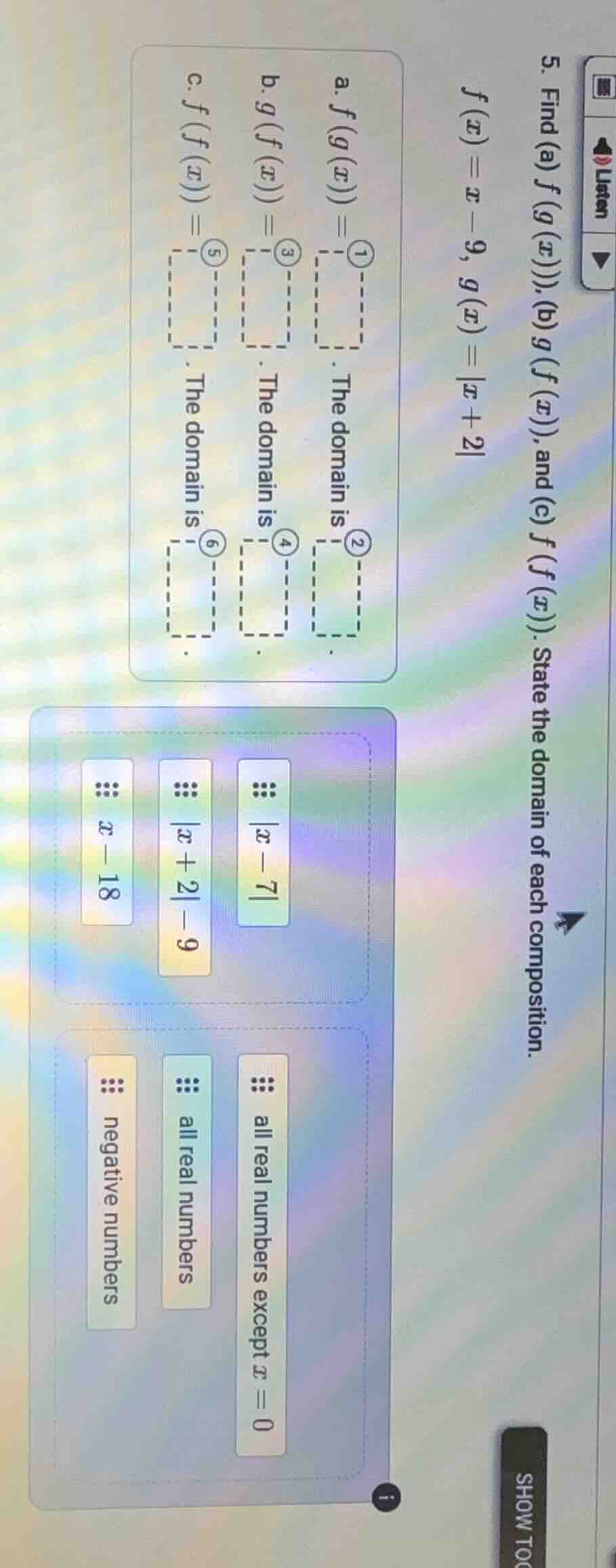
- find (a) ( f(g(x)) ), (b) ( g(f(x)) ), and (c) ( f(f(x)) ). state the domain of each composition. ( f(x) = x - 9 ), ( g(x) = |x + 2| )
a. ( f(g(x)) = ) (\boldsymbol{①}) (\boldsymbol{.}) the domain is (\boldsymbol{②}) (\boldsymbol{.})
b. ( g(f(x)) = ) (\boldsymbol{③}) (\boldsymbol{.}) the domain is (\boldsymbol{④}) (\boldsymbol{.})
c. ( f(f(x)) = ) (\boldsymbol{⑤}) (\boldsymbol{.}) the domain is (\boldsymbol{⑥}) (\boldsymbol{.})
(\boldsymbol{|x - 7|}) (\boldsymbol{|x + 2| - 9}) (\boldsymbol{x - 18})
(\boldsymbol{all real numbers except x = 0}) (\boldsymbol{all real numbers}) (\boldsymbol{negative numbers})
Part (a): \( f(g(x)) \)
Step 1: Substitute \( g(x) \) into \( f \)
We know \( f(x) = x - 9 \) and \( g(x) = |x + 2| \). To find \( f(g(x)) \), we replace \( x \) in \( f(x) \) with \( g(x) \). So:
\( f(g(x)) = g(x) - 9 = |x + 2| - 9 \)
Step 2: Determine the domain
The function \( g(x) = |x + 2| \) has a domain of all real numbers (since absolute value functions are defined for all real \( x \)), and when we substitute it into \( f(x) \), there are no additional restrictions. So the domain of \( f(g(x)) \) is all real numbers.
Part (b): \( g(f(x)) \)
Step 1: Substitute \( f(x) \) into \( g \)
We know \( g(x) = |x + 2| \) and \( f(x) = x - 9 \). To find \( g(f(x)) \), we replace \( x \) in \( g(x) \) with \( f(x) \). So:
\( g(f(x)) = |f(x) + 2| = |(x - 9) + 2| = |x - 7| \)
Step 2: Determine the domain
The function \( f(x) = x - 9 \) has a domain of all real numbers, and the absolute value function \( |x - 7| \) is defined for all real \( x \). So the domain of \( g(f(x)) \) is all real numbers.
Part (c): \( f(f(x)) \)
Step 1: Substitute \( f(x) \) into \( f \)
We know \( f(x) = x - 9 \). To find \( f(f(x)) \), we replace \( x \) in \( f(x) \) with \( f(x) \). So:
\( f(f(x)) = f(x) - 9 = (x - 9) - 9 = x - 18 \)
Step 2: Determine the domain
The function \( f(x) = x - 9 \) is a linear function, which is defined for all real numbers. Composing it with itself (substituting \( f(x) \) into \( f \)) doesn't introduce any new restrictions. So the domain of \( f(f(x)) \) is all real numbers.

Snap & solve any problem in the app
Get step-by-step solutions on Sovi AI
Photo-based solutions with guided steps
Explore more problems and detailed explanations
s:
a. \( f(g(x)) = \boldsymbol{|x + 2| - 9} \); Domain: \(\boldsymbol{\text{all real numbers}}\)
b. \( g(f(x)) = \boldsymbol{|x - 7|} \); Domain: \(\boldsymbol{\text{all real numbers}}\)
c. \( f(f(x)) = \boldsymbol{x - 18} \); Domain: \(\boldsymbol{\text{all real numbers}}\)