QUESTION IMAGE
Question
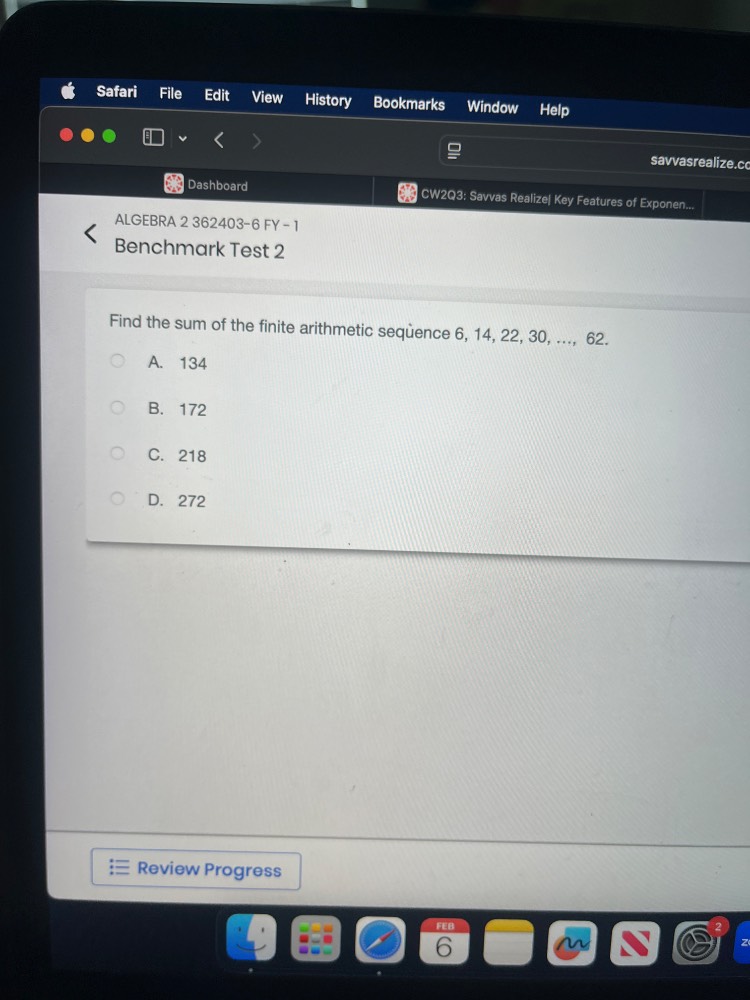
find the sum of the finite arithmetic sequence 6, 14, 22, 30, ..., 62.
a. 134
b. 172
c. 218
d. 272
Step1: Find the common difference \(d\)
The common difference \(d\) in an arithmetic sequence is the difference between consecutive terms. For the sequence \(6, 14, 22, 30, \dots\), we have \(d = 14 - 6 = 8\).
Step2: Find the number of terms \(n\)
The formula for the \(n\)-th term of an arithmetic sequence is \(a_n = a_1 + (n - 1)d\), where \(a_1\) is the first term, \(d\) is the common difference, and \(n\) is the number of terms. We know \(a_1 = 6\), \(d = 8\), and \(a_n = 62\). Substituting these values into the formula:
\[
62 = 6 + (n - 1) \times 8
\]
Subtract 6 from both sides:
\[
56 = (n - 1) \times 8
\]
Divide both sides by 8:
\[
7 = n - 1
\]
Add 1 to both sides:
\[
n = 8
\]
Step3: Find the sum \(S_n\) of the arithmetic sequence
The formula for the sum of the first \(n\) terms of an arithmetic sequence is \(S_n = \frac{n(a_1 + a_n)}{2}\). We know \(n = 8\), \(a_1 = 6\), and \(a_n = 62\). Substituting these values into the formula:
\[
S_8 = \frac{8(6 + 62)}{2}
\]
First, calculate the sum inside the parentheses: \(6 + 62 = 68\). Then:
\[
S_8 = \frac{8 \times 68}{2}
\]
Simplify: \(8 \div 2 = 4\), so \(S_8 = 4 \times 68 = 272\).

Snap & solve any problem in the app
Get step-by-step solutions on Sovi AI
Photo-based solutions with guided steps
Explore more problems and detailed explanations
D. 272