QUESTION IMAGE
Question
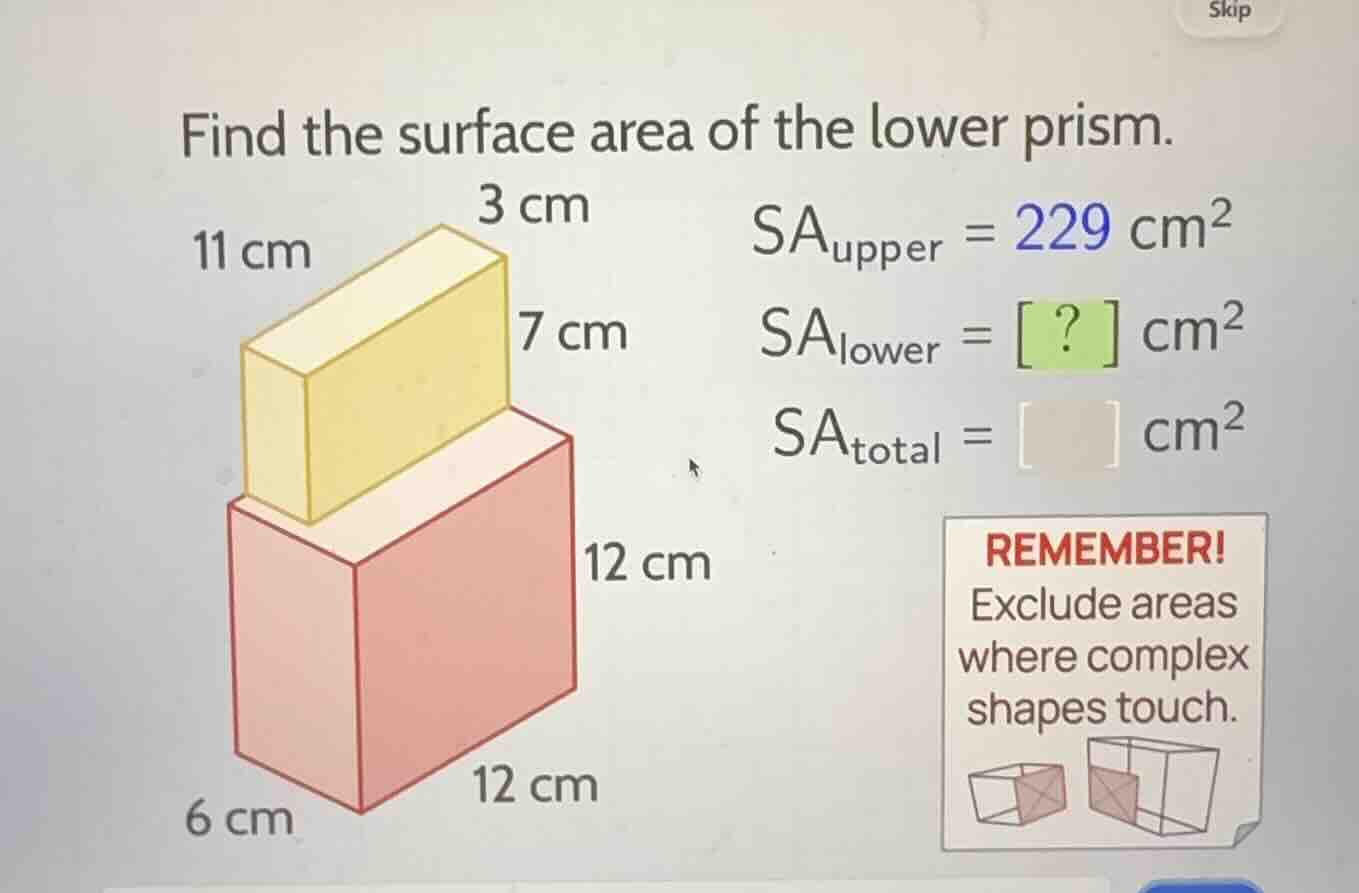
find the surface area of the lower prism.
11 cm 3 cm 7 cm
6 cm 12 cm 12 cm
$\text{sa}_{\text{upper}} = 229\\ \text{cm}^2$
$\text{sa}_{\text{lower}} = ?\\ \text{cm}^2$
$\text{sa}_{\text{total}} = \square\\ \text{cm}^2$
remember!
exclude areas where complex shapes touch.
Step1: Recall surface area formula for rectangular prism
The surface area of a rectangular prism is given by \( SA = 2(lw + lh + wh) \), where \( l \) is length, \( w \) is width, and \( h \) is height. For the lower prism, dimensions are \( l = 12 \, \text{cm} \), \( w = 6 \, \text{cm} \), \( h = 12 \, \text{cm} \). But we need to exclude the area where it touches the upper prism. The area of the touching face is the base area of the upper prism, which is \( 3 \times 11 \) (wait, no, wait: the upper prism has dimensions 11 cm, 3 cm, 7 cm? Wait, no, looking at the diagram: the upper prism's base (the face touching the lower prism) should have dimensions equal to the base of the upper prism. Wait, the upper prism: length 11, width 3, height 7? Wait, no, the lower prism has length 12, width 6, height 12. The upper prism is on top, so the area where they touch is the area of the base of the upper prism. Let's find the base area of the upper prism: from the upper prism's dimensions, the base (the face touching the lower prism) is \( 11 \times 3 \)? Wait, no, maybe I misread. Wait, the upper prism: length 11, width 3, height 7? Wait, the lower prism: length 12, width 6, height 12. So first, calculate the surface area of the lower prism as a standalone rectangular prism, then subtract twice the area of the touching face? Wait, no: when two prisms are joined, the total surface area is the sum of their surface areas minus twice the area of the touching face (because each prism had that face as part of their surface area, but now it's internal). But for the lower prism's surface area (SA_lower), we need to calculate its surface area as a rectangular prism, then subtract the area of the face where it touches the upper prism (because that face is no longer exposed).
First, calculate the surface area of the lower prism as a standalone rectangular prism: \( SA_{\text{lower standalone}} = 2(lw + lh + wh) \), where \( l = 12 \), \( w = 6 \), \( h = 12 \).
So \( lw = 12 \times 6 = 72 \), \( lh = 12 \times 12 = 144 \), \( wh = 6 \times 12 = 72 \). Then \( SA_{\text{lower standalone}} = 2(72 + 144 + 72) = 2(288) = 576 \, \text{cm}^2 \).
Now, the area where the upper prism touches the lower prism is the area of the base of the upper prism. The upper prism's base (the face touching the lower prism) has dimensions: looking at the upper prism's dimensions, the base is \( 11 \times 3 \)? Wait, no, the upper prism: length 11, width 3, height 7? Wait, the upper prism's length is 11, width 3, height 7. So the area of the touching face is \( 11 \times 3 = 33 \, \text{cm}^2 \). So we need to subtract this area from the lower prism's surface area (because that face is no longer exposed). Wait, no: when the upper prism is placed on the lower prism, the lower prism's top face has a portion covered (the area of the upper prism's base), so the exposed area of the lower prism's top face is its original top face area minus the area of the upper prism's base. The original top face area of the lower prism is \( 12 \times 6 = 72 \, \text{cm}^2 \). The area covered by the upper prism is \( 11 \times 3 = 33 \, \text{cm}^2 \). Wait, but that can't be, because 113=33, and 126=72, so 33 is less than 72, so it fits. Wait, maybe I got the dimensions wrong. Wait, the upper prism: length 11, width 3, height 7. The lower prism: length 12, width 6, height 12. So the base of the upper prism (touching the lower prism) is 11 (length) and 3 (width), so area 113=33. Now, the surface area of the lower prism as a standalone is \( 2(126 + 1212 + 612) \). Let's calculate that:…

Snap & solve any problem in the app
Get step-by-step solutions on Sovi AI
Photo-based solutions with guided steps
Explore more problems and detailed explanations
543