QUESTION IMAGE
Question
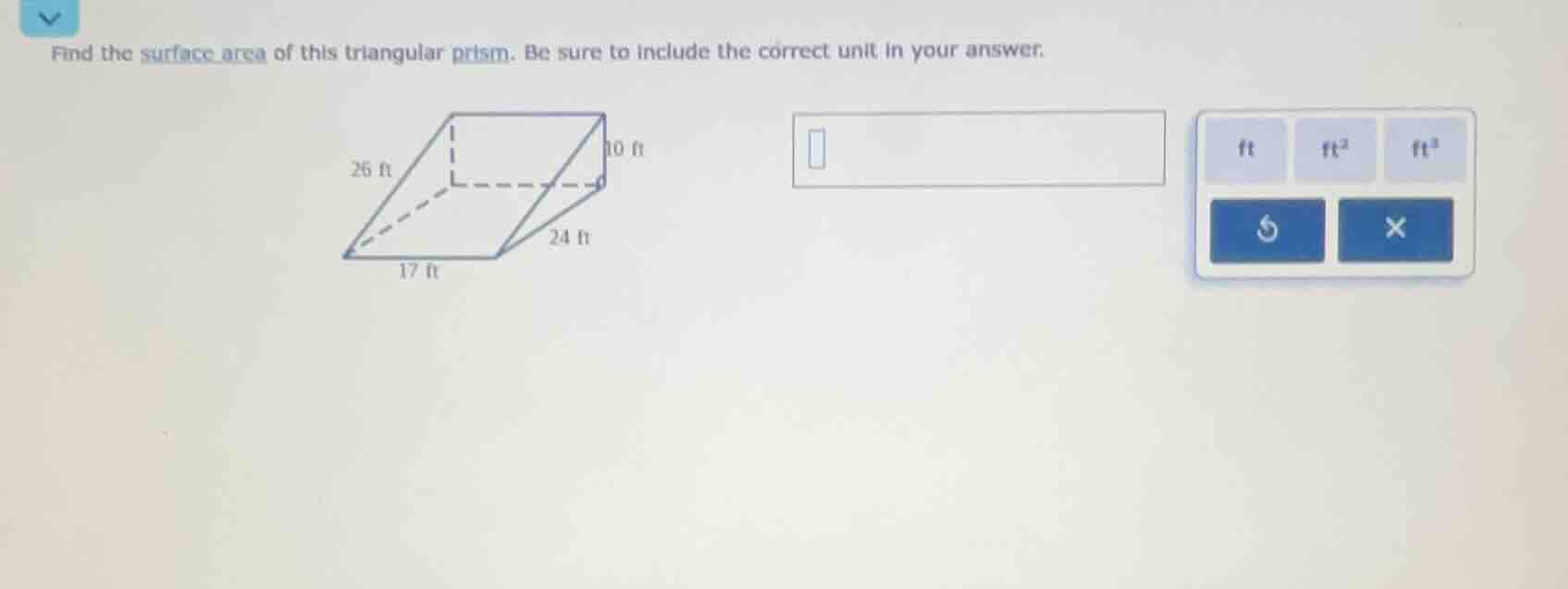
find the surface area of this triangular prism. be sure to include the correct unit in your answer.
Step1: Find area of triangular bases
The triangular base has sides 17 ft, 24 ft, 10 ft? Wait, no, actually, the triangle: let's check the right triangle? Wait, 17, 24, and the height? Wait, no, the triangular prism's bases are triangles. Wait, the sides of the triangle: 17 ft, 24 ft, and the height corresponding to 17 ft? Wait, no, maybe the triangle is a right triangle? Wait, 10, 24, and 26? Wait, 10² +24²=100 +576=676=26². Oh! So the triangular base is a right triangle with legs 10 ft and 24 ft, and hypotenuse 26 ft? Wait, no, the base of the prism (the triangle) has sides 10,24,26? Wait, no, the prism's length is 17 ft? Wait, the diagram: the triangular base has legs 10 ft and 24 ft (since 10²+24²=26², so it's a right triangle), and the length of the prism (the distance between the two triangular bases) is 17 ft.
Area of one triangular base: $\frac{1}{2} \times 10 \times 24 = 120$ square feet. Two bases: $2 \times 120 = 240$ square feet.
Step2: Find area of rectangular faces
The rectangular faces: there are three rectangles. The dimensions are:
- Length 17 ft, width 10 ft: area $17 \times 10 = 170$
- Length 17 ft, width 24 ft: area $17 \times 24 = 408$
- Length 17 ft, width 26 ft: area $17 \times 26 = 442$
Wait, no! Wait, the sides of the triangle are 10,24,26 (the right triangle), and the length of the prism is 17 ft. So the three rectangular faces have dimensions:
- Along the 10 ft side: 17 ft (prism length) and 10 ft: area $17 \times 10$
- Along the 24 ft side: 17 ft and 24 ft: area $17 \times 24$
- Along the 26 ft side: 17 ft and 26 ft: area $17 \times 26$
Wait, but wait, the triangle's sides: the two legs are 10 and 24, hypotenuse 26. So the three rectangles:
First rectangle: 17 (prism length) × 10 (leg)
Second: 17 × 24 (leg)
Third: 17 × 26 (hypotenuse)
Now sum the areas of the rectangles: $17×10 + 17×24 + 17×26$
Factor out 17: $17×(10 + 24 + 26) = 17×60 = 1020$
Step3: Total surface area
Add the area of the two triangular bases and the three rectangular faces: $240 + 1020 = 1260$
Wait, let's check again. Wait, the triangular base: right triangle with legs 10 and 24, so area $\frac{1}{2}×10×24=120$. Two bases: 240.
Rectangular faces: the three rectangles are:
- 17 (length) × 10 (one leg): 170
- 17 × 24 (another leg): 408
- 17 × 26 (hypotenuse): 442
Sum of rectangles: 170 + 408 = 578; 578 + 442 = 1020. Then total surface area: 240 + 1020 = 1260.
Wait, but let's confirm the prism's structure. The triangular base is a right triangle with legs 10 and 24 (since 10-24-26 is a Pythagorean triple), and the length of the prism (the distance between the two triangles) is 17 ft. So the three rectangular faces are attached to each side of the triangle: the two legs (10 and 24) and the hypotenuse (26), each with length 17. So that's correct.
So total surface area: 2(area of triangle) + (perimeter of triangle)length of prism.
Perimeter of triangle: 10 + 24 + 26 = 60. Length of prism: 17. So lateral surface area (area of rectangles) is perimeter × length = 60 × 17 = 1020. Area of two triangles: 2*(0.5×10×24)=240. Total: 1020 + 240 = 1260.
Yes, that's correct.

Snap & solve any problem in the app
Get step-by-step solutions on Sovi AI
Photo-based solutions with guided steps
Explore more problems and detailed explanations
1260 square feet (or 1260 ft²)