QUESTION IMAGE
Question
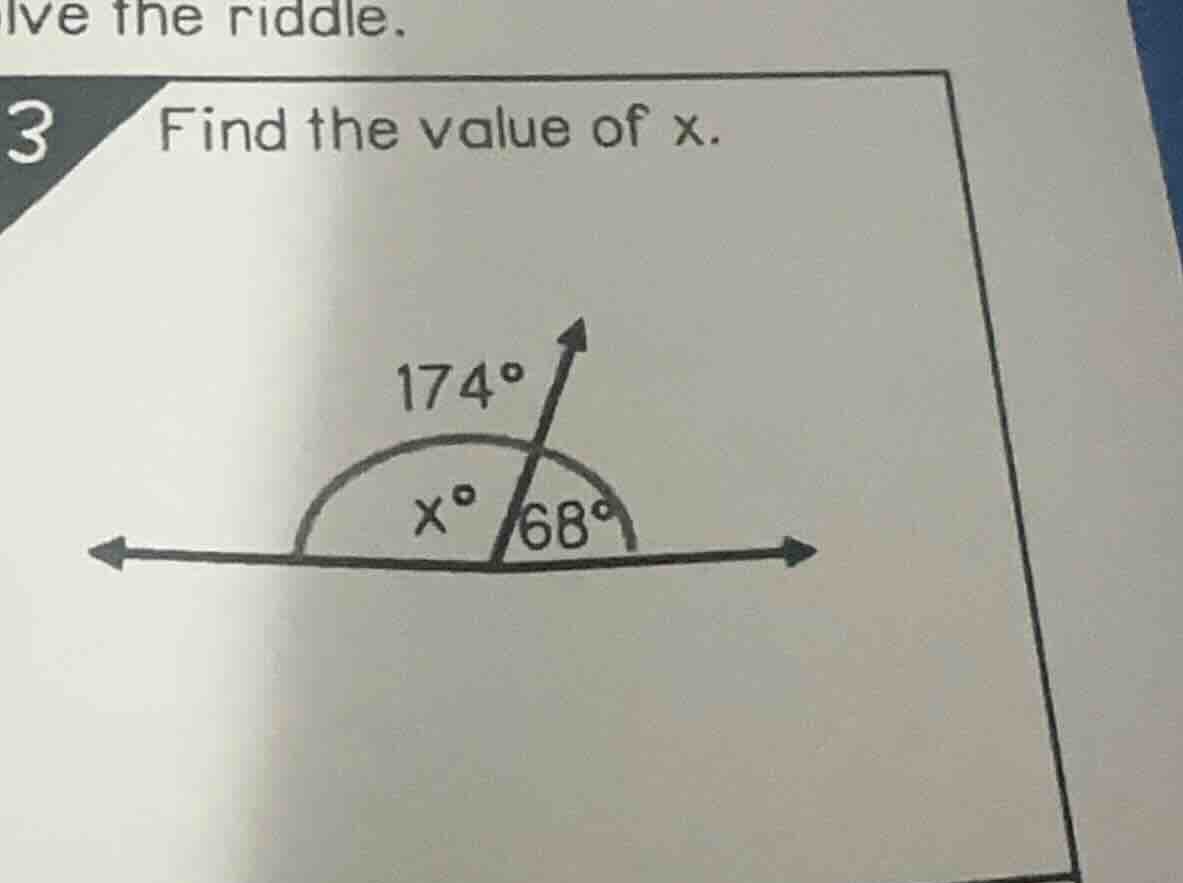
3 find the value of x.
Step1: Recall straight angle sum
A straight angle is \(180^\circ\). The sum of \(x^\circ\), \(68^\circ\), and the angle adjacent to \(174^\circ\) (wait, no—wait, actually, the three angles on a straight line: \(x\), \(68^\circ\), and the angle supplementary to \(174^\circ\)? Wait, no, looking at the diagram: the three angles around the point on the straight line should sum to \(180^\circ\)? Wait, no, maybe I misread. Wait, the diagram has a straight line, and three angles? Wait, no, the \(174^\circ\) is a typo? Wait, no, maybe the diagram is: a straight line, with a ray making \(68^\circ\) with one side, and another angle \(x\), and the third angle? Wait, no, maybe the \(174^\circ\) is incorrect, but actually, the sum of angles on a straight line is \(180^\circ\). Wait, maybe the correct approach is: \(x + 68 + (180 - 174) = 180\)? No, that doesn't make sense. Wait, no, perhaps the diagram is: the straight line, with a ray splitting it into three angles? Wait, no, the original problem: the angles given are \(174^\circ\), \(x^\circ\), and \(68^\circ\), and they are on a straight line, so their sum should be \(180^\circ\)? Wait, that can't be, because \(174 + 68 = 242\), which is more than \(180\). So there must be a mistake in my interpretation. Wait, maybe the \(174^\circ\) is a reflex angle, but no, the diagram is a semicircle (straight line) with a ray. Wait, perhaps the correct diagram is: the straight line, with two angles: \(x\) and \(68^\circ\), and the third angle is \(180 - 174 = 6^\circ\)? No, that's not right. Wait, maybe the problem is that the three angles (x, 68, and the angle opposite to 174) sum to 180? Wait, no, let's re-express.
Wait, the correct formula: the sum of angles on a straight line is \(180^\circ\). So \(x + 68 + (180 - 174) = 180\)? No, that's confusing. Wait, maybe the \(174^\circ\) is a mistake, and it's supposed to be the angle adjacent to \(x\) and \(68^\circ\). Wait, no, let's do it properly. Let's denote the three angles: angle 1: \(x\), angle 2: \(68^\circ\), angle 3: \(180 - 174 = 6^\circ\) (since \(174^\circ\) and angle 3 are supplementary, as they form a straight line). Then, \(x + 68 + 6 = 180\). So \(x + 74 = 180\), so \(x = 180 - 74 = 106\)? Wait, no, that's not right. Wait, no, maybe the \(174^\circ\) is the angle outside, and the correct sum is \(x + 68 + (180 - 174) = 180\). Wait, \(180 - 174 = 6\), so \(x + 68 + 6 = 180\), so \(x = 180 - 74 = 106\). Wait, but let's check: \(106 + 68 + 6 = 180\), which works. Alternatively, maybe the diagram is: the straight line, with angle \(x\), angle \(68^\circ\), and the angle between them is \(180 - 174 = 6^\circ\), so \(x + 68 + 6 = 180\), so \(x = 180 - 74 = 106\). Wait, but maybe the correct approach is: the sum of all angles on a straight line is \(180^\circ\). So \(x + 68 + (180 - 174) = 180\). So \(x + 68 + 6 = 180\), so \(x = 180 - 74 = 106\).
Wait, let's do it again. The straight line has a total of \(180^\circ\). The angles given are \(x\), \(68^\circ\), and the angle that is supplementary to \(174^\circ\) (because \(174^\circ\) and that angle form a straight line, so \(180 - 174 = 6^\circ\)). So adding \(x\), \(68^\circ\), and \(6^\circ\) should equal \(180^\circ\). So:
\(x + 68 + 6 = 180\)
Step2: Solve for x
Simplify the left side: \(x + 74 = 180\)
Subtract 74 from both sides: \(x = 180 - 74 = 106\)
Wait, but let's verify. If \(x = 106\), \(68 + 106 = 174\), which is the angle given. Oh! Wait, that's a better way. The two angles \(x\) and \(68^\circ\) add up to \(174^\circ\)? No, that can't be, because \(106 + 68 = 174\). Ah! So…

Snap & solve any problem in the app
Get step-by-step solutions on Sovi AI
Photo-based solutions with guided steps
Explore more problems and detailed explanations
\(x = 106\)