QUESTION IMAGE
Question
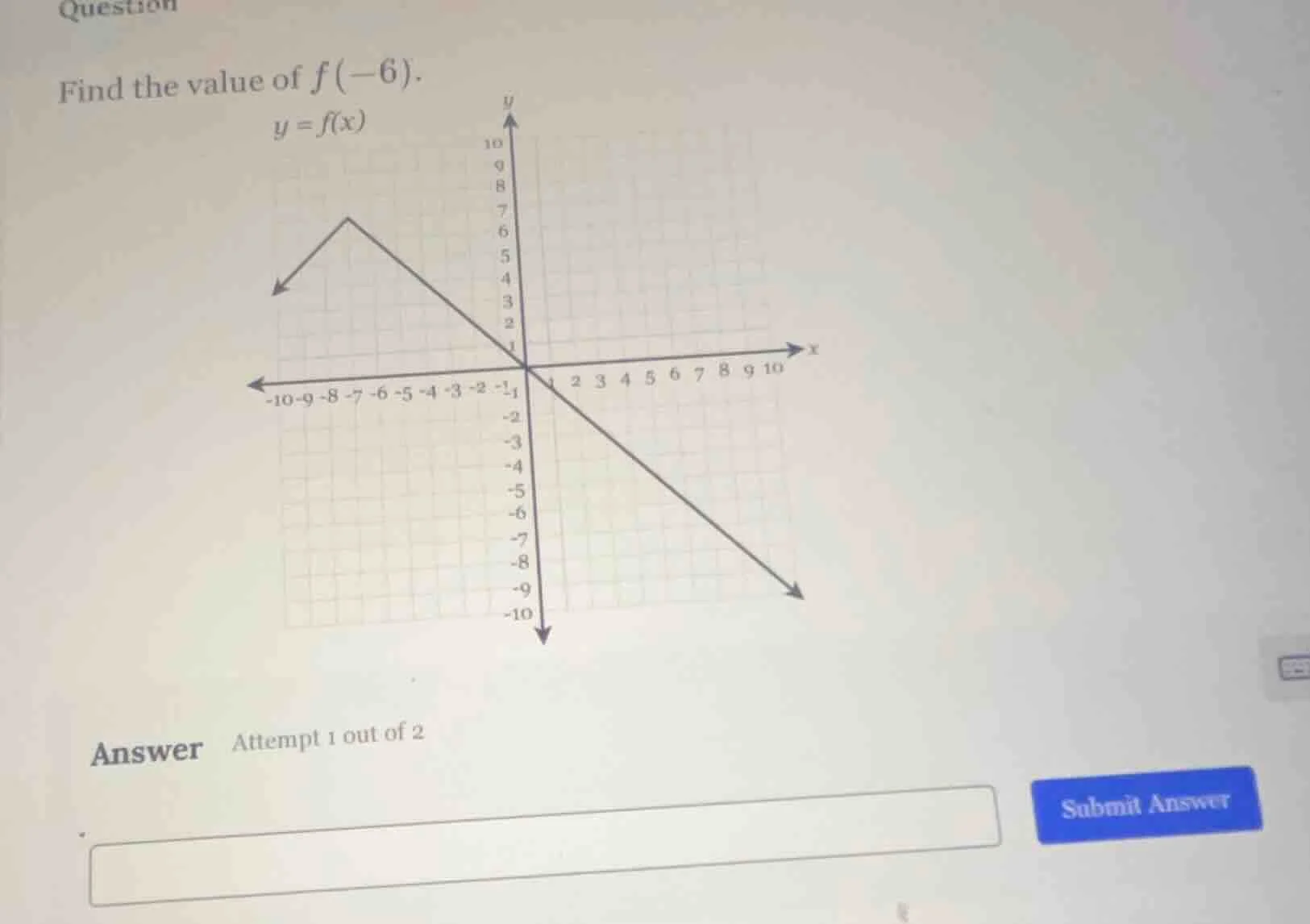
find the value of $f(-6)$.
$y = f(x)$
Step1: Locate x = -6 on the graph
Find the vertical line corresponding to \( x = -6 \) on the x - axis.
Step2: Find the intersection point
Look at the graph of \( y = f(x) \) and find the point where \( x=-6 \). From the graph, we can see that when \( x = - 6 \), the corresponding \( y \) - value (which is \( f(-6) \)) can be determined by looking at the line segment. The line from the peak (let's assume the peak is at \( x=-7 \) with \( y = 7 \)) to the origin has a slope, but more simply, by looking at the grid, when \( x=-6 \), we can see that the y - coordinate is 6? Wait, no, wait. Wait, let's re - examine the graph. Wait, the left - hand part: from the origin (0,0) going left, the line? Wait, no, the graph has a peak, then a line going down to the origin, and then another line going down. Wait, no, looking at the x - axis at \( x=-6 \), we need to find the y - value. Let's count the grid. Each square is 1 unit. At \( x=-6 \), the point on the graph (the left - hand line segment) has a y - coordinate of 6? Wait, no, wait, when \( x = - 6 \), let's see the line. Wait, the peak is at \( x=-7 \), y = 7? Then from \( x=-7 \) (y = 7) to \( x = 0 \) (y = 0), the line. So the equation of that line: the slope \( m=\frac{0 - 7}{0-(-7)}=\frac{-7}{7}=- 1 \). So the equation is \( y-7=-1(x + 7) \), which simplifies to \( y=-x \). Wait, when \( x=-6 \), \( y=-(-6)=6 \)? Wait, but let's check the graph. Wait, the x - axis is from - 10 to 10, y - axis from - 10 to 10. At \( x=-6 \), the point on the left - hand line (the one going from the peak to the origin) should have y - value equal to 6? Wait, no, maybe I made a mistake. Wait, the graph: when x is negative, the left part: let's see, at x=-7, what's y? The peak is at x=-7, y = 7? Then at x=-6, moving 1 unit to the right from x=-7, since the slope is - 1 (because from x=-7,y=7 to x = 0,y=0, the change in y is - 7, change in x is 7, so slope - 1), so when x increases by 1 (from - 7 to - 6), y decreases by 1? Wait, no, slope is \( \frac{\Delta y}{\Delta x}=-1 \), so \( \Delta y=-1\times\Delta x \). If \( \Delta x=(-6)-(-7) = 1 \), then \( \Delta y=-1\times1=-1 \). So y at x=-6 is \( 7-1 = 6 \). So \( f(-6)=6 \)? Wait, but let's check the graph again. Wait, the line from the peak (let's say at x=-7, y = 7) to (0,0): when x=-6, y should be 6. Yes, because the line is y=-x? Wait, when x=-6, y=-(-6)=6. So that's correct.

Snap & solve any problem in the app
Get step-by-step solutions on Sovi AI
Photo-based solutions with guided steps
Explore more problems and detailed explanations
6