QUESTION IMAGE
Question
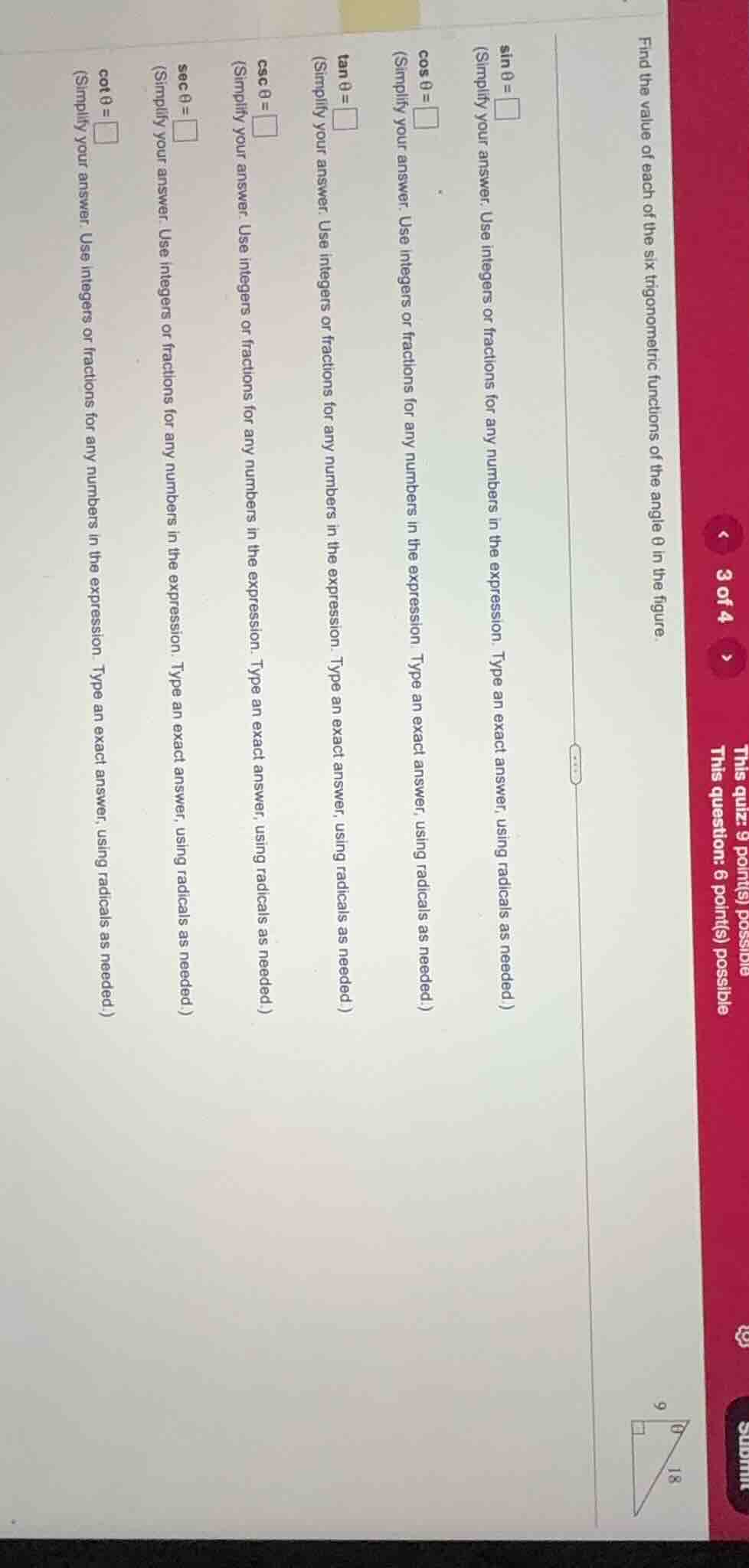
find the value of each of the six trigonometric functions of the angle θ in the figure.
( sin\theta = square )
(simplify your answer. use integers or fractions for any numbers in the expression. type an exact answer, using radicals as needed.)
( cos\theta = square )
(simplify your answer. use integers or fractions for any numbers in the expression. type an exact answer, using radicals as needed.)
( \tan\theta = square )
(simplify your answer. use integers or fractions for any numbers in the expression. type an exact answer, using radicals as needed.)
( csc\theta = square )
(simplify your answer. use integers or fractions for any numbers in the expression. type an exact answer, using radicals as needed.)
( sec\theta = square )
(simplify your answer. use integers or fractions for any numbers in the expression. type an exact answer, using radicals as needed.)
( cot\theta = square )
(simplify your answer. use integers or fractions for any numbers in the expression. type an exact answer, using radicals as needed.)
To solve for the trigonometric functions of \(\theta\) in the right triangle, we first need to identify the sides relative to \(\theta\). Let's assume the triangle has:
- Hypotenuse \(= 18\)
- Opposite side to \(\theta = 9\)
- Adjacent side to \(\theta\): We can find it using the Pythagorean theorem. Let the adjacent side be \(a\). Then \(a=\sqrt{18^{2}-9^{2}}=\sqrt{324 - 81}=\sqrt{243}=9\sqrt{3}\)
1. \(\sin\theta\)
Step 1: Recall the definition of sine
\(\sin\theta=\frac{\text{opposite}}{\text{hypotenuse}}\)
Step 2: Substitute the values
\(\sin\theta=\frac{9}{18}=\frac{1}{2}\)
2. \(\cos\theta\)
Step 1: Recall the definition of cosine
\(\cos\theta=\frac{\text{adjacent}}{\text{hypotenuse}}\)
Step 2: Substitute the values
\(\cos\theta=\frac{9\sqrt{3}}{18}=\frac{\sqrt{3}}{2}\)
3. \(\tan\theta\)
Step 1: Recall the definition of tangent
\(\tan\theta=\frac{\text{opposite}}{\text{adjacent}}\)
Step 2: Substitute the values
\(\tan\theta=\frac{9}{9\sqrt{3}}=\frac{1}{\sqrt{3}}=\frac{\sqrt{3}}{3}\) (rationalizing the denominator)
4. \(\csc\theta\)
Step 1: Recall the definition of cosecant
\(\csc\theta=\frac{1}{\sin\theta}\)
Step 2: Substitute the value of \(\sin\theta\)
\(\csc\theta=\frac{1}{\frac{1}{2}} = 2\)
5. \(\sec\theta\)
Step 1: Recall the definition of secant
\(\sec\theta=\frac{1}{\cos\theta}\)
Step 2: Substitute the value of \(\cos\theta\)
\(\sec\theta=\frac{1}{\frac{\sqrt{3}}{2}}=\frac{2}{\sqrt{3}}=\frac{2\sqrt{3}}{3}\) (rationalizing the denominator)
6. \(\cot\theta\)
Step 1: Recall the definition of cotangent
\(\cot\theta=\frac{1}{\tan\theta}\)
Step 2: Substitute the value of \(\tan\theta\)
\(\cot\theta=\frac{1}{\frac{\sqrt{3}}{3}}=\sqrt{3}\)

Snap & solve any problem in the app
Get step-by-step solutions on Sovi AI
Photo-based solutions with guided steps
Explore more problems and detailed explanations
s:
\(\sin\theta=\boldsymbol{\frac{1}{2}}\)
\(\cos\theta=\boldsymbol{\frac{\sqrt{3}}{2}}\)
\(\tan\theta=\boldsymbol{\frac{\sqrt{3}}{3}}\)
\(\csc\theta=\boldsymbol{2}\)
\(\sec\theta=\boldsymbol{\frac{2\sqrt{3}}{3}}\)
\(\cot\theta=\boldsymbol{\sqrt{3}}\)