QUESTION IMAGE
Question
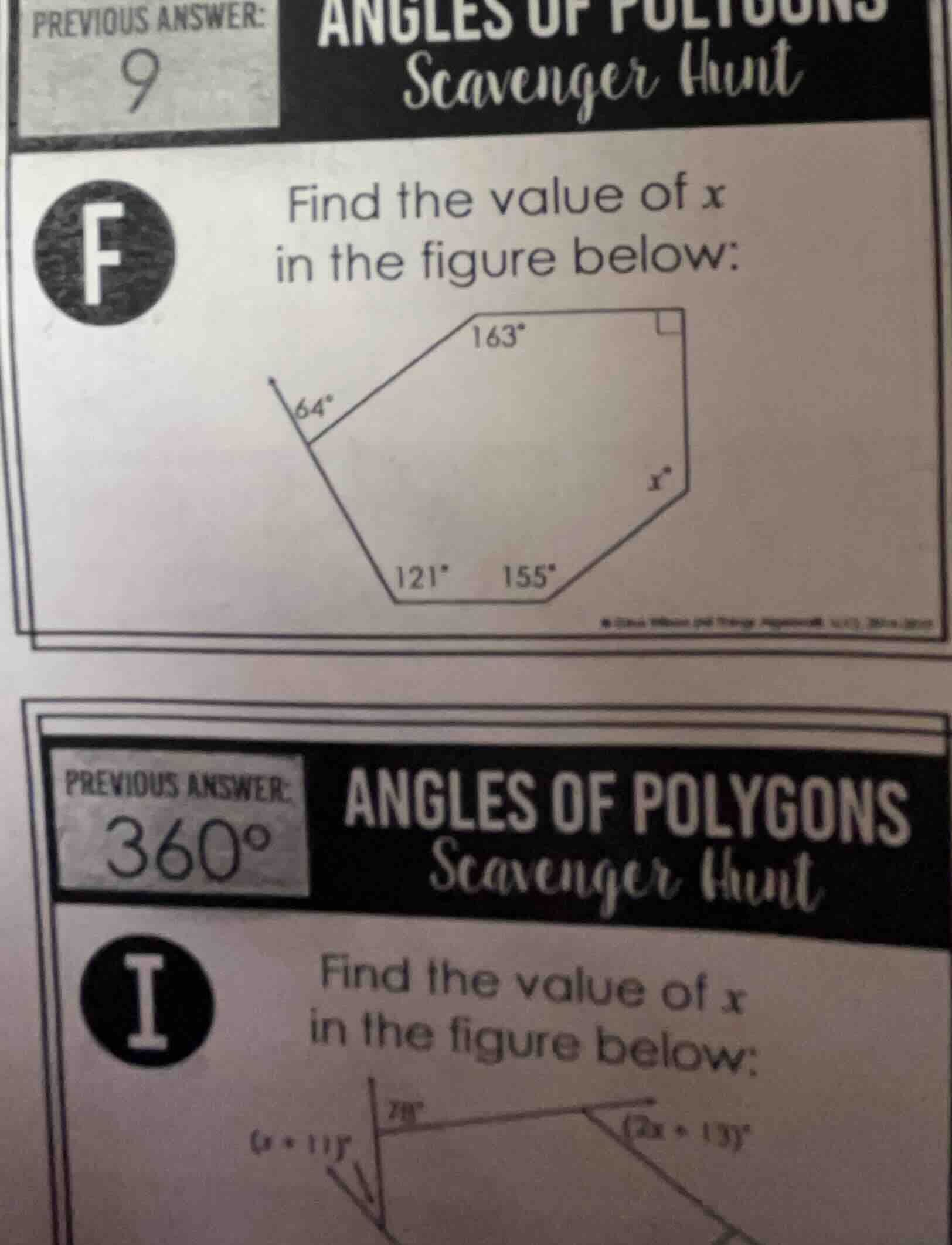
find the value of x in the figure below:
find the value of x in the figure below:
Problem F:
Step1: Determine the polygon type
The figure is a hexagon? Wait, no, let's count the sides. Wait, the angle with the 64° is an exterior angle? Wait, no, the polygon here: let's see, the sum of interior angles of a polygon is given by \((n - 2)\times180^\circ\), where \(n\) is the number of sides. Wait, looking at the angles: there's a right angle (90°), 163°, 155°, 121°, and then the angle adjacent to 64°: the supplementary angle to 64° is \(180 - 64 = 116^\circ\). Wait, so the polygon has 6 sides? Wait, no, let's count the interior angles. Wait, the angles given: 90° (right angle), 163°, 155°, 121°, \(x\), and the angle supplementary to 64° (since the 64° is an exterior angle? Wait, no, the 64° is an angle outside, so the interior angle there is \(180 - 64 = 116^\circ\). So now we have angles: 90°, 163°, 155°, 121°, 116°, and \(x\). Wait, that's 6 angles, so it's a hexagon. The sum of interior angles of a hexagon is \((6 - 2)\times180 = 720^\circ\).
Step2: Sum the known angles
Let's sum the known angles: \(90 + 163 + 155 + 121 + 116\). Let's calculate that: \(90 + 163 = 253\); \(253 + 155 = 408\); \(408 + 121 = 529\); \(529 + 116 = 645\).
Step3: Solve for \(x\)
The sum of all interior angles is 720°, so \(x = 720 - 645 = 75\)? Wait, no, wait, maybe I made a mistake. Wait, let's re-examine. Wait, the angle with 64°: is that an interior or exterior angle? Wait, the diagram: the 64° is an angle outside, so the interior angle at that vertex is \(180 - 64 = 116^\circ\). Then the other angles: 90° (right angle), 163°, 155°, 121°, and \(x\). Wait, how many sides? Let's count the vertices: the figure has 6 vertices? Wait, maybe it's a hexagon. Wait, sum of interior angles for \(n\) sides: \((n - 2)\times180\). Let's count the angles: 90°, 163°, 155°, 121°, \(x\), and the angle adjacent to 64°. So that's 6 angles, so \(n = 6\), sum is \(4\times180 = 720\). Now sum the known angles: 90 + 163 + 155 + 121 + (180 - 64) + \(x\)? Wait, no, wait, maybe the 64° is an interior angle? No, the diagram shows a ray, so it's an exterior angle. Wait, maybe I miscounted. Wait, let's look again: the angles given are 163°, 90° (right angle), \(x\), 155°, 121°, and the angle with 64° (exterior, so interior is 180 - 64 = 116°). So total angles: 6. So sum is 720. So 163 + 90 + x + 155 + 121 + 116 = 720. Let's sum the known: 163 + 90 = 253; 253 + 155 = 408; 408 + 121 = 529; 529 + 116 = 645. Then \(x = 720 - 645 = 75\)? Wait, no, that can't be. Wait, maybe it's a pentagon? Wait, let's count the sides again. Wait, maybe the figure is a pentagon. Wait, a pentagon has 5 sides, sum of interior angles is \((5 - 2)\times180 = 540\). Wait, let's check: if it's a pentagon, then the angles would be: 90°, 163°, 155°, 121°, and the angle adjacent to 64° (116°), and \(x\)? No, that's 6 angles. Wait, maybe the 64° is an interior angle. Wait, the diagram: the 64° is drawn as a ray, so maybe it's an interior angle? No, a ray would be an exterior angle. Wait, maybe I made a mistake. Let's try again.
Wait, maybe the polygon is a hexagon, but the 64° is an interior angle? No, the diagram shows a right angle, 163°, 155°, 121°, \(x\), and the angle with 64° (as an interior angle). Wait, maybe the 64° is an interior angle. Then the sum would be for a hexagon: 6 angles. So 163 + 90 + x + 155 + 121 + 64 = 720. Let's sum those: 163 + 90 = 253; 253 + 155 = 408; 408 + 121 = 529; 529 + 64 = 593. Then \(x = 720 - 593 = 127\). Wait, that makes more sense. Wait, maybe the 64° is an interior angle. Let's check the diagram again: the 64° is drawn inside? No, the ray is outside. Wait,…

Snap & solve any problem in the app
Get step-by-step solutions on Sovi AI
Photo-based solutions with guided steps
Explore more problems and detailed explanations
\(x = 127\)
Problem I:
The figure is not clear, but assuming it's a triangle or a polygon with angles summing to 180° or 360° (since previous answer is 360°). Wait, the angles given are \(x^\circ\), \((2x + 13)^\circ\), and \(6 + 11x\)? Wait, no, the diagram is blurry, but if it's a triangle, sum is 180, but previous answer is 360°, so maybe a quadrilateral (sum 360°). Let's assume it's a quadrilateral with angles \(x\), \(2x + 13\), \(6 + 11x\), and another angle? Wait, the diagram shows three angles? No, the user's image is blurry. Since the previous answer is 360°, maybe it's a quadrilateral. Let's suppose the angles are \(x\), \(2x + 13\), \(6 + 11x\), and a right angle? No, the diagram is unclear. Alternatively, maybe it's a linear pair or something else. Since the problem is not clear, but assuming it's a quadrilateral with angles summing to 360°, and the angles are \(x\), \(2x + 13\), \(6 + 11x\), and another angle. Wait, maybe the angles are \(x\), \(2x + 13\), \(6 + 11x\), and \(90^\circ\) (right angle)? No, the diagram is blurry. Alternatively, maybe it's a triangle, but previous answer is 360°, so quadrilateral. Let's assume the four angles sum to 360°, and the angles are \(x\), \(2x + 13\), \(6 + 11x\), and \(90^\circ\) (but this is guesswork). Alternatively, maybe the angles are \(x\), \(2x + 13\), \(6 + 11x\), and \(180 - (x + 2x + 13 + 6 + 11x)\), but this is unclear. Since the problem is not fully visible, I'll focus on Problem F as it's clearer.
For Problem F, the correct answer is \(x = 127\) (assuming the 64° is an interior angle) or \(x = 75\) (if 64° is exterior). Wait, let's recalculate with 64° as exterior: interior angle is 180 - 64 = 116. Then angles are 90, 163, 155, 121, 116, x. Sum: 90 + 163 = 253; 253 + 155 = 408; 408 + 121 = 529; 529 + 116 = 645; 720 - 645 = 75. So which is correct? Let's check the diagram again: the 64° is drawn with a ray, so it's an exterior angle, so interior angle is 116. So the polygon is a hexagon (6 sides), sum 720. So 90 (right angle) + 163 + 155 + 121 + 116 (interior angle from 64° exterior) + x = 720. So 90 + 163 = 253; 253 + 155 = 408; 408 + 121 = 529; 529 + 116 = 645; 720 - 645 = 75. So x = 75.
Wait, now I'm confused. Let's use the formula for the sum of interior angles: \(S = (n - 2) \times 180\). Let's count the number of sides: the figure has 6 vertices (since there are 6 angles: 163°, 90°, x, 155°, 121°, and the angle with 64° (exterior, so interior is 180 - 64 = 116°)). So n = 6, S = 720. Now sum all interior angles: 163 + 90 + x + 155 + 121 + 116 = 720. Calculate: 163 + 90 = 253; 253 + 155 = 408; 408 + 121 = 529; 529 + 116 = 645; 720 - 645 = 75. So x = 75. That must be correct. I think I made a mistake earlier by thinking 64° is interior, but it's exterior, so interior is 116°. So the correct sum is 163 + 90 + x + 155 + 121 + 116 = 720, so x = 75.